
- Podcasts
 Podcasts
 - Videos
 Videos
 - Policy Issues
 Policy Issues
 - About
 About
About


Introduction
More than 60% of school district referendums on the April ballot passed, despite prior public opinion polling indicating voters cared more about property taxes than funding public schools.
In March, a Marquette Law School Poll found that 58% of respondents were more concerned about property taxes, while 41% were more concerned about K-12 public school funding. In that same poll, however, 48% said they would vote for a referendum to increase taxes for schools in their community.
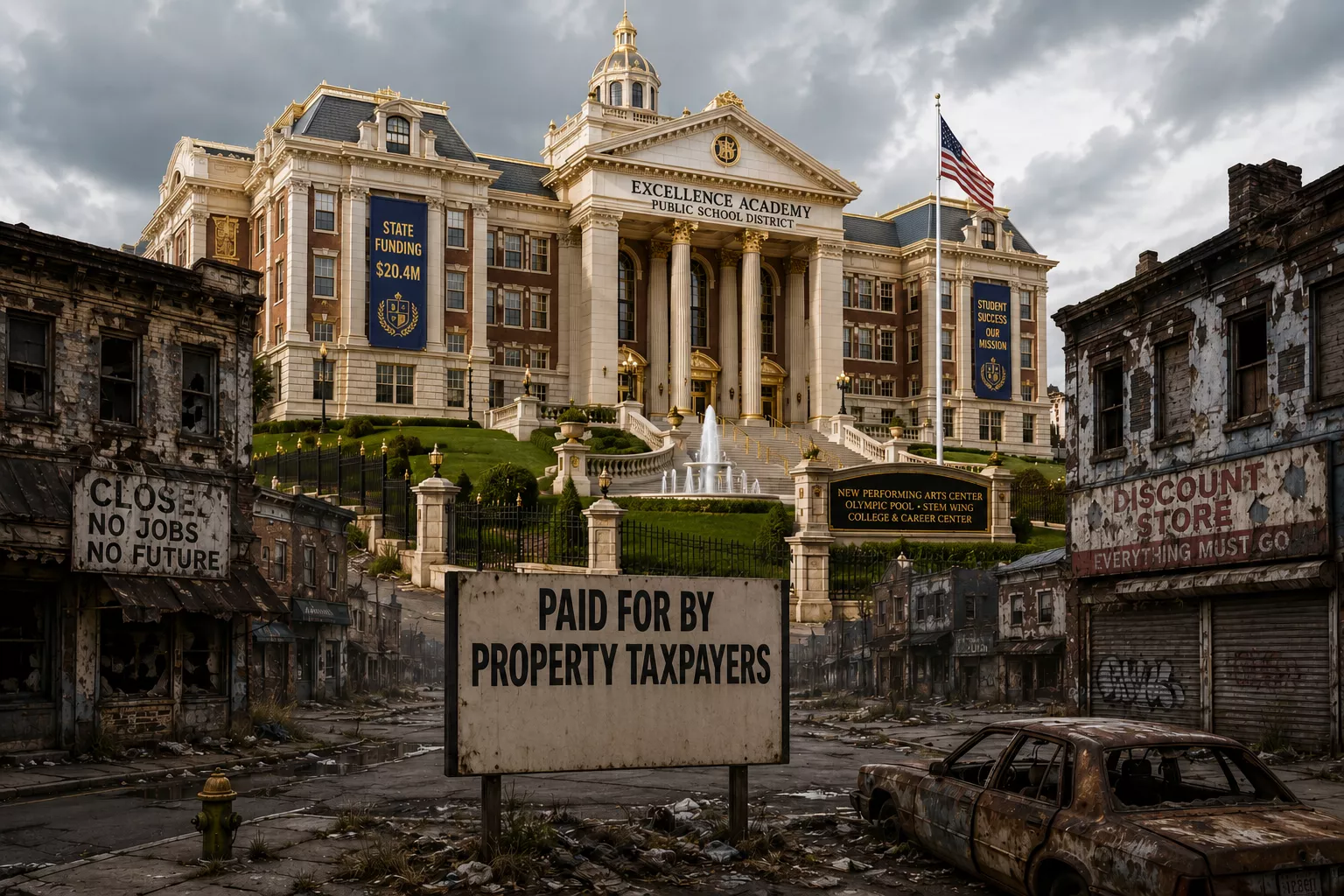
While Wisconsinites are already struggling with inflation and higher costs of living, more than $1 billion in new school district taxes appeared on Wisconsin’s ballot this April. Of the 75 referendums proposed, 43 passed, resulting in an increase of more than $500 million in property taxes throughout the state.
The debate around the funding and management of Wisconsin schools has existed since the inception of the state, but recent controversies––including lawsuits over school funding, repeated referendum requests, and school closures following failed referendums––have pushed the issue back into the spotlight. As districts continue asking taxpayers for more money despite declining enrollment and student outcomes, questions about accountability, efficiency, and competition within the public school system are becoming harder to ignore.
The Spring Referendum Cycle
Civic Media reported that many of the referendums were decided by a strikingly small number of votes. In some districts the margins were razor thin. Butternut School District referendum passed on just one vote, after previously failing to pass a referendum twice.
In the aftermath of the April election, many districts whose referendums failed are looking to try again on the November ballot or hoping that lawmakers give them more funding in the next state budget.
School Districts seem to have a better shot of a successful referendum the second time around. Wisconsin Public Radio reported that of the 20 districts that went to referendum this April after their referendums previously failed, 16 passed.
At the same time, those districts whose referendums failed, like Fond du Lac, are cutting staff and programs or closing down schools to tighten their budget.
The Hustisford School District is considering shutting down completely.
The cycle has become increasingly common in Wisconsin: districts seek more funding through referendums, voters reject the request, districts warn of cuts or closures, and then many districts return to the ballot months later.
School Funding and the Lawsuit Against the Legislature
Wisconsin law limits how much revenue school districts can collect each year in order to protect taxpayers. However, districts can place referendums on the ballot asking taxpayers in their district to approve property tax increases to further fund the schools. Many of these districts are hopeful that state funding will come along to bail them out.
In an attempt to force lawmakers to pay the schools more, the liberal legal organization Law Forward is currently suing Wisconsin's Joint Finance Committee, whose job it is to appropriate the state budget. Among other claims, the lawsuit argues that the Wisconsin Constitution “guarantees every child an equal opportunity for a sound basic education”.
In his three-part investigation of the claims of this lawsuit, MacIver Policy Analyst Michael Lucas spells out the framers of the Wisconsin Constitution’s original intent for school district funding and how Law Forward gets it wrong.
As Lucas explains in his analysis, Wisconsin law does not stipulate that the state government is responsible for fully funding the current K-12 education system nor does it guarantee a “sound basic education”. Rather, he argues, the framers of Wisconsin’s Constitution intended for local communities to raise a minimum contribution to the support of their common schools, and allowed them to raise more than this minimum if the state’s aid was insufficient. Importantly, no minimum funding contribution was placed on the state.
The debate reflects the broader disagreement over the role of state government in education and whether school districts themselves should bear greater responsibility for raising revenue and budgeting responsibly.
The 400-Year Veto Debate
This November, Wisconsin voters will be asked about the governor’s partial veto power, including the 400-year “Frankenstein veto” Governor Evers used to increase school district revenue for centuries into the future.
A Marquette Law School Poll asked voters whether governors should keep the ability to use partial vetoes:
“Wisconsin governors have long had the power to cast a partial veto of budget legislation. This allows them to strike out individual words or sentences, in some cases significantly changing the effect of the legislation. Do you think this is an appropriate power for governors to have, or does it give too much power to governors to change the intent of the legislature?”
Sixty-one percent said it gives governors too much power, while 39% said the partial veto is appropriate. However, when asked specifically about Evers’ use of this “partial veto” to increase spending limits for school districts for 400 years, 48% said it was necessary to fund public schools while 52% were concerned with tax increases.
Though Evers frequently argues that public schools need more funding, earlier this year he vetoed the Federal Education Tax-Credit––a credit that wouldn’t have reduced Wisconsin’s revenue by even one dollar, while increasing funding for public and private education.
This measure would have provided up to a $1,700 federal tax credit for donations to Wisconsin-based scholarship granting organizations (SGOs). These organizations could then have provided families with financial assistance for tutoring, special needs care, private school tuition, or even public school field trips.
In his veto letter, Evers wrote that it would drain resources away from public schools (presumably indirectly because, again, the state budget that funds the Department of Instruction would have lost $0).
This is indicative of deeper issues with public school funding. When people discuss “supporting public schools”, often there is no mention of the performance of the schools, either of their effectiveness in educating children or their ability to manage a budget.
The Milwaukee Example
Wisconsin student’s performance on national standardized exams such as the NAEP has steadily worsened. The problem is especially severe in Milwaukee Public Schools (MPS). According to recent testing data, only 9% of fourth graders tested in Milwaukee were proficient or better at reading and 15% showed basic achievement. A whopping 73% of students scored below basic proficiency. In most professions, persistent failure brings consequences. In public schools, however, there isn’t accountability for an elementary school whose children don’t read at grade level or for high schools that fail to teach their students algebra before they leave for college.
Financial accountability is also required. The Milwaukee Public Schools district consistently fails audits. In 2024, the district failed to submit required financial reports until months after their deadline, resulting in the Wisconsin Department of Public Instruction withholding funding. The crisis ultimately led to the superintendent’s resignation and further damaged public trust in the district. Brenda Cassellius, MPS’s new superintendent, seems to be trying to clean up the district’s finances through cuts and reforms. This accountability is a step in the right direction, though it remains to be seen how much impact it will have.
The public schools aren’t the only ones to blame for declining student performance. Children from unstable home environments face lower academic achievement and greater barriers to success in school. A child’s family life––including whether they have stable, active, and involved parents––plays a huge role in their academic success. Broken homes are not a problem that can be solved by draining taxpayers’ wallets.
What is in control of the state is the ability to allocate funds and to legislate and regulate state education. When the state protects the institution of public schools at the expense of public schools’ key mission––educating children––something has gone wrong.
Many Wisconsin districts are now facing declining enrollment alongside financial strain. Milwaukee Public Schools has considered closing as many as 25 buildings because of underutilization. Public schools aren’t nimble and don’t respond well to supply and demand. Maintaining underused facilities requires millions in funding that could otherwise go toward instruction, tutoring, or other services for students to improve learning.
Keeping schools open simply to preserve institutions regardless of enrollment or performance prevents resources from being allocated more effectively. Schools should be evaluated on whether they teach effectively and foster student achievement.
How to Fact Check Your Own School District
One of the biggest problems in education policy is that many taxpayers simply don’t know how their local district operates financially.
Parents and community members should understand:
Fortunately, much of this information is publicly available. In 2024, MacIver’s Senior Fellow William Osmulski wrote an article with resources on how to investigate your own school district. Here is an expanded list of resources to do just that:
Wisconsin School District Referendum Report
This database tracks school district referendums across the state, including whether they passed or failed and how much money districts requested.
Wisconsin DPI Administrative Salary Report
This report shows public school administrator positions and salaries throughout Wisconsin.
Wisconsin DPI Teacher Salary Report
This database provides public teacher salary information by district.
Wisconsin DPI All Staff Report
This database compares staffing levels and positions across districts.
Wisconsin DPI School and District Report Cards
This portal includes academic performance data, graduation rates, and other measures of school effectiveness.
This report allows taxpayers to see how much revenue districts receive and how much is spent per student.
Potential Solutions
Allow School Consolidation and Closure
School districts are rarely held accountable for poor performance, budgeting failures, or long-term enrollment decline. Allowing districts to consolidate schools or close underutilized buildings more easily could reduce waste and redirect resources toward actual educational improvement. Trade-offs exist and money spent maintaining mostly empty buildings is money that cannot be spent on teachers, tutoring, curriculum, or student services.
Expand School Choice and Universal Vouchers
Education funding should follow the student rather than automatically flow to institutions regardless of performance. Under a universal voucher system, families could choose the educational environment that best fits their child whether that be public, charter, private, religious, or homeschooling. It would increase competition and incentivize schools to improve performance and responsiveness to families.
Increase Transparency and Financial Accountability
School districts should provide clearer financial reporting so taxpayers can better understand how their money is being spent. Districts that want additional taxpayer funding should also demonstrate how they used past funding increases to measurably improve learning.
Encourage Innovative Use of School Buildings
Unused classroom space could be rented or shared with charter schools, private schools, micro schools, or other community educational organizations. Rather than leaving underused facilities partially empty, districts could use those buildings more efficiently, generate revenue, and expand educational options for families.
Conclusion
Wisconsin’s education debate shouldn't simply revolve around whether taxpayers should pay more money. It must also involve questions of school accountability, financial transparency, and educational outcomes. It is important that the public is informed about their community’s school districts, so they can fact check the narrative and know whether their district can justifiably ask them to pay more in taxes.
Public schools exist to educate children, not merely to preserve institutions indefinitely. If Wisconsin wants stronger schools, the conversation must move beyond funding alone and refocus on whether the system is fulfilling its purpose.

Interested in the content of this Article?
Reach out to the MacIver Institute to aquire more information


