
- Podcasts
 Podcasts
 - Videos
 Videos
 - Policy Issues
 Policy Issues
 - About
 About
About


Introduction & Review
In Part I of this series from last week, I introduced several claims made by the Law Forward Plaintiffs in their attempt to have the state's School Funding Mechanism reviewed and ruled unconstitutional.
I presented 4 "findings" in that article, and went into detail on two (here & here).
First, Finding #1 showed that the state Constitution––in Art. X, Sec. 2, Sub. 1 & 2––demonstrates a ranked preference scale with respect to school funding. Specifically, Sub. 1 states that the School Fund will be used exclusively for "the support and maintenance of common schools, in each school district..." while Sub. 2 states that "The residue shall be appropriated to the support and maintenance of academies and normal schools..."
I show from the record of the Journal that the supporters and drafters of the Education Article intended for common schools to receive funding first, and that if any funds should remain after they had been sufficiently provided for, those funds shall be used for the support of academies and normal schools.
Second, Finding #4 shows that the Plaintiffs' claim of dereliction of duty on the grounds that the state does not account for a significant share of total school funding is mistaken. The Plaintiffs state that the founders "intended" for the state's contribution to be the "primary" source of school funding, accounting for "up to two-thirds" of a school's revenue. But both the Constitution (in Art. X, Sec. 4) and the Chairman of the Education Committee, Mr. Experience Estabrook, make clear that the requirement of a minimum contribution is placed on the schools, not the state:
"Each town and city shall be required to raise by tax, annually, for the support of common schools therein, a sum not less than one-half the amount received by such town or city respectively for school purposes from the income of the school fund."
That finding demonstrates that the bulk of a school's revenue coming from the state's School Fund is only incidental to the fact that a school is raising its constitutionally required minimum contribution. It also highlights the Committee's intent to force residents to contribute directly to their common schools, and explicitly allows for schools to raise more than their legal minimum.
This article will address one of the two remaining findings reported in Part I, namely, Finding #2. Finding #3 will be addressed in a follow-up article.
Focus of this Study
This article will address Finding #2. Finding #3 will be addressed in a follow-up report, but it is stated in brief below.
In short, Finding #2 shows what the Framers meant by "common schools", "academies", "normal schools", "sound", and "residue." By understanding these terms the way the Framers did, we can correctly interpret Art. X, Sec. 2, Sub. 1 & 2, as well as Sec. 4 and Sec. 5 of the Constitution.
Finding #3 shows that the Framers placed no obligation on the state to fund schools at all. It also addresses the Plaintiffs' assertion that the children of this state have a "right" to an education. "Rights" are much misunderstood, and the language used by the Framers to assert this alleged right is misunderstood as well. It in no way suggests the kind of right the Plaintiffs suggest.
Findings in Detail
The meanings of most of these terms has thankfully been preserved due to their having fallen out of use. Their definitions are easily searchable online, but for thoroughness sake, I provide their definitions by citing contemporaneous dictionaries from the 19th century.
In brief, the meanings of these terms are as follows:
The first thing of note here is a matter of logic:
Since the Constitution names academies, common schools, and normal schools, the naming of each separates them from the others. In other words, these terms are mutually exclusive. By the very fact that these are named individually, the Framers are saying that academies are not common schools or normal schools, common schools are not academies or normal schools, and normal schools are not academies or common schools. Each is sui generis.
Furthermore, the terms 'academies' and 'normal schools' are used in their general senses. They refer to both kinds of academies and normal schools––namely, public and private. Crucially, this means that public academies and public normal schools are excluded from the category of common schools. If the Framers understood these to be common schools, Sub. 2 would have qualified that funds shall be given to private academies and normal schools. The absence of that qualification means that the state is permitted to give money to these kinds of private schools, hence why the state, today, does and is authorized to give money to private (even sectarian) secondary schools. And for that matter, while academies tended to be private, public academies did exist at the time and had for more than a hundred years in the U.S., especially New England where most of the Founders were from (Journal, "List of Members" p.18-19).
Second, both the original draft of the Education Article and the Journal of the Constitutional Convention indicate that 'common schools' were simply the public (government) version of the more general 'primary schools'.
Below is a comparison of the original and final drafts of the Education Article with respect to school funding...
The change in Sub. 1st from "primary schools" to "common schools" is most revealing.
In the original draft we see that 'primary' is struck and replaced by 'common'. Here we can clearly see the difference between primary schools in general and public primary schools specifically. The Framers had originally proposed to fund primary schools in general, but chose instead to reserve funding for public primary schools. Consequently, the use of this term actually indicates that the state is prohibited from giving money from the School Fund to private primary schools. While there is no record in the Journal as to why this change was made, the Framers likely wanted all students to have a primary education that was commonly shared. Such a desire was intended, therefore, to discourage the well-to-do from sending their kids to private primary schools, so that they would learn alongside students from the class of common people, and receive an education on a common footing.
As for the discussions recorded in the Journal, many of the most important quotations on this matter have already been cited in Part I, but I will recount the most relevant interaction below...
In opposition to a proposed amendment by Mr. McClellan, Education Chairman Mr. Estabrook said: "As a sufficient provision was made for the support of common schools in the first place..."
Mr. King, in agreement with Estabrook, then said that he "hoped to see the time when the fund would be sufficiently large to afford free instruction in all the institutions of the state, from the primary schools to the universities."
Mr. Rountree, in agreement with both King and Estabrook, said that "It was necessary to make ample provision for the support of common schools in the first place..." (Journal, p.333-34).
What this interaction demonstrates is that the supporters of 'Sub. 1st' were comfortable referring to common schools as primary schools. The supporters switch from common to primary and back without objection from the Convention. Estabrook and Rountree in this context called them common schools, but King, in particular, reveals through his comment that common schools were understood to be primary schools––only of the public variety. This exchange is that much more important because it likely happens after the amendment to substitute "common" for "primary" (Journal, p.328: Mr. Martin's amendment to Sec. 3 of the original draft is likely when this substitution occurred). So it becomes less likely, then, that King misspoke or misunderstood the section since he was not corrected for his use of the term 'primary', and since he was a supporter and advocate for the section.
But beyond the debates––rather than relying on context and "likelihood"––we can consult the contemporaneous dictionaries and encyclopedias of the time to show, explicitly, how common schools were understood.
The first image below compares three editions of Webster's Dictionary (1828, 1841, & 1848). The second image compares two encyclopedias from the 19th century (1858 & 1897) where "common schools" first appear as entries.
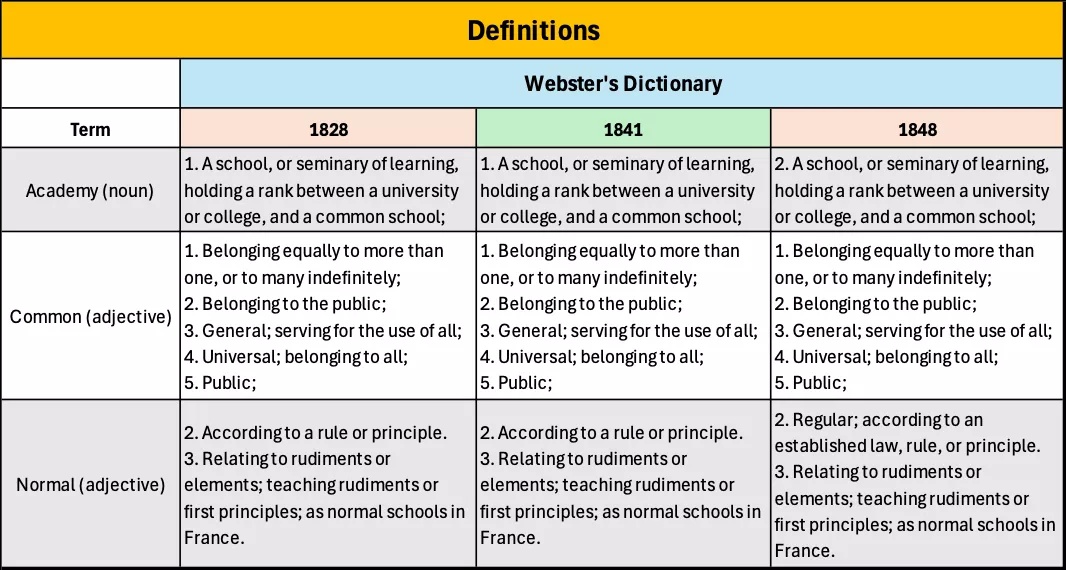 Webster's was most the most popular American English dictionary at the time. The Superintendent even reported in the 1859 "Laws of the State of Wisconsin Relating to Common Schools" that the Legislature required the Superintendent to purchase copies of Webster's Unabridged Dictionary of the English Language for needy school districts (click image for link to source).
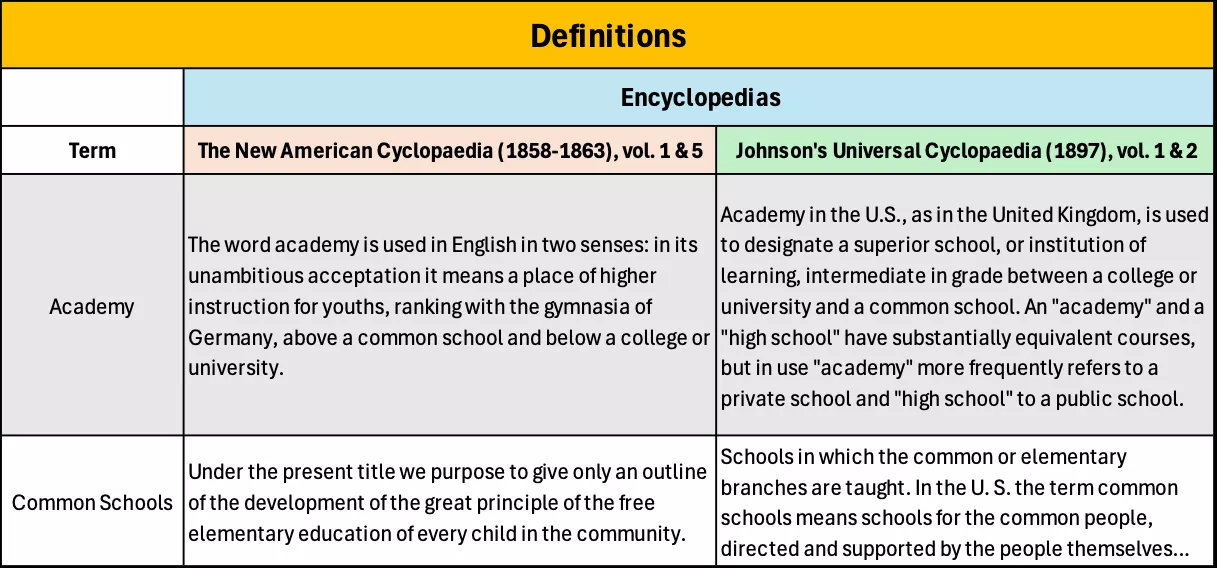
These entries demonstrate that an 'academy' is the general term used for a secondary school. They were "between" common schools and colleges. Later, after the national movement to establish high schools, 'academy' tended to refer only to private secondary schools, but was used for both. In contrast, today, 'academy' tends to be used mostly in reference to public classical schools, but private ones may use this term as well. This is mainly an attempt to capture the original meaning of the term associated with Plato's Academy.
As for 'common', these entries make two things clear:
First, that common schools are like a commons (noun) in that they are open to the use of all children. They are also 'common' in that they are supported financially by all in the community, like 'communes' and 'communal' property are. Second, that common schools are institutions of "free elementary education" which teach the "common or elementary branches" of subjects. This is clearly the purpose of primary schools, generally. Common schools, therefore, are public primary schools. Their purpose as an institution is to deliver a free primary education that is common to all children.
Lastly, the Framers' distinction between 'common' primary schools and other kinds of schools––particularly high schools––is expressed yet again in the state's Free High-School Law of 1875 (see also: 1875 WI Act 323 for full text).
Again, as a matter of logic, if 'common schools' included public secondary schools (high schools) there would be no need for specific statutory authority permitting their creation. Wisconsin's first common school law (1848), in contrast, did not grant the authority to found common schools, but rather, described the rules governing their organization (this was necessary and proper to the execution of Art. X, Sec. 3).
Section 1 of the High-School Law, quoted below, makes clear that it is granting permission to form high schools, implicitly showing that these did not fall under the category of 'common schools'.
Section 1.*
Any town, incorporated village, or city, or school-district which contains within its limits an incorporated village, in this State, may establish and maintain, not exceeding two free high-schools whenever a majority of the legal voters voting upon that question at any regular annual meeting thereof, or at any special meeting legally called and held for that purpose, shall determine so to do.
Section 12 of that law, again, makes the distinction between common and high schools clear when it distinguishes between funds raised for high school purposes, and those raised for common school purposes. This also has bearing for Finding #1 from Part 1 where I argue that the Framers intended to have common schools funded first, and with priority, with respect to other kinds of schools.
I quote an abridged version of Section 12 below to capture the essence of the Section (click the link above to read the section in full).
Section 12.
When any free high-school shall have been established and maintained as provided by this act for at least thirteen weeks in any one year, such high-school district...shall be entitled to receive from the State one-half the amount actually expended for instruction in said school...and provided further, that no high-school district...shall be entitled to such aid unless the appropriation and expenditure for the high school or schools...has been exclusive of the amounts required by law to be expended for common-school purposes.
This section stipulates that high schools will receive money from the state only so long as the local authorities have first raised the amount of money required for their common schools, per the Constitution (Art. X, Sec. 4).
Here we see that there are funding laws pertaining to common schools, and separate funding laws pertaining to high schools. Why don't the former apply to the latter?
Because high schools aren't common schools.
The definitions for these can be found in the image below.
Beginning first with 'basic', we see that this term is not used in the mid-19th century. As mentioned in Part 1, this term is taken from the Vincent v. Voight decision, and does not appear in either the Constitution or the Journal debates surrounding the Education Article.
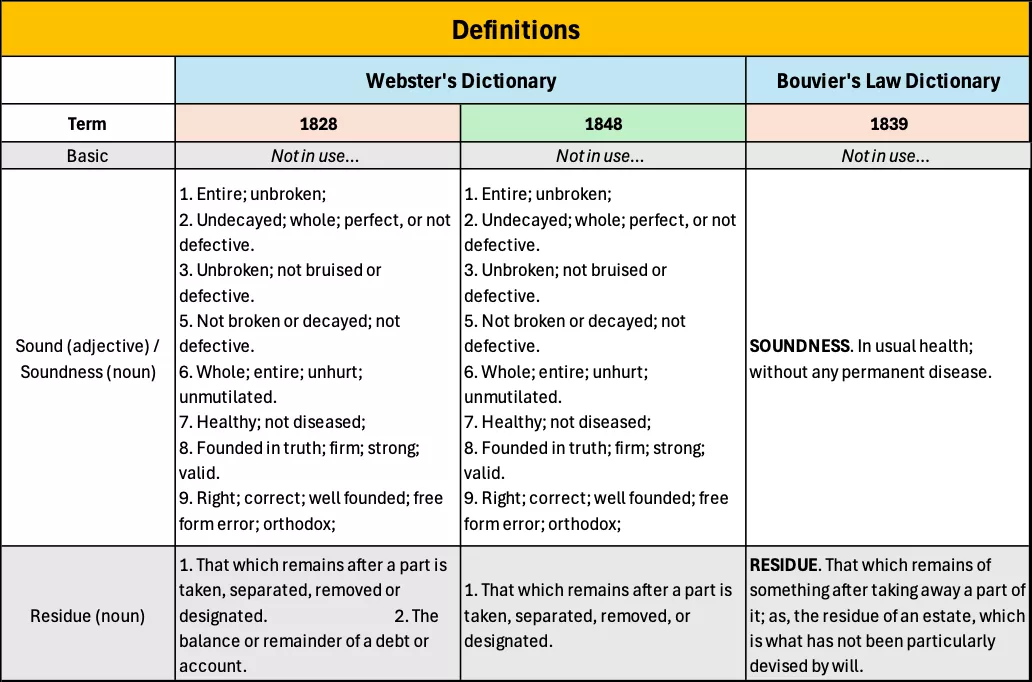
If any close synonym were to be used by the Framers, it would have been 'basis', meaning "The foundation of any thing; The ground work or first principle."
It is likely that Justice Crooks and others are using it in its contemporary sense––"fundamental; concerned with fundamental scientific principles", in which case a 'basic' education would correspond to the Framers' understanding of a primary school education. But as this term is not used by the Framers, it is mostly irrelevant for an understanding of original intent.
As for 'sound', this comes directly from the Journal when the Committee introduces the Education Article and their purpose in drafting it (Journal, p.262):
"...to bring a sound education within the reach of every child in the state."
'Sound', however, has various meanings. Does it mean working and healthy? or does it mean true and orthodox? Perhaps both? or neither? More investigation is warranted here, but the discussions recorded in the Journal do seem to indicate the former more than the latter––that they intended to design a working and healthy education system. That lends credibility to the Plaintiffs' claim of insufficient financial means to properly educate students, but only if we ignore the particular circumstances which have made that financial support allegedly insufficient. It is also important to recognize that the Framers are creating a vast educational system––from the primary stage all the way up through the college and university level. With that in mind, 'sound' could be referring to their attempt to design an education system that covers completely every possible level of educational attainment.
The last term, 'residue', is relevant for our understanding of Art. X, Sec. 3, Sub. 2:
"The residue shall be appropriated to...academies and normal schools..."
The use of the term 'residue' here––meaning "what remains"––supports my initial claim of common schools receiving funding first and with priority over academies and normal schools. If the Framers had intended to fund common schools and academies in equal proportion, they would have said so... "An equal proportion shall be given from the school fund to the support and maintenance of academies and normal schools." They don't say that, though.
The debates recorded in the Journal make clear that the Framers gave preference to common schools when it came to state aid, hence the use of the term 'residue' and the absence of any minimum funding provision imposed on the state. Only local governments have any such minimum imposed on them.

Interested in the content of this Article?
Reach out to the MacIver Institute to aquire more information


