
- Podcasts
 Podcasts
 - Videos
 Videos
 - Policy Issues
 Policy Issues
 - About
 About
About



Vetoing the Federal Education Tax Credit
Wisconsin Governor Tony Evers vetoed Assembly Bill 602 that would have required the state to opt into a federal program to promote donations to Wisconsin Scholarship Granting Organizations (SGOs) in exchange for a federal tax credit.
The decision effectively blocks a way for taxpayers to support students’ education without reducing funding for public schools or increasing state spending.
The Education Freedom Tax Credit (EFTC), established by a provision in the “Big Beautiful Bill”, would give taxpayers up to a $1,700 credit for charitable donations made to SGOs that use their funds to provide educational scholarships. These scholarships could have been used for students in public and private schools for a range of education-related expenses like tuition, tutoring, special needs therapies, classroom supplies, etc.
In his letter vetoing the bill, Evers made a case against school choice:
“I have spent decades of my life watching the impacts that draining public funds from public schools to fund private voucher school programs instead has had on kids, schools, and public education in Wisconsin. Wisconsinites have, too.”
“What's best for our kids is what's best for our state, and it remains unclear how this bill will do what's best for the more than 800,000 Wisconsin public school kids for whom the state has a constitutional obligation to adequately provide and invest in public education.”
In his letter, Evers argued that “public funds should go to public schools.” A closer look at the EFTC reveals that it would not have affected state education funding.
Wisconsin public schools are primarily funded through state aid and local property taxes. This measure would have left that pot of money alone.
It would have reduced the amount of federal income tax owed, allowing people to donate a portion of what they would have otherwise paid in federal taxes to SGOs.
Peggy Wirtz-Olson, president of the Wisconsin Education Association Council, Wisconsin’s largest teachers’ union, argues that opting into this program would have made voucher school programs "infinitely more unaccountable.”
Other opponents of school choice argue that this measure would indirectly take funding away from public schools if families decided to use these scholarships to put their children in private schools (One might ask why families would want to take their kids out of public schools and into ‘unaccountable’ private schools in the first place). Though supporters note the scholarship funding could be used for public and private school programs alike.
The consistently poor and declining performance of Wisconsin students may offer an explanation. DPI has attempted to obfuscate the worsening performance of Wisconsin children by fiddling with Wisconsin’s standardized testing.
The Wisconsin Institute for Law and Liberty’s (WILL) annualApples to Apples report that analyzes and compares the academic performance of Wisconsin’s schools demonstrates this trend. When compared to national assessments like the NAEP, it is clear that the state’s children are performing worse academically.
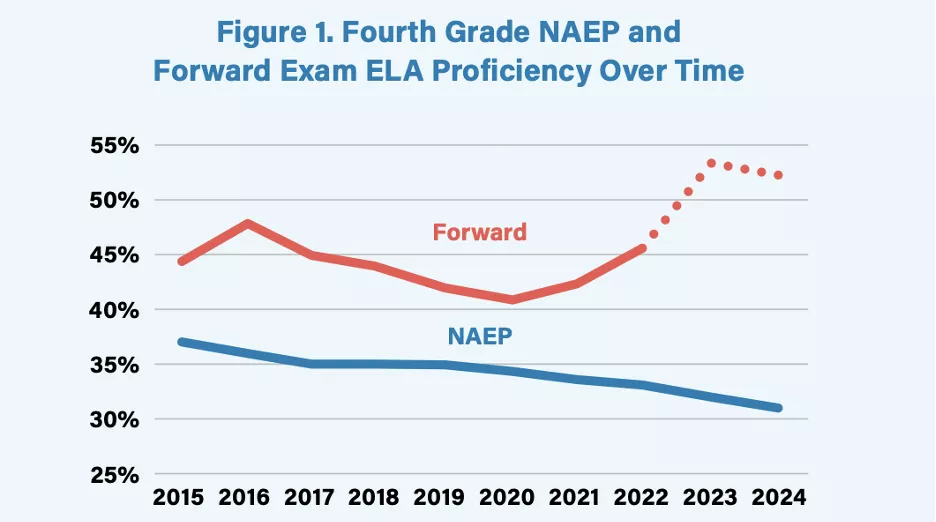
The report’s newest edition compared private and charter schools to traditional public schools in Wisconsin. Its results were not surprising: choice schools outperform traditional public schools, despite receiving less funding.
The WILL report also found that “choice and charter schools demonstrate stronger academic growth. Beyond proficiency levels, both private choice schools and charter schools post higher growth scores on average, suggesting greater year-to-year academic progress for students.”
Whether through extra tutoring or enrolling their children in private schools, the EFTC would have given motivated families the chance to provide a better education for their children, regardless of their income.
After Evers vetoed AB 602, State Representative Jessie Rodrigues wrote in a press release about the impact the program could have had.
Rodrigues wrote that more than 80% of Wisconsin K-12 students would have been eligible for the educational scholarships.
“There is a school for every child – but not every family can afford to get their child through the door. This program would have offered that chance,” Rodrigues wrote.
The financial implications extend beyond Wisconsin. A report from the America First Policy Institute found that over the course of three years, the 22 states that have decided not to opt-in will forgo nearly $23 billion dollars for their students.
Those forfeited funds won’t disappear, they will be redirected.
Among the great ironies of the “pro-kid” governor rejecting education funding is this: Wisconsin taxpayers can still claim the federal tax credit––just not for donating to Wisconsin SGOs. Instead, they would have to donate to SGOs in other states that opted into the federal program, meaning those states’ children would benefit.
MacIver Institute Senior Fellow Bill Osmulski wrote in his 2025 analysis of the Department of Public Instruction, “No one knows how much money public schools need to provide Wisconsin students with a basic level of education.”
“Public school advocates refuse to put a number on it. The answer is always simply ‘more.’”
An opportunity to do more for Wisconsin children––across both public and private schools––without raising taxes or cutting existing programs was presented. The Evers administration chose to reject it. Wisconsinites can still donate their money to SGOs for a tax credit, but those funds will never reach Wisconsin kids.
Interested in the content of this Article?
Reach out to the MacIver Institute to aquire more information


