
- Podcasts
 Podcasts
 - Videos
 Videos
 - Policy Issues
 Policy Issues
 - About
 About
About


Introduction
While Wisconsin’s economy is still growing, data shows that the Badger State's GDP growth rate is not increasing as fast as the rest of the United States. This paints a concerning picture of Wisconsin’s economy as its strength and growth rate diverge from the rest of the nation.
Two reports, Accounting for Growth in Wisconsin: Performance and Prospects (MacIver Institute) and the WMC Wisconsin Competitiveness Report (Wisconsin Manufacturing & Commerce Foundation), offer some perspective on why this could be happening.
The report published by the MacIver Institute analyzed the Wisconsin economy in two different time periods, from 2008 to 2014 and from 2014 to 2024, and compared it to that of the whole U.S. economy in those same time periods.
The report reads, “In every year from 2014 to 2024, per capita Gross Domestic Product (GDP) in Wisconsin grew more slowly than for the United States as a whole. This was the worst record among the 50 states.” Moreover, the per capita GDP in Wisconsin as a share of the United States per capita GDP has declined from 93.6 percent in 2014 to 86.6 percent in 2024.
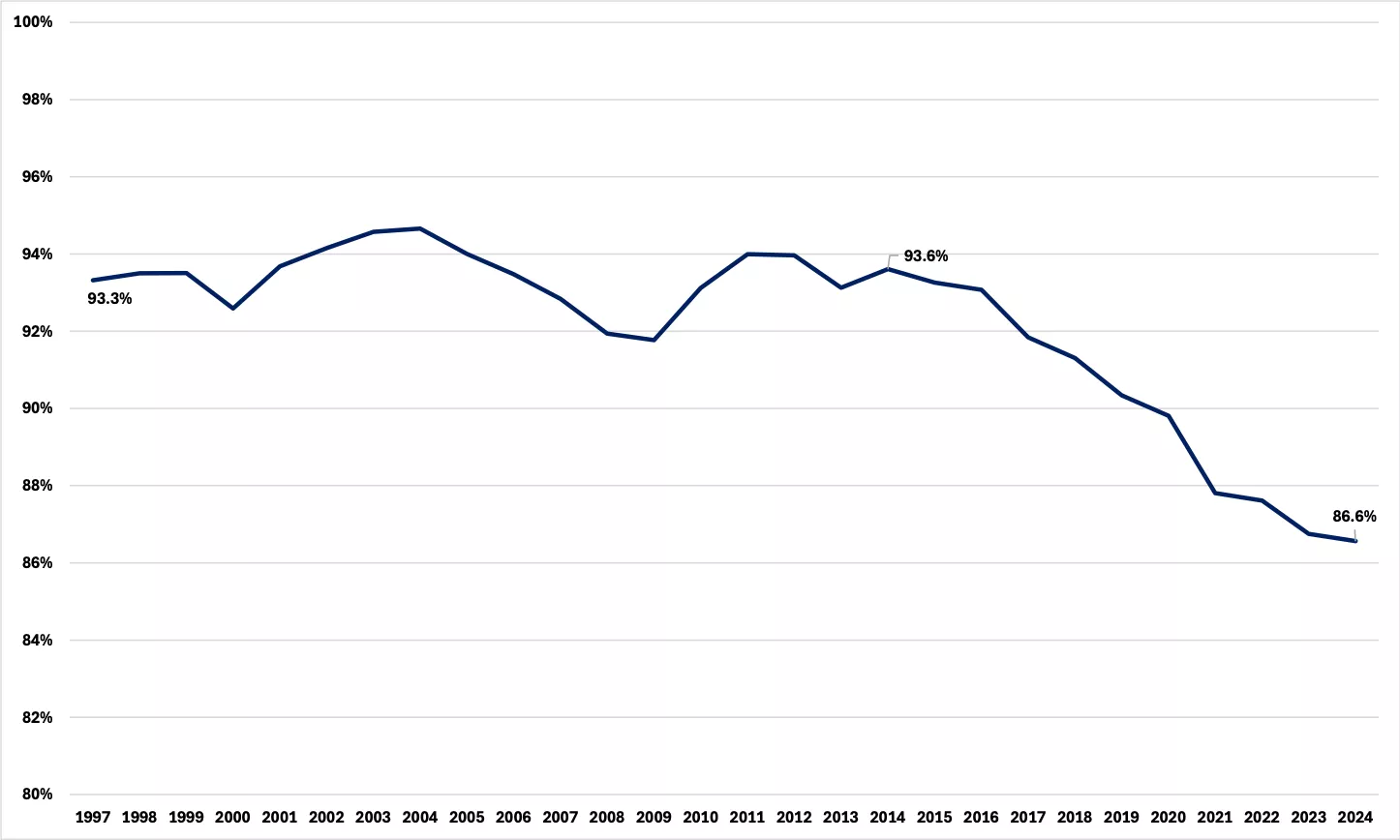
John Phelan, who is an economist at the Center for the American Experiment, aided the MacIver Institute in figuring out what was causing this slowdown. To do so, he used a technique known as “growth accounting,” which is often used by economists to differentiate the factors contributing to economic growth, or lack thereof.
Growth accounting offers additional insight by breaking real GDP into three categories: human capital, physical capital, and total factor productivity (TFP). By measuring GDP this way, it can be identified whether growth is driven by accumulating more and higher-quality labor, accumulating more tools for workers to work with, or increasing efficiency in production.
What the report found is that while human capital, physical capital, and total factor productivity in Wisconsin are growing, they all grew at a slower rate than the rest of the United States on average. This resulted in a relative economic slowdown.
The WMC’s Wisconsin Competitiveness Report, on the other hand, assesses the structural factors and policy decisions that may be causing our state’s economy to slow, relatively speaking. WMC looks at factors such as taxation, regulation, and education to evaluate why Wisconsin is no longer competitive on the national stage.
By analyzing both reports together, we can have a better understanding of the underlying factors affecting Wisconsin’s economy and discover real policy decisions that will actually increase economic growth in the long run.
Human Capital
The first area that our growth accounting report looked at was human capital. Human capital refers to a country’s quantity and quality of labor, which can be analyzed by looking at a country’s employment rate, education levels, and experience levels.
The MacIver Institute’s growth report shows that the average growth rate of human capital did grow overall from the time period of 2008-2014 to 2014-2024 from -0.2 percent annually to 0.2 percent annually. However, in that same time period, the United States on average saw an increase in the growth rate from -0.6 percent annually to 0.6 percent annually. This means that Wisconsin’s growth rate in human capital has been in decline, at least in relative terms.
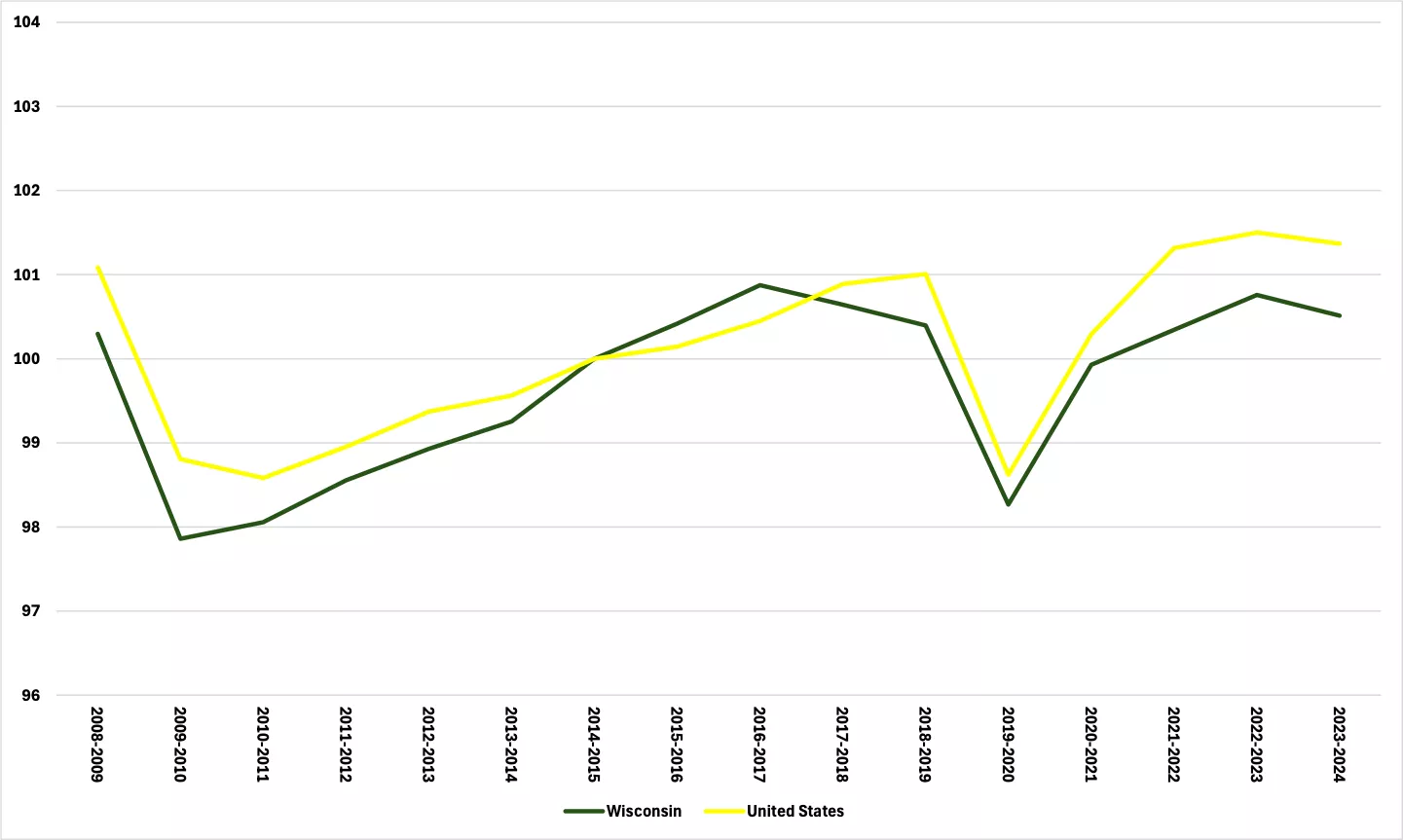
The divergence in the growth rates of human capital between Wisconsin and the rest of the United States can be seen in the graph above.

Human capital can be further broken down into raw labor and knowledge capital. Raw labor is typically measured in numbers of hours worked and the total employment. Between 2008 and 2014, and 2014 and 2024, Wisconsin actually saw a slowdown in the number of hours worked per year, not just in relative terms, but in real terms. The drop in the growth rate of hours worked was also much larger in Wisconsin than it was in the rest of the country.
Total employment in Wisconsin saw a surge between the two time periods, bringing in an average annual growth rate of 0.6 percent. However, this was lackluster in comparison to the United States’ average annual change in employment of 0.9 percent.
Looking at WMC’s Wisconsin Competitiveness Report, we can see some policy and demographic explanations for why growth in raw labor is slowing in Wisconsin. First off, the report notes that Wisconsin's population growth is consistently lagging that of the rest of the nation.
Wisconsin’s population is rapidly aging, as birth rates continue to fall. The report notes that the median age in Wisconsin is 40.7 years, which is more than a year older than the national average. Moreover, 19.2 percent of Wisconsinites are over the age of 65. This is compared to only 18 percent of the whole U.S. population being over age 65.
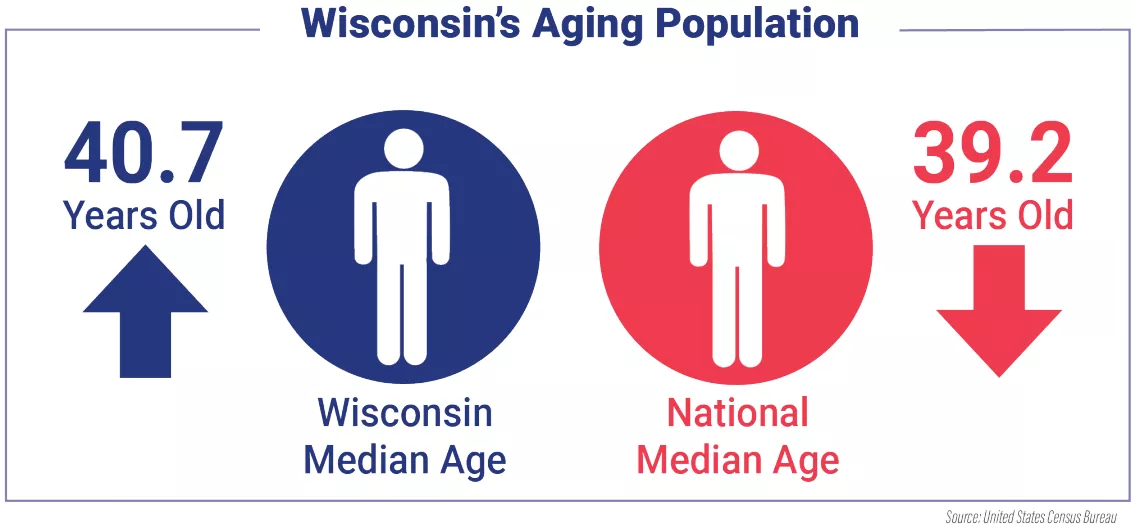
An aging population can be a problem for employment because older workers are more likely to exit the workforce or reduce their hours, shrinking the overall labor supply. This especially becomes a problem when coupled with low birthrates, as there are not enough skilled and productive young workers to replace the aging ones.
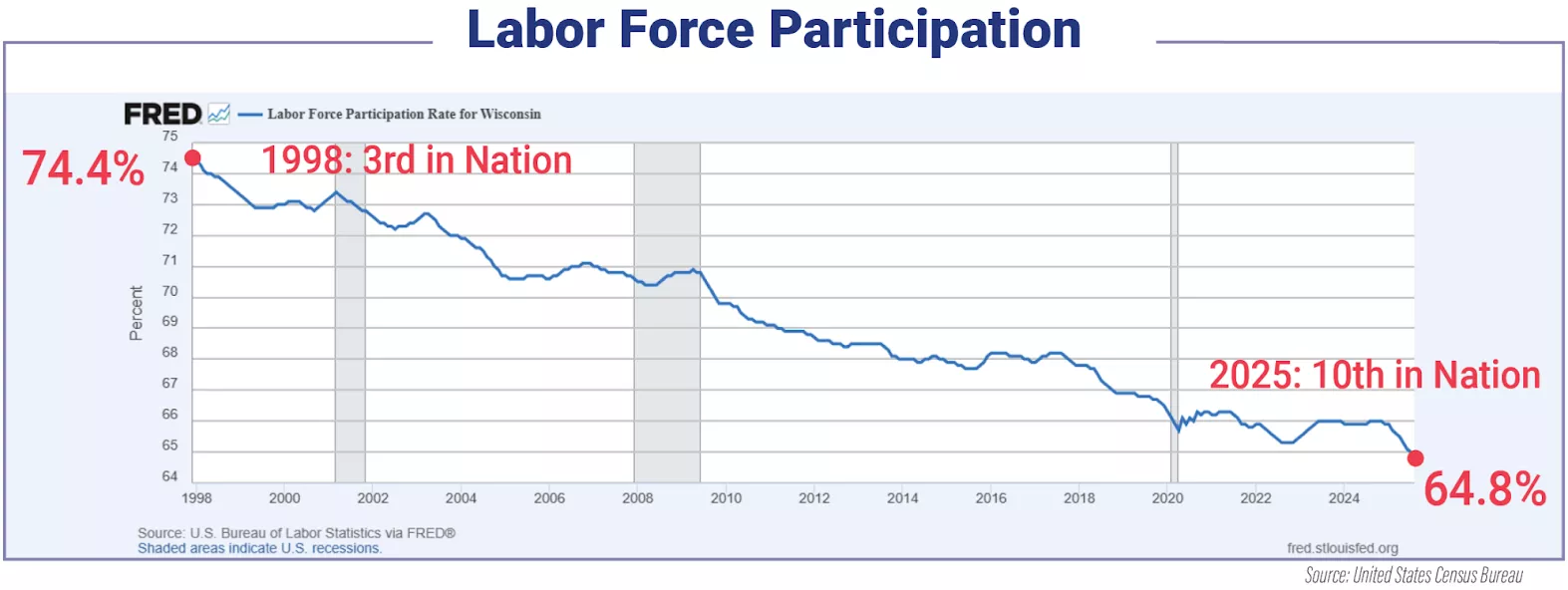
The Wisconsin Competitiveness Report also mentions that incentives created by the state’s welfare programs can contribute to less employment and work overall. Having strong welfare benefits, with few work restrictions, can encourage people to not look as hard to join the workforce. This too results in a lower labor force participation rate.
WMC recommends that Wisconsin implement stronger work requirements, better aligning unemployment benefits with labor-market conditions. Additionally, they recommend increasing auditing on the work-search process to identify individuals who are declining job offers or failing to participate in job interviews.
The other area of human capital is knowledge capital. Workers’ skills gained from work experience and education constitute knowledge capital. Looking at the chart from our previous report, Wisconsin has seen a 0.3 percent increase in the average annual growth rate of skills gained from work experience between the two time periods. This is actually better than the United States’ increase in the growth rate of only 0.2 percent.
However, when looking at the skills gained from education, things look more bleak for Wisconsin. The Badger State has seen a decline in its average annualized growth rate of experience gained from education of 0.1 percent. The whole United States, on the other hand, has seen its growth rate stay constant.
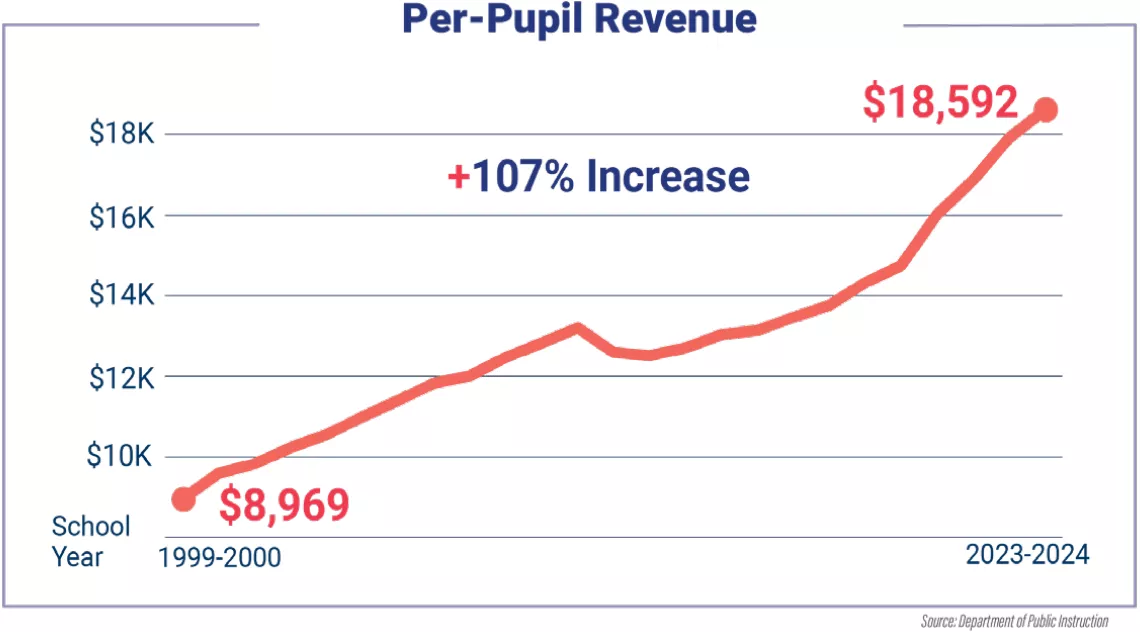
Wisconsin has been plagued by rising education spending and declining educational outcomes. The WMC’s report notes that recent data shows falling educational proficiency, where nearly two-thirds of Wisconsin students are below grade-level in math, and nearly seven-tenths are below grade-level in reading. This is despite the fact that spending per pupil has more than doubled since the turn of the century.
In 2026, WMC conducted a survey among employers asking what their biggest obstacle was in finding workers. Nearly 60 percent cited the difficulty of finding workers with the proper skills as being their main hurdle.
It is clear that in order for Wisconsin to increase its growth rate in knowledge capital, it is going to need better educational outcomes. Investing in proven methods that increase student outcomes, such as school choice programs, will be critical to achieving this goal.
Furthermore, K-12 students should be introduced to different career paths early on through career readiness programs, youth apprenticeships, internship opportunities, and greater access to vocational programs in high schools.
Physical Capital
Physical capital refers to the durable, physical items that workers have to use and can be key to increasing productivity and economic growth. Physical capital can include things such as buildings, equipment, and tools.
Our previous report from the MacIver Institute found that Wisconsin’s weighted growth rate in physical capital stayed steady between 2008 and 2024. Therefore, it did not meaningfully contribute to changes in the GDP growth rate. However, the United States saw its weighted physical capital growth rate move from 0.3 percent annually in 2008-2014 to 0.7 percent in 2014-2024, causing Wisconsin to lag behind in growth.
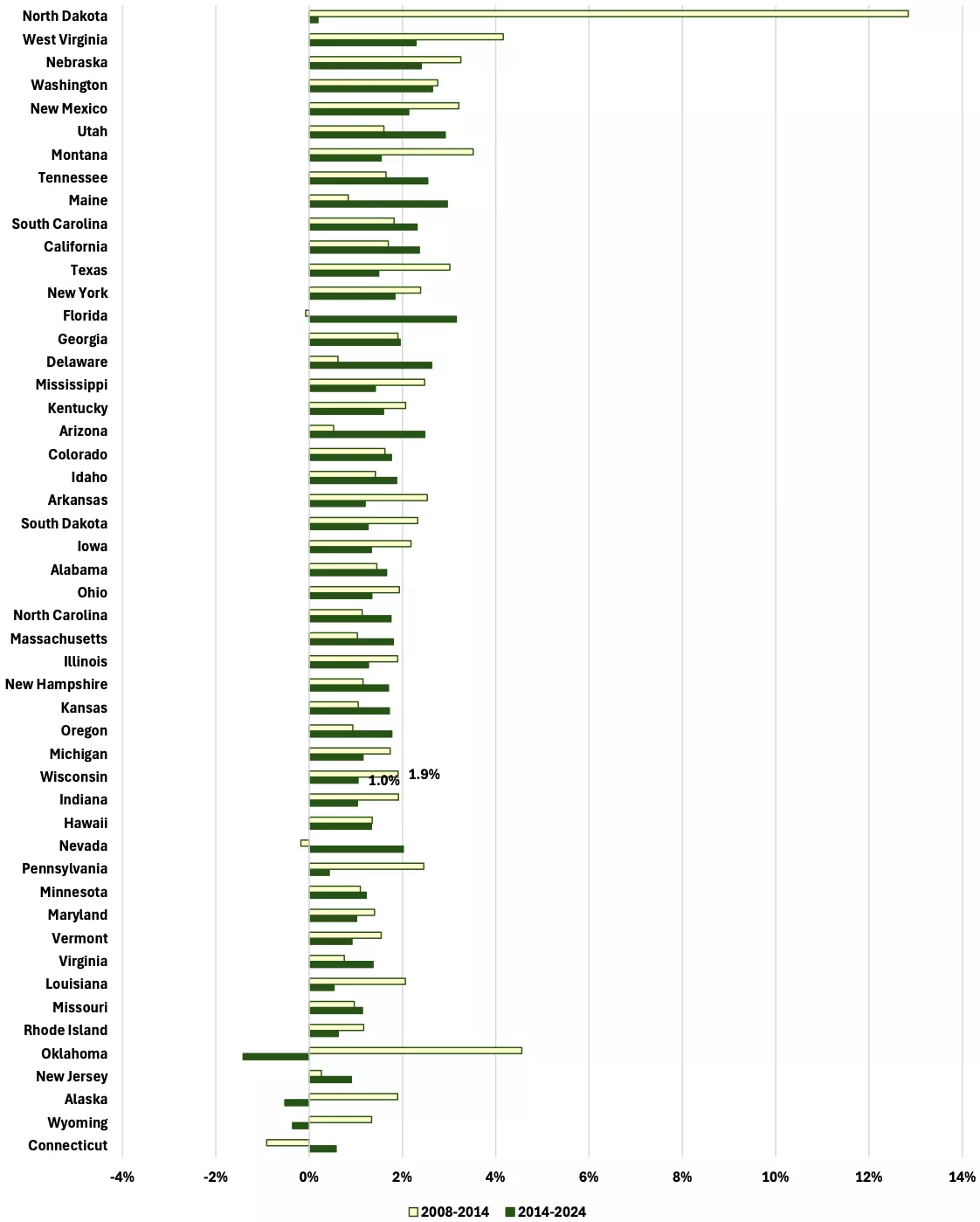
As seen in the chart above, the unweighted growth rate in physical capital stock per worker in Wisconsin decreased pretty dramatically between the two time periods, from 1.9 percent in annual growth to 1 percent. The national average, on the other hand, only decreased from 1.8 percent in 2008-2014 to 1.7 percent in 2014-2024. Moreover, Wisconsin’s stock of physical capital per worker is lower than 43 of the 50 states.
This slowdown in physical capital stock per worker was particularly prominent in the real estate and leasing sector.
The report further suggests that Wisconsin's slowdown in per-worker physical capital growth was likely a result of slowing investment per worker. WMC’s report also blames lack of investment for slowing GDP growth.
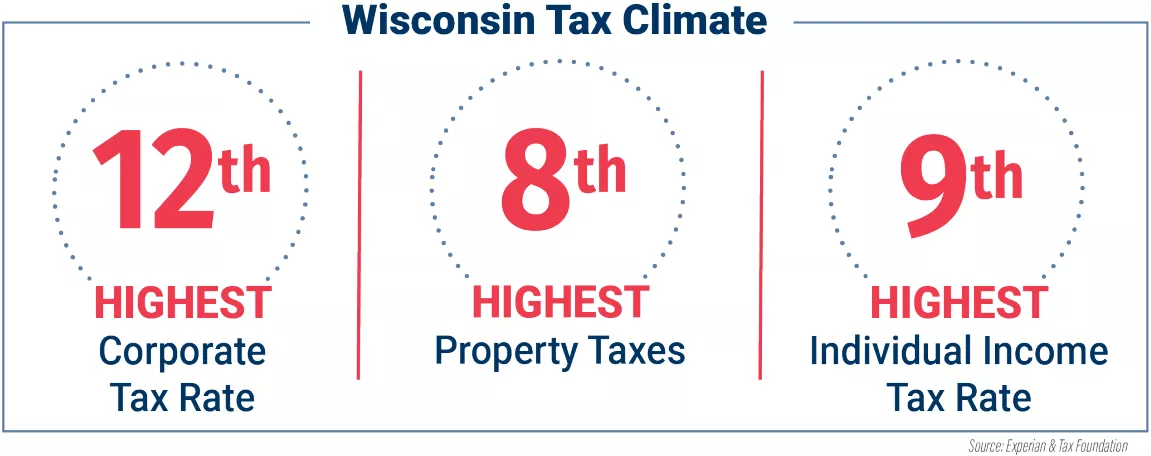
A big reason why Wisconsin is falling behind in this regard, according to WMC, is the state’s hostile tax climate. Wisconsin’s corporate tax rate is the 12th highest in the nation at 7.9 percent. The state also has the 9th highest income tax rate, with the top bracket getting taxed 7.65 percent, and the 8th highest property tax rate.
The income tax rate is especially significant since many of Wisconsin’s companies are labeled as “pass-throughs" and are therefore taxed at the state’s personal income tax rate rather than the corporate tax rate.
This issue is exacerbated by the fact that Wisconsin is not competitive with its neighboring states. Many other states in the Midwest, such as Michigan, Illinois, Indiana, Ohio, and Iowa, all have adopted flat income tax rates and offer an overall lower rate than the marginal rate paid by most Wisconsinites. South Dakota, another Midwestern neighbor, has no individual state income tax and no state corporate tax.
Wisconsin’s tax structure has made it a struggle to stay competitive, as both businesses and families have a financial incentive to set down roots in other states that offer better rates.
High corporate tax rates are especially perilous, as they directly increase the cost for businesses to invest in capital, which can discourage businesses from upgrading or expanding their physical assets. High individual income tax rates can also be problematic for economic growth and capital investment, as they reduce the incentives to work, save, and invest. When businesses and individuals retain less of their earnings, they will be less likely to reinvest in productive activities as the returns on their investments shrink.
On top of high taxes, Wisconsin is also a heavily regulated state with over 165,000 unique codes, making it the 13th most regulated state in the country.
Regulation drives down investment in physical capital in a similar manner to high taxation. Regulation forces businesses to incur compliance costs, leaving less money for investment in physical capital. Moreover, regulations can increase inefficiencies for businesses, leading to lower total factor productivity and, therefore, lower GDP growth in the long run.
Wisconsin’s economic growth could greatly benefit from lowering taxes and deregulation. More specifically, Wisconsin should consider adopting a low flat-tax rate for individual income. This would make Wisconsin a more attractive state to work, live, and invest in, preventing the flight of businesses and families to surrounding states.
Another possible policy solution to boosting investment and growth in physical capital would be to not run structural deficits in the state budget. This is known as the “crowding out effect," where an excess in government borrowing leads to an increase in overall interest rates and therefore a reduction in private investment.
By prioritizing fiscal responsibility, low taxes, and deregulation, Wisconsin can increase business investment, increase physical capital growth, and achieve stronger long-term GDP growth.
Total Factor Productivity
The last area of growth accounting is total factor productivity. TFP measures the efficiency with which labor and capital outputs are combined to produce a certain output. Since TFP is the growth in output not explained by labor or capital inputs, it is often used as a gauge for technological innovation and entrepreneurship.
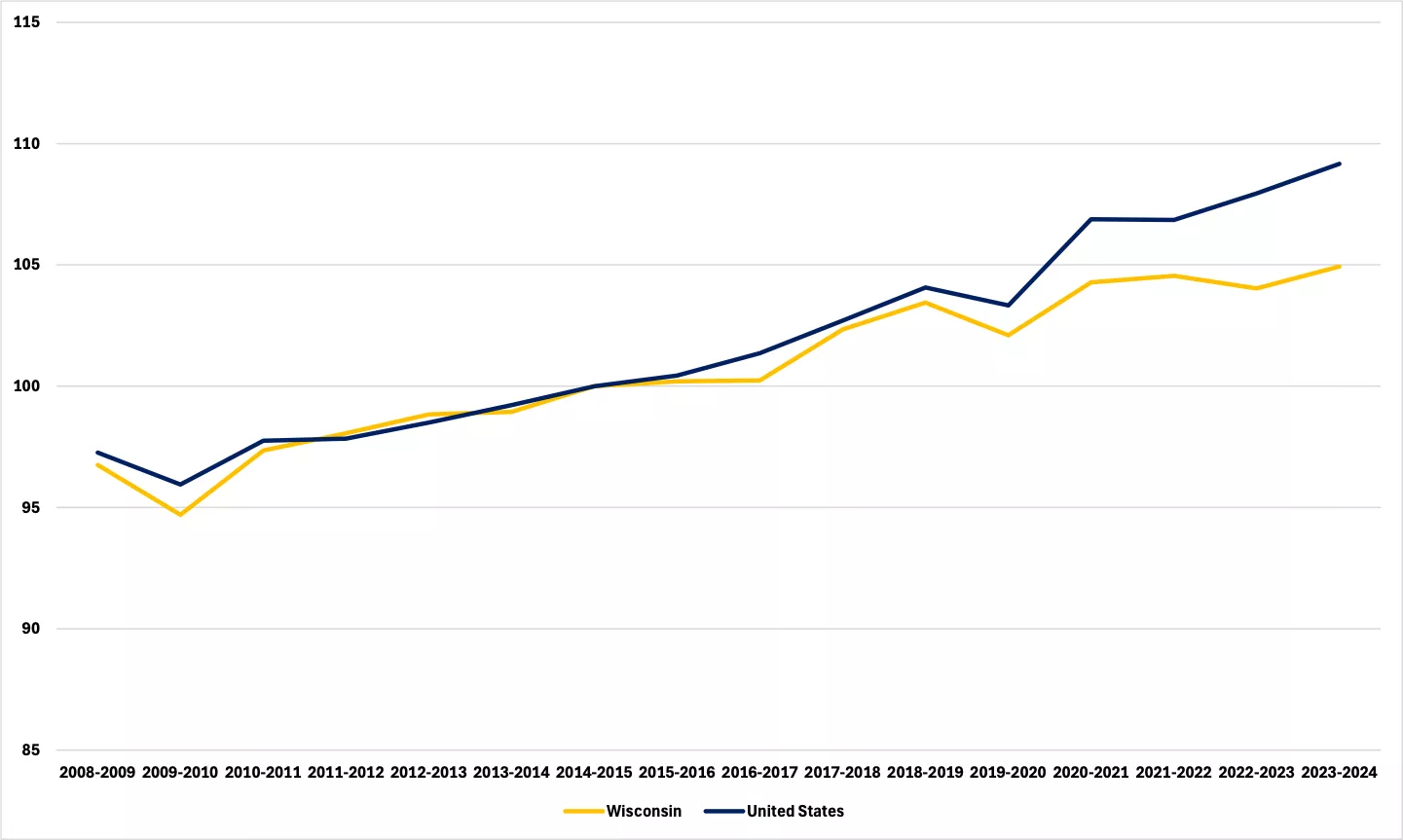
According to the MacIver Institute’s previous report, the growth rate of TFP in Wisconsin slightly increased from 0.5 percent annually from 2008 to 2024 to 0.6 percent annually from 2014 to 2024. This contributed to about one-third of the increase in Wisconsin’s GDP growth rate.
However, like human capital and physical capital, this increase in the growth rate lagged the rest of the United States. The U.S. as a whole saw an increase in the TFP growth rate from 0.5 percent annually to 1 percent annually. You can see the divergence between the growth rates in Wisconsin and the U.S. more broadly in the graph above.
Research conducted at the University of Wisconsin-Madison further supports this data by showing how far behind patent activity, a proxy for innovation, is in the state of Wisconsin. Data showed that between 1992 and 2020, Wisconsin produced 1.36 utility patents for 10,000 people. This is far behind the national average of 3.26 utility patents. It is also behind most of our Midwestern neighbors, including Illinois, which produced on average a whopping 12.5 patents per 10,000 people.
This underscores the fact that Wisconsin's lack of growth in both TFP and overall GDP is being partially driven by a lack of innovation and entrepreneurship.
However, demographics also play an important role. According to the Institute for Economics Policy Research at Stanford University, a 10 percent increase in the fraction of the population above 60 years old leads to a 5.7 percent reduction in GDP per capita. The study concluded that this decline in GDP was due to both a reduction in labor supply and a reduction in labor productivity that comes with aging.
Increasing TFP growth through public policy is a very challenging task. This is especially true in advanced economies due to the diminishing returns of innovation, where many developing countries have already taken on the significant innovation and technological advancements and now face the global technological frontier.
So what, if anything, can be done? Generally, the only way to shift out the global technological frontier is through finding new, groundbreaking innovations. That means that Wisconsin must adopt policies that strengthen innovation and entrepreneurship so new productivity-boosting technology can shift the global technological frontier out.
First, Wisconsin should again focus on deregulation. Research has consistently shown that an increase in government regulation leads to hesitancy to invest and a reduction in innovation. By deregulating the economy, Wisconsin can reduce compliance costs and increase efficiency for businesses, leading to more money going toward innovation and more confidence for people to embark on entrepreneurial endeavors.
Secondly, reducing corporate tax rates can be beneficial for total factor productivity growth as well by keeping money in the private sector and freeing up more money for research and development investment.
Conclusion
The evidence is clear: Wisconsin’s economy is not lagging due to a collapse in one area, but rather from consistent underperformance in human capital, physical capital, and total factor productivity growth.
Reversing these trends will require unique policy solutions that solve the root of Wisconsin's lackluster economic growth. This includes growing the labor force, creating a more competitive tax structure, increasing innovation, bolstering the education system, reforming welfare incentives, and attracting younger and more productive workers.
If policymakers commit to strengthening the foundation of the economy, Wisconsin can close the GDP growth rate gap between itself and the rest of the United States and become a leader in economic prosperity once again.

Interested in the content of this Article?
Reach out to the MacIver Institute to aquire more information


