
- Podcasts
 Podcasts
 - Videos
 Videos
 - Policy Issues
 Policy Issues
 - About
 About
About


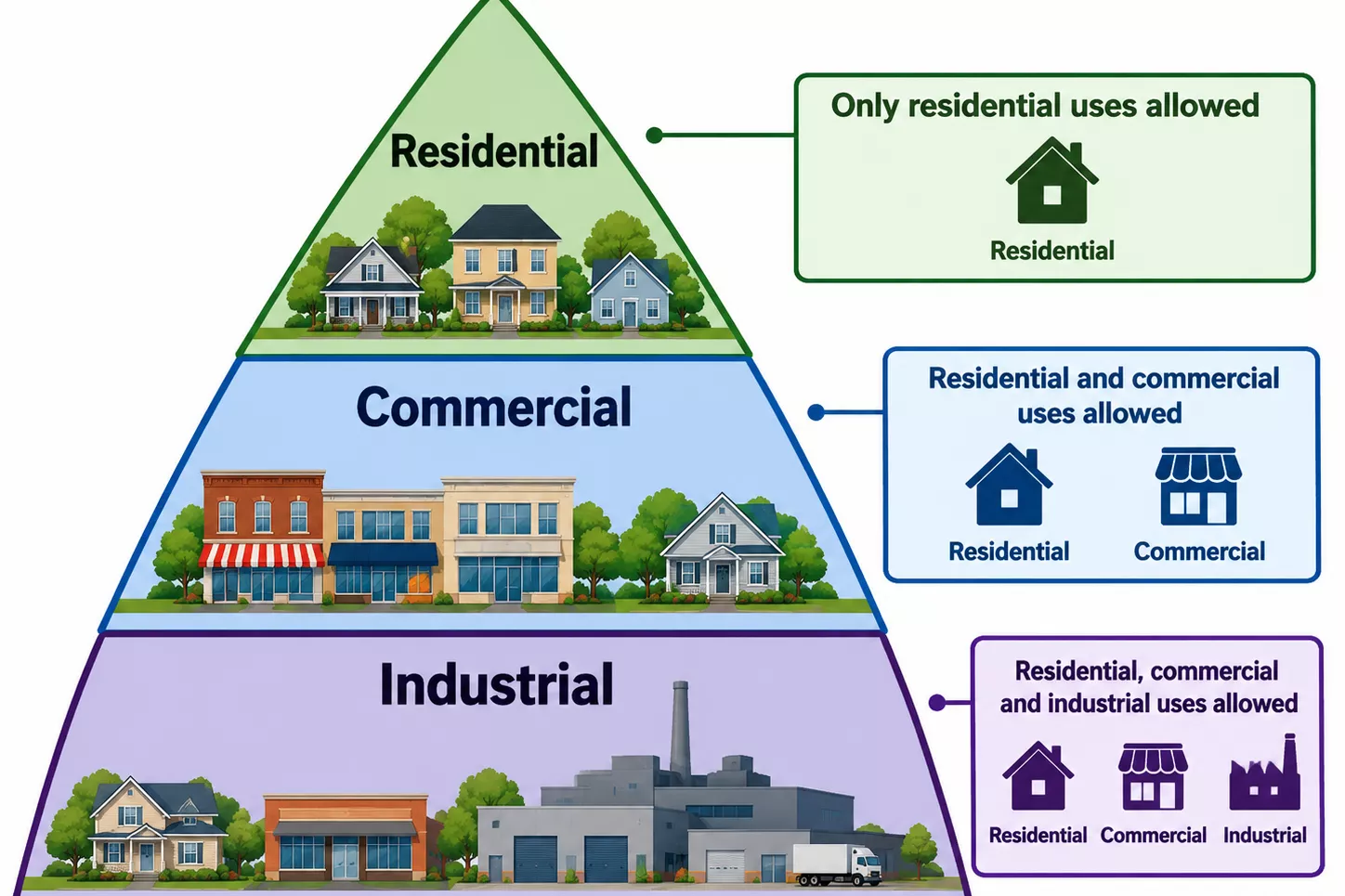
Hierarchical & Euclidean Zoning
In every zoning code there are three fundamental zoning categories: residential (R), commercial (C) and industrial (I). These zones exist to separate different uses of property with the goal of preventing conflicts between them.
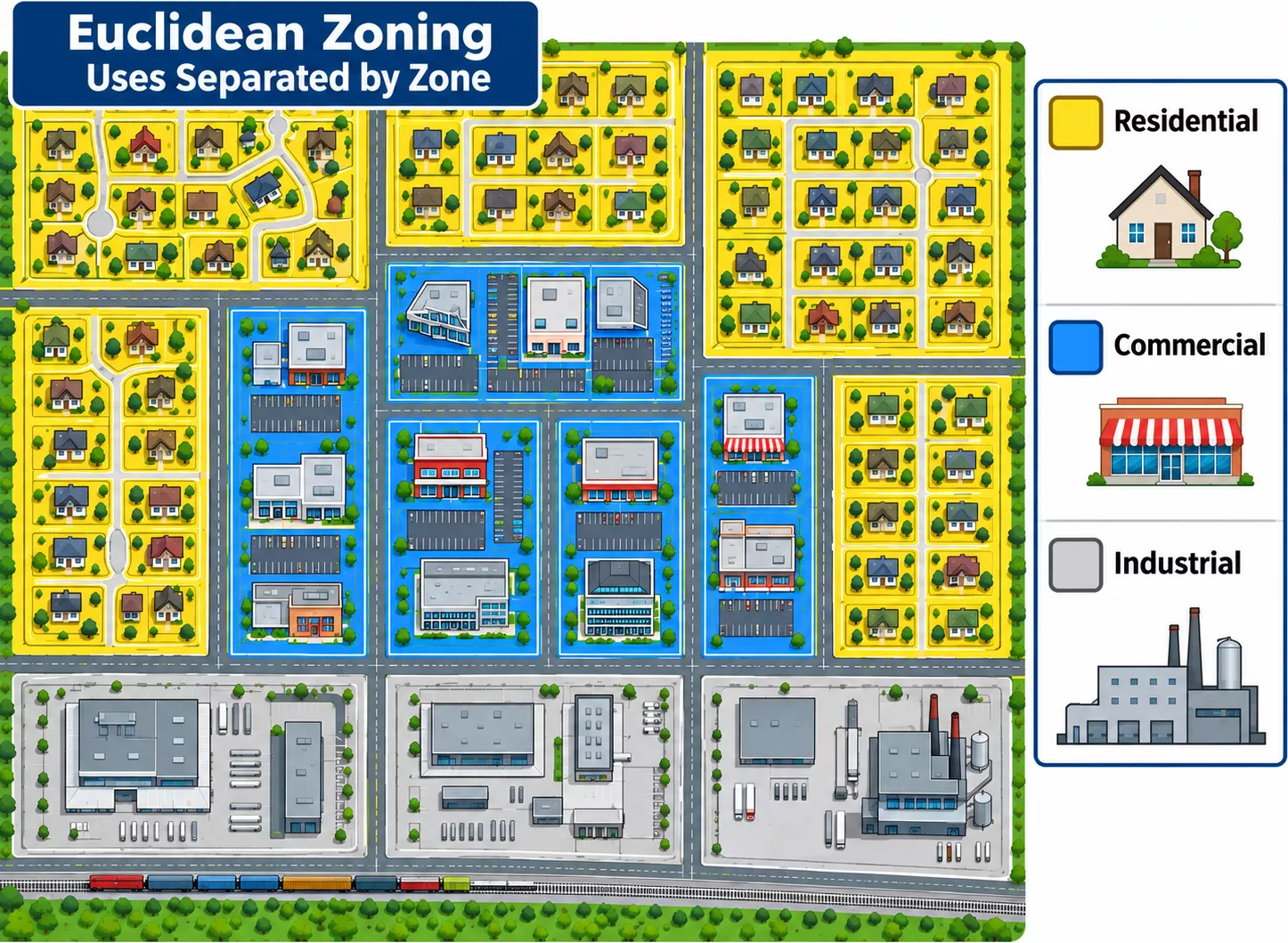
Under the prevailing zoning system, called Euclidean zoning, these zones generally do not allow for mixed-use development.
Residential uses are confined to residential zones, commercial uses to commercial zones, and so on. Since it's conceivable that large department stores or factories could interfere with road access or expose residents to unwanted pollution (atmospheric, light, and noise), these uses are excluded from residential zones. Similar exclusions apply to other zones.
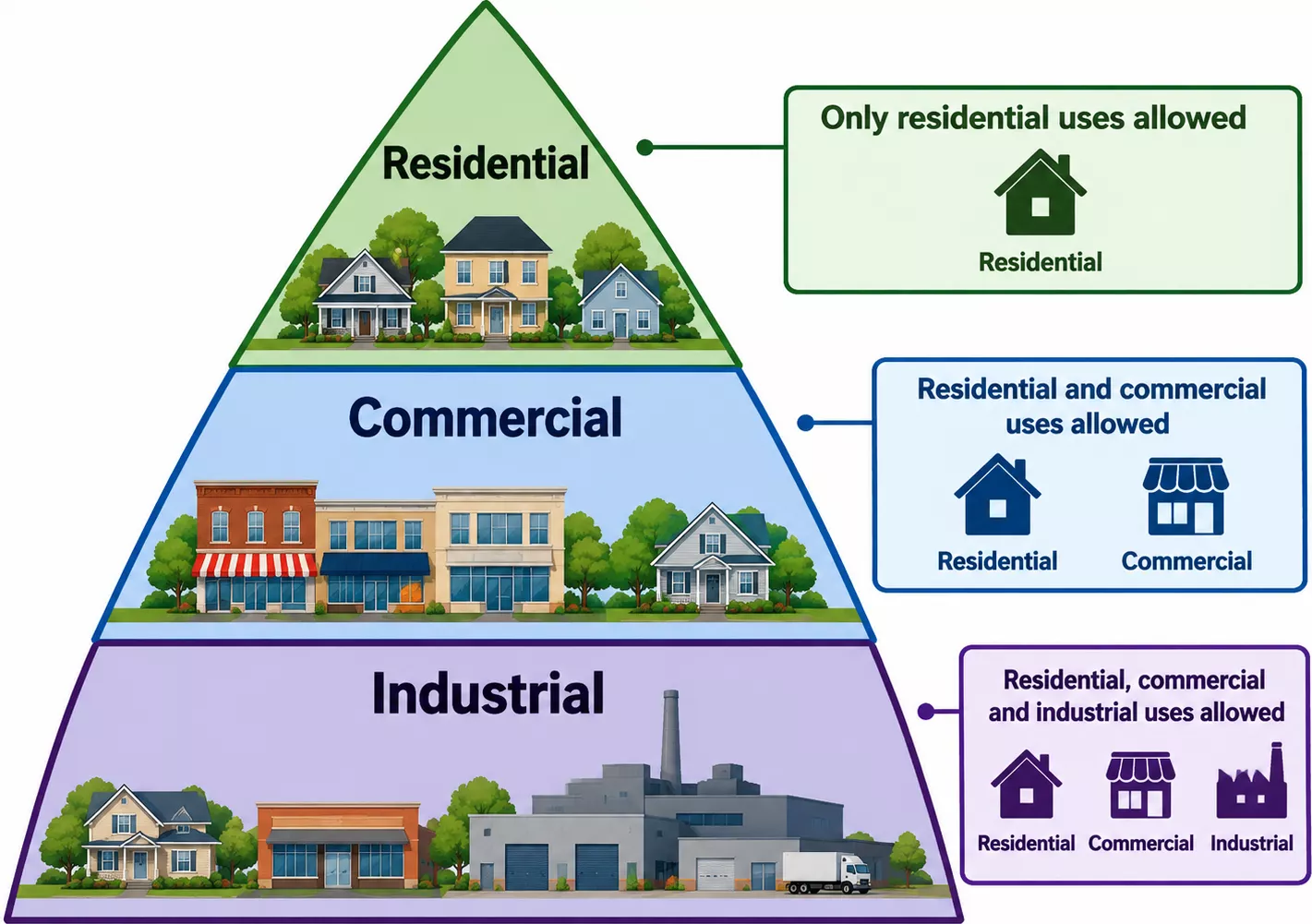
In contrast, hierarchical or "tiered" zoning is a zoning system which allows for varying degrees of mixed-use development within certain fundamental zones.
In this system, the three fundamental zones are arranged hierarchically in a pyramid with residential at the top, commercial in the middle, and industrial at the bottom. Each use case is then allowed to trickle-down to the layers below it, such that residential uses are allowed in all three zones, commercial uses are allowed in commercial and industrial zones, and industrial uses are allowed only in industrial zones.
The greatest difference between these two systems is the degree to which they allow for flexibility in land use.
With respect to Euclidean zoning, the zones exclude any uses which do not conform to the principal use of the zone. Conditional uses may be permitted, but zoning authorities do not have the power to approve uses which are not already permitted by the zoning code, and are under no obligation to permit conditional uses anyway if an applicant applies for a permit. In the event that there is not enough land for new housing within residential zones, zoning authorities are often prohibited from allowing housing development in commercial or industrial zones with excess land unless an applicant goes through a re-zoning process––a process which can take several years.
Hierarchical zoning, on the other hand, permits such development by-right.
By allowing residential uses in all three zones, the bottleneck that currently exists in housing development can be alleviated by allowing developers to take up the slack that exists in other zones without going through the re-zoning process. The same holds true for commercial uses which are now permitted in industrial zones. In addition to increasing the supply of housing and commercial uses (placing downward pressure on rents), this system allows people to sort themselves into urban- as opposed to suburban-life.
Historically, urban living was a cheaper alternative to suburban living, and offered more opportunities for employment than rural life. Access to amenities like grocers, restaurants, financial services and entertainment within walking distance meant that low- and middle-income people could avoid the expense of daily commuting to work and retailers. And the fact that commercial zones are generally noisier, and industrial zones noisier still, this means that new housing is offered at a discount.
The hierarchical system renews that history and offers residents more options for housing, but it also confers benefits to the owners of commercial and industrial buildings. These owners now have access to a workforce that is nearby––reducing commute times and tardiness––and also reduces the need for parking while lowering congestion on roadways. In addition, they also have the benefit of what Jane Jacobs called "eyes on the street"––more people nearby means criminals have more opportunities to be caught, so crimes like breaking and entering decrease.
As the Independent Institute writes:
Since 2023, six states—California, Florida, Montana, New Hampshire, Oregon, and Texas—have passed laws requiring local governments to permit multifamily and mixed-use developments in commercial zones (and in some cases, industrial zones).
California passed a law allowing multifamily housing in all commercial zones back in 2022.
Montana passed S.B. 243 in 2025 which allows apartment buildings to be built in both commercial and industrial zones.
Texas passed S.B. 840 in 2025 which allows "mixed-use and residential development on commercial properties by right." They also passed S.B. 2477 which "removes unnecessary regulatory barriers to make office-to-residential conversions more feasible."
These and many other states have enacted similar laws which allow for mixed-use, hierarchical zoning. But the best iterations of this kind of zoning reform are those which allow mixed-use development by right––Texas's S.B. 840, in particular. So long as local zoning authorities are given the option to deny mixed uses, even though they may be allowed, the positive impact of hierarchical zoning is only felt when zoning authorities shall allow mixed uses.
The idea of many legislators that zoning reforms such as this would be "top-down" laws interfering with "local control" is mistaken. Hierarchical zoning requires nothing of private property owners––it only restricts the powers of zoning authorities. "Local" control under the status quo is merely small-scale feudalism allowing zoning authorities to engage in central planning by denying the exercise of private property rights. Zoning fundamentally contradicts a private property system by granting governments the power to infringe upon these rights, making government the de facto owners of all property within its boundaries. If "local" control is the goal, individual control (self-government) is much more local than municipal zoning.
Hierarchical Zoning Prevents Objector Lawsuits
Back in 2025 I wrote an article about an objector lawsuit brought against a housing developer in Osceola, Wisconsin, and how both the appellate court and SCOWIS ruled against the objectors, thus allowing the development to go forward. This was only possible because Wisconsin had passed Act 16 in 2023. That Act and the subsequent decision of the High Court placed much-needed limits on the ability of third-parties to object to developments that do not directly affect them. But the great thing about hierarchical zoning is that laws like Act 16 aren't even necessary.
If zoning's proper role is to prevent "conflicting uses"––landfills being built in the middle of neighborhoods, say––then it ought to confine itself to assigning property rights to common resources, particularly air. Under the status quo, zoning does do this. Zoning codes regulate how much light and sound may be emitted into the air in each zone. In a residential zone, codes place relatively low limits on light and sound by measuring lumens and decibels. In commercial zones these limits are higher, and in industrial zones they are higher still. In commercial and industrial zones, too, high limits are placed on the quantity of particulate pollution that is allowed.
What zoning does in each of these cases is assign a general property right to the air within each zone, thus establishing reasonable expectations. For example, in a residential zone residents may have a reasonable expectation that noise will not exceed 60dB and light pollution will not exceed 2000 lumens (at night). These are each higher in commercial and industrial zones.
Hierarchical zoning makes the reasonable expectations that apply to residents in residential zones a moot point because by virtue of locating within zones principally designated for commercial or industrial activity, residents waive their rights to these reasonable expectations.
For that reason, the residents of this neighborhood cannot sue San Jose Airport.
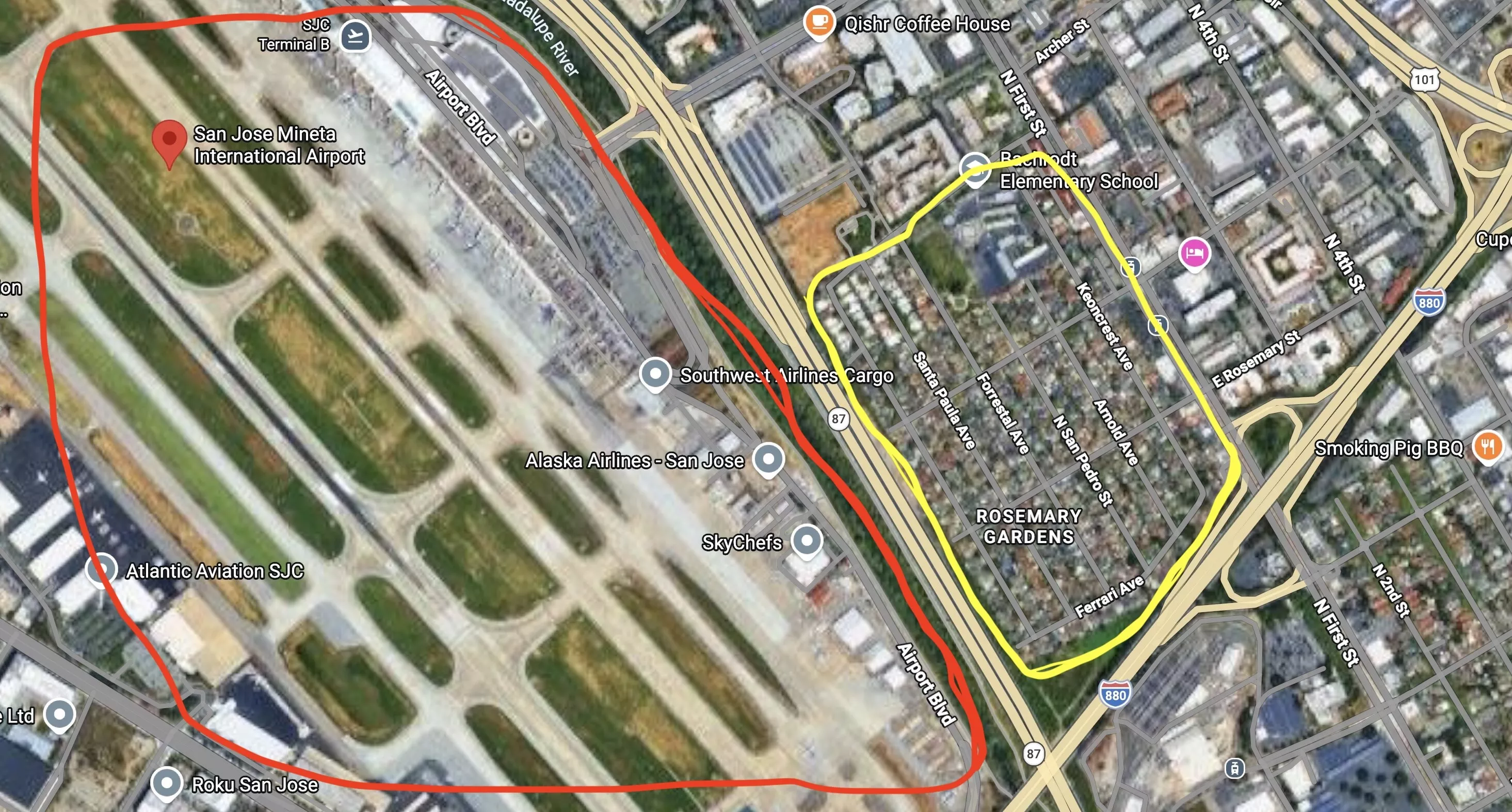
It is also the reason that tenants who live above shops in the many historic districts scattered throughout Wisconsin cannot petition the city to close the noisy breakfast joint beneath their apartments, or the dive bar across the street blasting music at 2 a.m. It is also why there is no issue with car insurance salesmen and chiropractors working out of their homes.
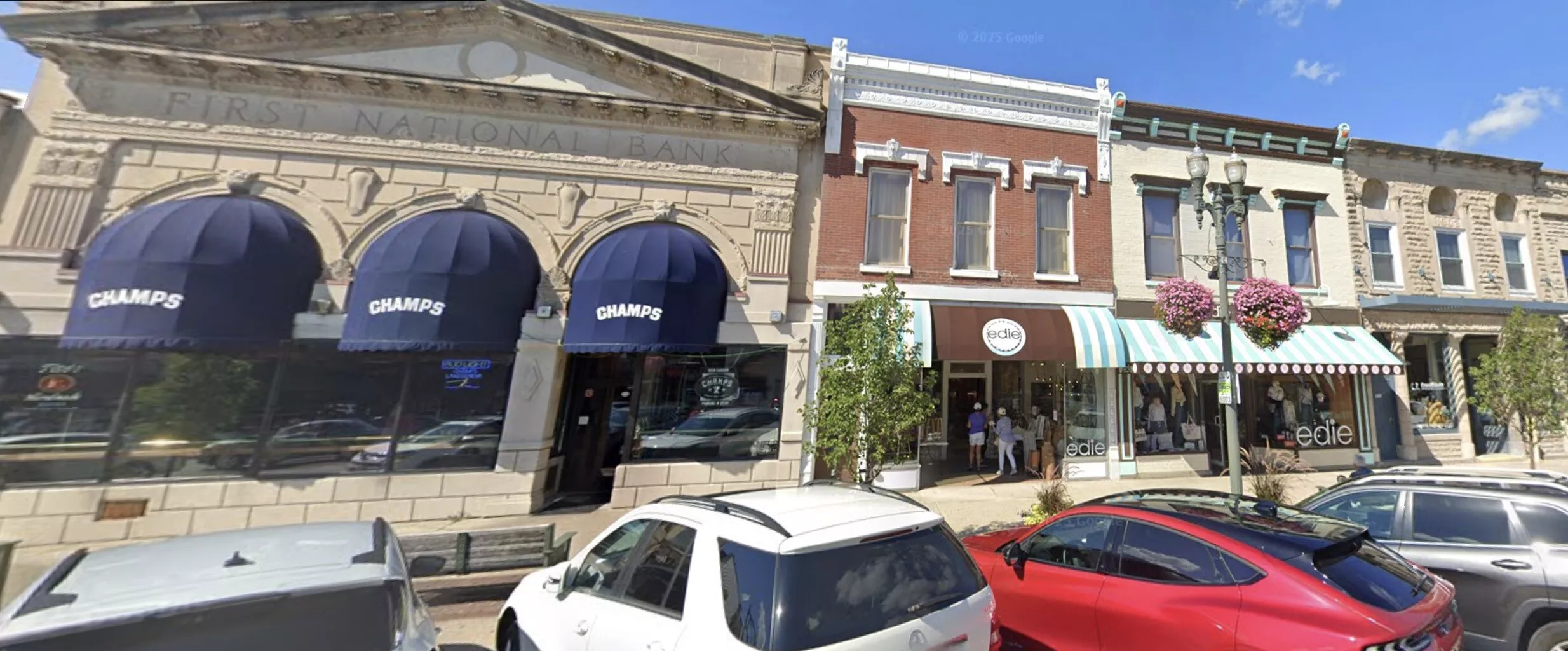
There is no conflict between these uses because they do not impinge upon the reasonable expectations that are defined for the zone, and hierarchical zoning meshes with that framework perfectly. Reforms such as those passed by California and Texas are reasonable legislative changes that satisfy all parties and alleviate housing scarcity, create conditions which reduce crime without impacting policing budgets, provide retailers and manufacturers with customers and a nearby workforce, and enhance private property rights.
Zoning certainly has its uses, but what once began as a regulatory authority intended to engage in thoughtful local planning has now become (or revealed itself to be) a vehicle for exclusionary practices that stifle development and homeownership. Wisconsinites are driven from their hometowns and forced to relocate, often across state lines, simply because our zoning institutions may veto developments they don't like.
Central planning is still central planning no matter how local it is. And individual planning faces the same challenges that local zoning boards do––uncertainty, risk, the possibility of failure. But unlike individual planning, central planning is too far removed to ever make use of the knowledge that could avoid failure. It has no profit motive so cannot plan in the best interests of the people it serves, and its bureaucratic nature means that it is slow to act and respond to change. Individual planning done by the market is not. As Hayek said,
The curious task of economics is to explain to men how little they really know about what they imagine they can design.
Hierarchical zoning is a good first step toward revitalizing our cities and towns, making our communities places where the young want to live, and places where they actually can live.

Interested in the content of this Article?
Reach out to the MacIver Institute to aquire more information


