
- Podcasts
 Podcasts
 - Videos
 Videos
 - Policy Issues
 Policy Issues
 - About
 About
About


New Zoning Code by October
The city of Eau Claire is nearing the end of a multi-year process to update and reform its zoning and land use regulations.
The city is expected to put the new plan into effect by October, after it settles the debate surrounding fee schedules––particularly tree preservation fees.
At MacIver, I've written often about the property rights issues that zoning and land use regulations impose, and have conducted a case study for the cities of Lake Geneva and Williams Bay that attempts to measure the impact of zoning regulations on home prices.
Spoiler: zoning makes housing more expensive––much more expensive.
So it is all for the better that Eau Claire is taking great steps to liberalize the land and housing market by relaxing its control over what, where and how buildings are built. It is curious, however, that more municipalities haven't done this sooner, and for one simple reason: increases in local governments' property tax revenue is limited by the value of net new construction.
The more net new construction there is, the more a government can collect in property taxes because there is more property to tax. This, by the way, does not increase individual tax burdens since the additional tax revenue is collected from new tax payers.
Although, local governments tend to be staffed by local community members who may have personal interests at odds with their interests as government employees. Longstanding members of the community often have a conservative impulse to keep the status quo. No new buildings. No new people. No problems.
The Social Cost of Zoning
But of course there are unintended consequences associated with trying to maintain the town of your childhood. Cities are organic, living creatures. They are made by organic, living creatures. And no living thing ever stays the same. They change, adapt, suffer and die. But they also live in community with others who they constantly interact with. They eat and work together, they live and reproduce with each other, and eventually raise the next generation to take their place. All of this life and activity necessitates change in the ecosystem; that is, the city and its residents.
If a city is kept, by force, in a state of static equilibrium unable to adapt and respond to the decisions of the individuals who inhabit it, then those individuals will leave. What this means for you, dear reader, is that the life and experience you are trying to preserve for your children, friends and fellow neighbors will inevitably result in none of them being able to enjoy it. And so, they will move. And they will move to those places that can accommodate them.
So what has happened to your community now? Now, the generation raised by you and your neighbors––those who understand and appreciate the community by virtue of having grown up there––go somewhere else and take that appreciation with them. This is all the worse for maintaining the "character" of the community. And as is more and more the case, it is every son, every daughter, every cousin, aunt and uncle who decides to move away. And once they venture elsewhere to establish careers, make homes and build families they have little reason to come back. If a parent or grandparent passes away and leaves them the house, their first thought is "Why would I live in that house? Everyone else has moved away anyway."
All of this is to say that there is a great irony to zoning. While it tries, explicitly, to preserve and protect the community by avoiding the painful process of change, it guarantees change of the worst kind––the severing and exile of its own members.
New Simplified Zones
But not so for Eau Claire. It will take many years for the city to be able reap the full fruits of the reforms, but some are ripe for the picking right now.
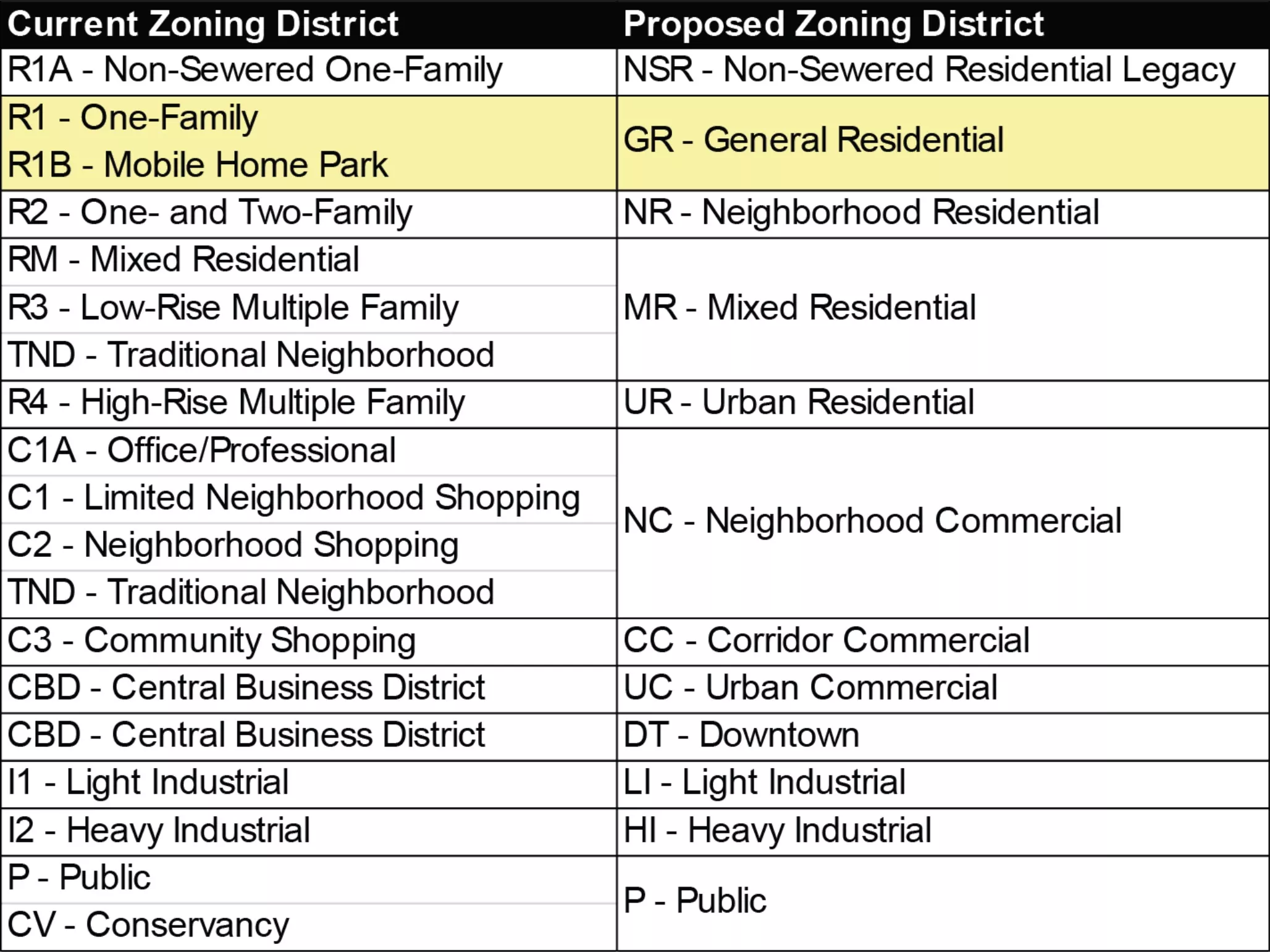
The first thing to mention is that the number of residential zones has been greatly reduced. Typical zoning codes will have 5, 6, even 10 distinct residential zones with varying lot regulations. But the new code replaces the 8 residential zones with just 5, and allows for multiple dwelling types in each zone.
Fewer zones is a telltale sign of greater housing flexibility. Allowing multiple dwelling types in a single zone allows individuals and developers to better respond to local conditions. Rather than force individuals to build traditional Single Family homes (SFs) with 3 beds and 2 baths, permitting smaller duplexes with fewer rooms can better accommodate singles, couples without children and the elderly on fixed incomes.
Broadened Principal and Accessory Uses
Which brings us to the next improvement to the zoning code: more by-right principal uses and by-right accessory uses in every residential zone.
First, there's the principal uses shown in the table below.
The new General Residential (GR), Neighborhood Residential (NR), Mixed Residential (MR) and Urban Residential (UR) zones all allow for at least 3 dwelling types. Naturally, SFs are allowed in every zone (even UR which permits by-right Rowhouses, typically Single Family Attached (SFA) dwellings), but each new zone allows for not just multiple dwelling types, but multi-unit structures and multiple dwelling structures on the same lot.
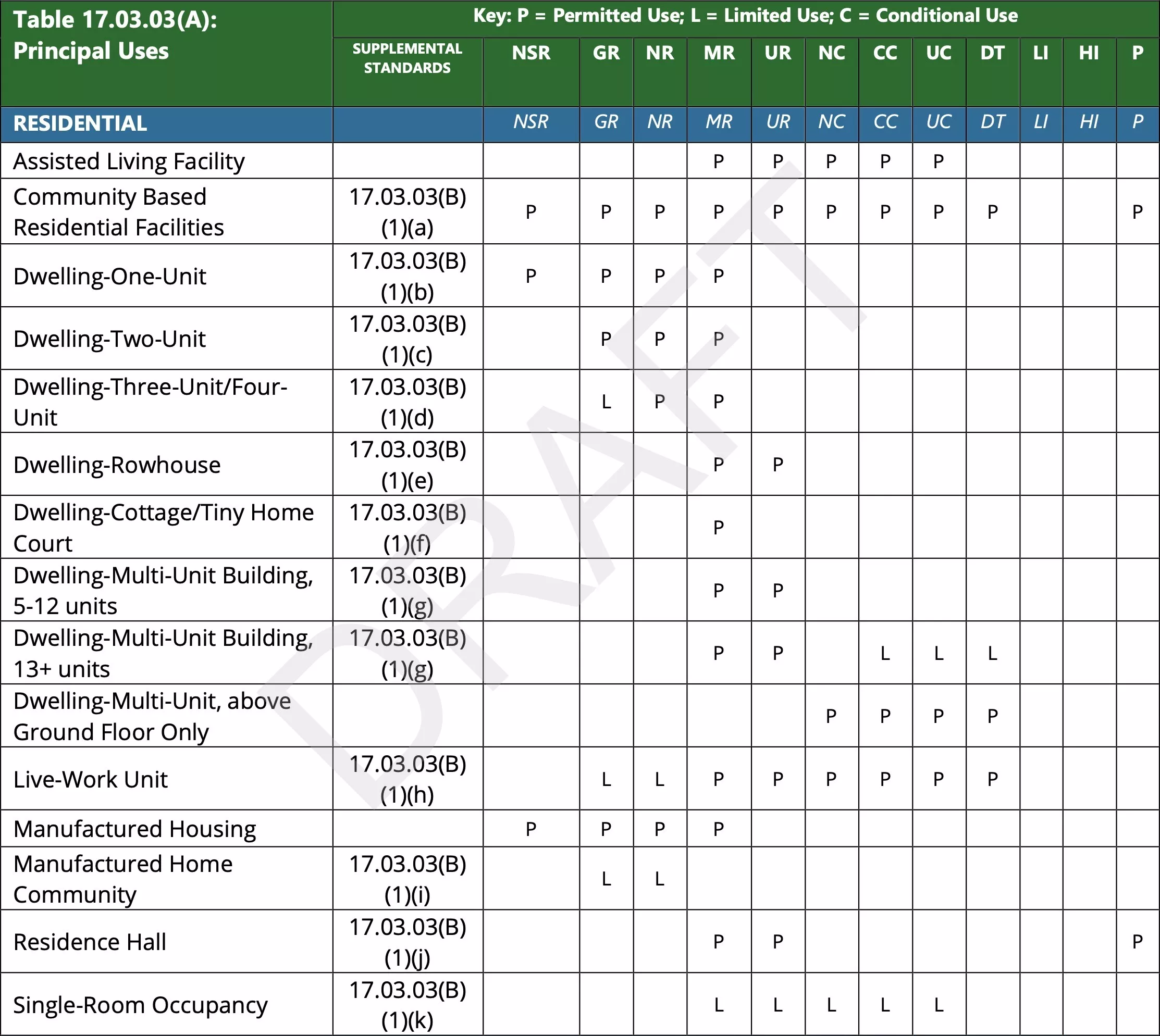
As for allowing multiple dwelling structures on the same lot in every zone, this is BIG news. Earlier I mentioned that the people of Eau Claire could reap some of the benefits of the zoning reform immediately. What I was alluding to is the development of Accessory Dwelling Units (ADUs).
These are permitted as a principal use under the Community Based Residential Facilities use and are explicitly mentioned under section B.1.A.ii. on page 53 of the new zoning ordinance. ADUs are also permitted as an accessory use in each residential zone in the accessory use table below.

Although the table codes the use of ADUs as limited use (L), in reality the only requirement is that ADUs meet certain utility hookup and dimensional standards. Section 17.12.09 (p. 359) of the new code lists the requirements for a permit:
Seems simple enough. But the real test will be whether the city denies permits on the basis of "changing the character of the community," or some such other euphemistic veto.
As the table below shows, the dimensional standards are quite good. The code does not impose any sort of minimum floor area or parking requirement (which would defeat the purpose of ADUs by making them too big and therefore too expensive for renters), and only limits the building area and building height, as well as imposing some modest setbacks.

What this means, essentially, is those with fixed or highly variable incomes can supplement their income by erecting a tiny home in the backyard.
This could be a prefabricated ADU (which tend to be quite pricey in my opinion), a large self-assembly shed from Home Depot, or a custom build by your local contractor. They can be built in a single day, furnished the next, and then marketed to fresh college graduates, young professionals, bachelors, traveling salesmen, truckers, or high school graduates trying to dip their feet into independence. If that fails, you can list them on Airbnb or use them as guest houses for visiting relatives.
The units can also be 26 feet tall which means construction of two-story ADUs is more than possible. This eliminates parking concerns in some instances because homeowners could build carriage house ADUs that accommodate tenants' vehicles.
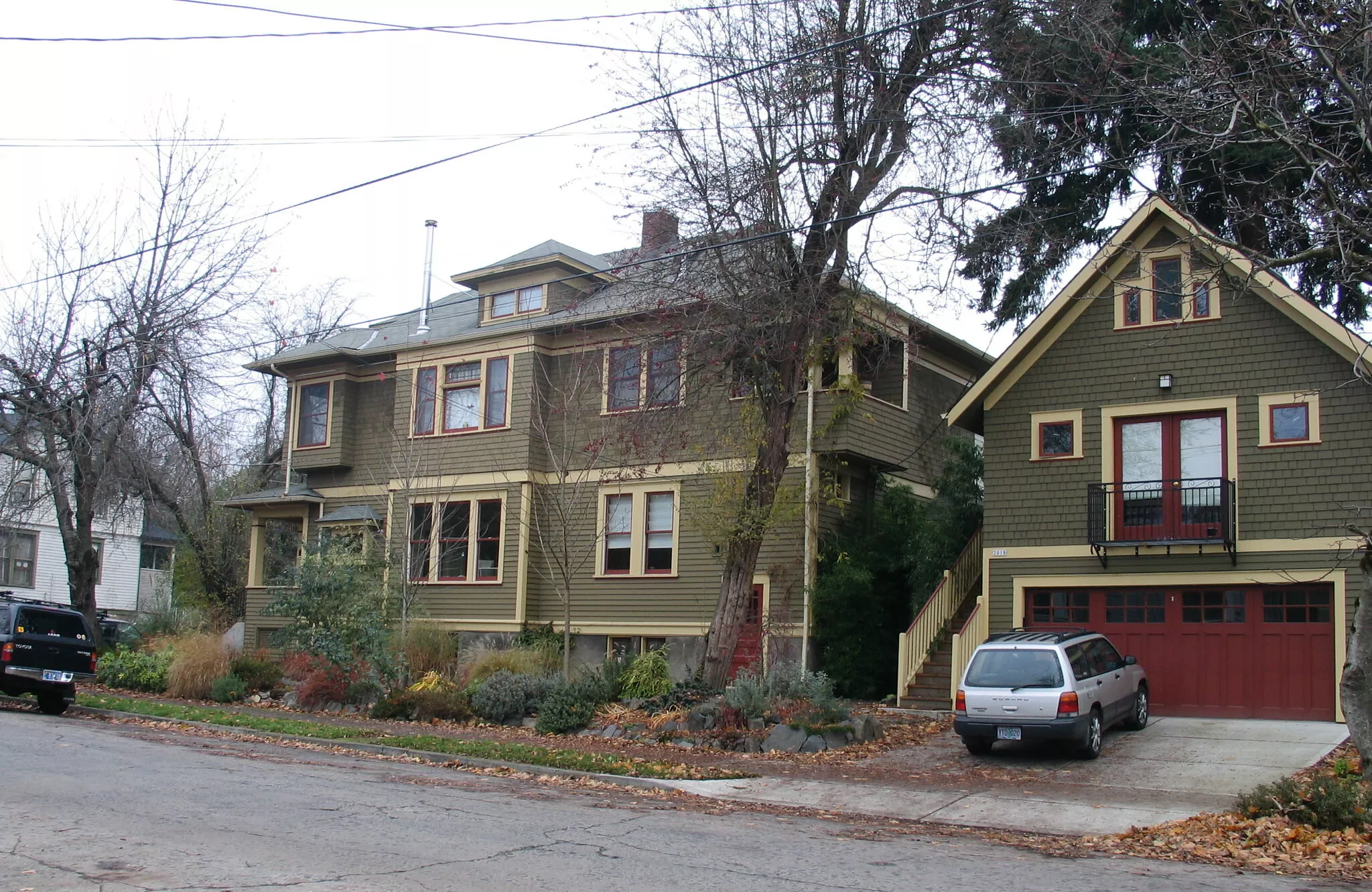 radcliffe dacanay via Flickr, CC BY 2.0 (https://creativecommons.org/licenses/by/2.0/deed.en)
But that's just for detached, independent ADUs. The code also allows for attached ADUs, which do not need independent utilities. Attached units can be annexes, in-law suites, or entire basements and attics.
This is a great, quick fix for short-term housing supply deficits that has been utilized in many states and metros throughout the U.S. And giving the green light to homeowners who were hesitant to rent out space in their home (perhaps because they could only do so under-the-table), or those who've been wanting to finish their basement but never have, now have a good incentive to do so.
But the zoning changes in Eau Claire go well beyond the renting market. Housing has experienced a total overhaul as well.
Smaller Lots, More Lots, More Houses, Lower Prices
The new code lists the lot regulations for each zone in convenient tables (pp. 8, 9, 11, 13, 15). I compared these to the tables of the old zoning code for each residential zone being replaced.
Text highlighted in green represents an improvement to the code, orange text signifies that the benefit of the change is context-dependent, and red text represents a regression.
The table shows the old residential zone and compares it to the new zone replacing it.

As you can see, every single lot regulation has been relaxed with the exception of side setbacks in two zones. And even then, there is only a possibility that the new side setbacks are worse. Lots that are most likely to be negatively affected are SF dwellings on corner lots, but these are comparatively few and the specific setbacks required by the old code are highly variable. So, in short, even the side setbacks have been improved in these two zones!
The lot regulations most worthy of note are the following:
Reducing the minimum lot size and width, and increasing the maximum coverage of lots has the effect of increasing dwelling density in the new GR zone by 166%, almost a tripling in dwelling density. But that's only assuming that SF homes are replaced exclusively by smaller SF homes. If some older SF homes are replaced by du- tri- or quad-plexes, dwelling density quadruples.
The two images below show the maximum building area and lot coverage of a SF home on the old R-1 zone compared to coverage on the new GR zone. The next image overlays the new over the old to better see the increase in density.


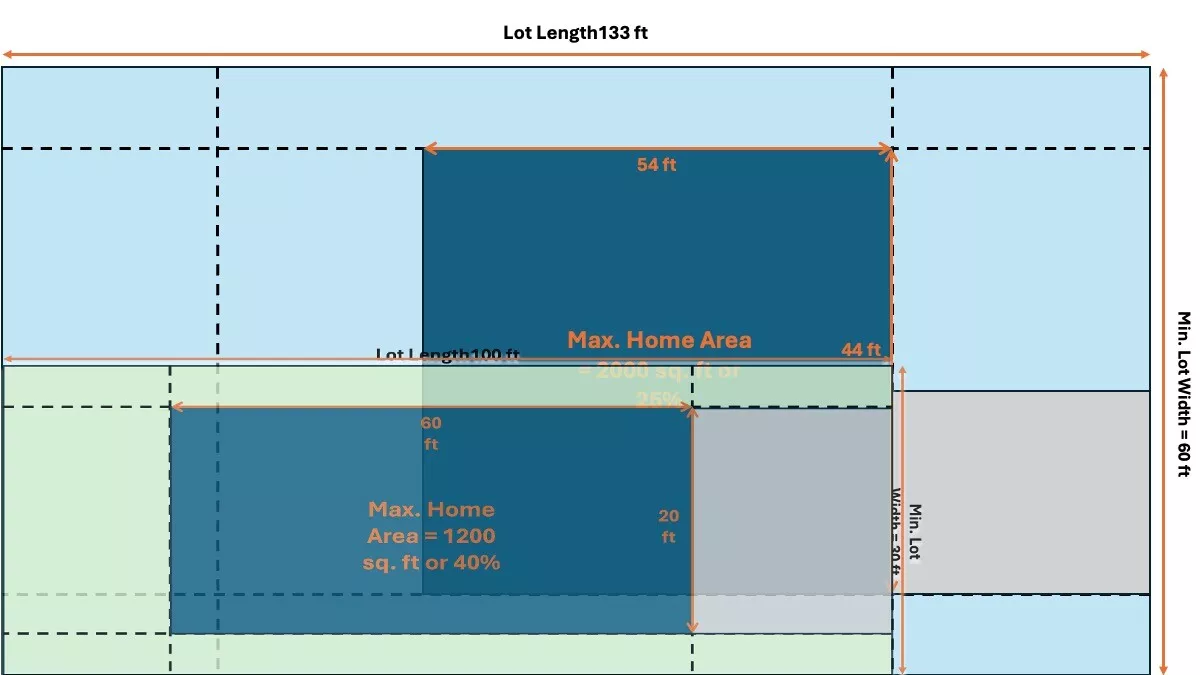
As the images above show, increases in dwelling density lead to smaller living areas but a greater proportion of land usage per dwelling. This is all implied by an increase in density. But while greater density increases the proportion of land usage, this actually preserves land in the future.
Changes in land policy like this, while widely unpopular among conservationists and environmentalists, actually benefit conservation efforts. Compared to the status quo where a city plans to clear 20 acres to construct 20 SF homes, the GR zone enables Eau Claire to build the same number of homes on just 37-25% of the land.
Add that to the fact that the city doesn't have to spend nearly as much on infrastructure (fewer feet of water, sewer and electric lines) and the city can actually generate a positive return on investment by taking advantage of economies of scale.
Follow The Lead
Eau Claire's decision to reform its zoning code is an incredibly positive development––not just for its residents, but others too.
The example of Eau Claire and the precedent it sets will very likely lead to similar reforms in other places. When exactly that will occur is anybody's guess, but sooner or later others will come to realize the benefits of a truly liberal society of the kind imagined by Smith, Jefferson, Mises and so many others.
For those curious about which trees are subject to a fee, the link provided here specifies that the removal of a high-value tree (trees with diameters of 12 inches or greater at breast height) requires that a new tree be planted and a $400 fee paid.
Notwithstanding the controversy surrounding the $400 fee, this zoning code is incredibly good, and the citizens of Eau Claire should not allow this provision to get in the way of the zoning reform.
Congratulations in advance to the people of Eau Claire. Well done.

Interested in the content of this Article?
Reach out to the MacIver Institute to aquire more information


