
- Podcasts
 Podcasts
 - Videos
 Videos
 - Policy Issues
 Policy Issues
 - About
 About
About


The Rule of Law, or Law by Rule?
There is a difference—a profound and increasingly dangerous difference—between the rule of law, which everyone claims to support, and what we are increasingly living under: the law of rule.
The rule of law is uncomplicated. It says that the people, through their elected representatives, make the laws. The legislature codifies the people’s will, agencies implement and carry out those laws, and the courts, when necessary, interpret them, bounded by statute, legislative intent, and the constitution. Governing authority rises up from the people, and the people can take it back.
It’s a pretty cool system of government, if I do say so myself.
The law of rule is something else entirely. In that system, the bureaucracy writes the rules, interprets them, and then enforces them with the effect and force of law. In this system, the people do not govern. They comply.
Those are two distinct systems of government, and here is the key insight about them—burn this into your mind because it explains nearly everything that has gone wrong in modern governance: Due process and democracy can never be served in a bureaucratic state. Bureaucratic collectivism, as this system is known, is the antithesis of a constitutional republic.
That’s ‘never’ as in never. Never meaningfully and never constitutionally. Because no matter how many hearings are held, or how many “public” comments are submitted, or how many “stakeholder meetings” are staged, the bureaucracy makes the final decision. There is no legislature with the ability to overturn it. A governor is either a facilitator or a temporary speed bump because there’s no firing the bureaucrats. One might sue, but that’s expensive, risky, and fraught with the court’s own potential ideological and institutional alignments.
At the end of the day, the decision does not belong to you. When bureaucrats have the final say, the people have no say at all. To steal part of a slogan from one of my least favorite newspapers, democracy dies in the administrative code.
There’s darkness in those pages, folks. And it is especially dark in our state, given that the Supreme Court has given the state bureaucracies carte blanche legislative powers.
Only when elected officials make the decisions do we get anything resembling real accountability, real due process, or real representative democracy. That’s because, unlike bureaucrats, lawmakers never have the final say—voters do in the next election.
If all that sounds abstract, it isn’t. You can see it clearly—right now—starting in Wisconsin.
When a 1,700 Percent Fee Increase is a “Process” Problem
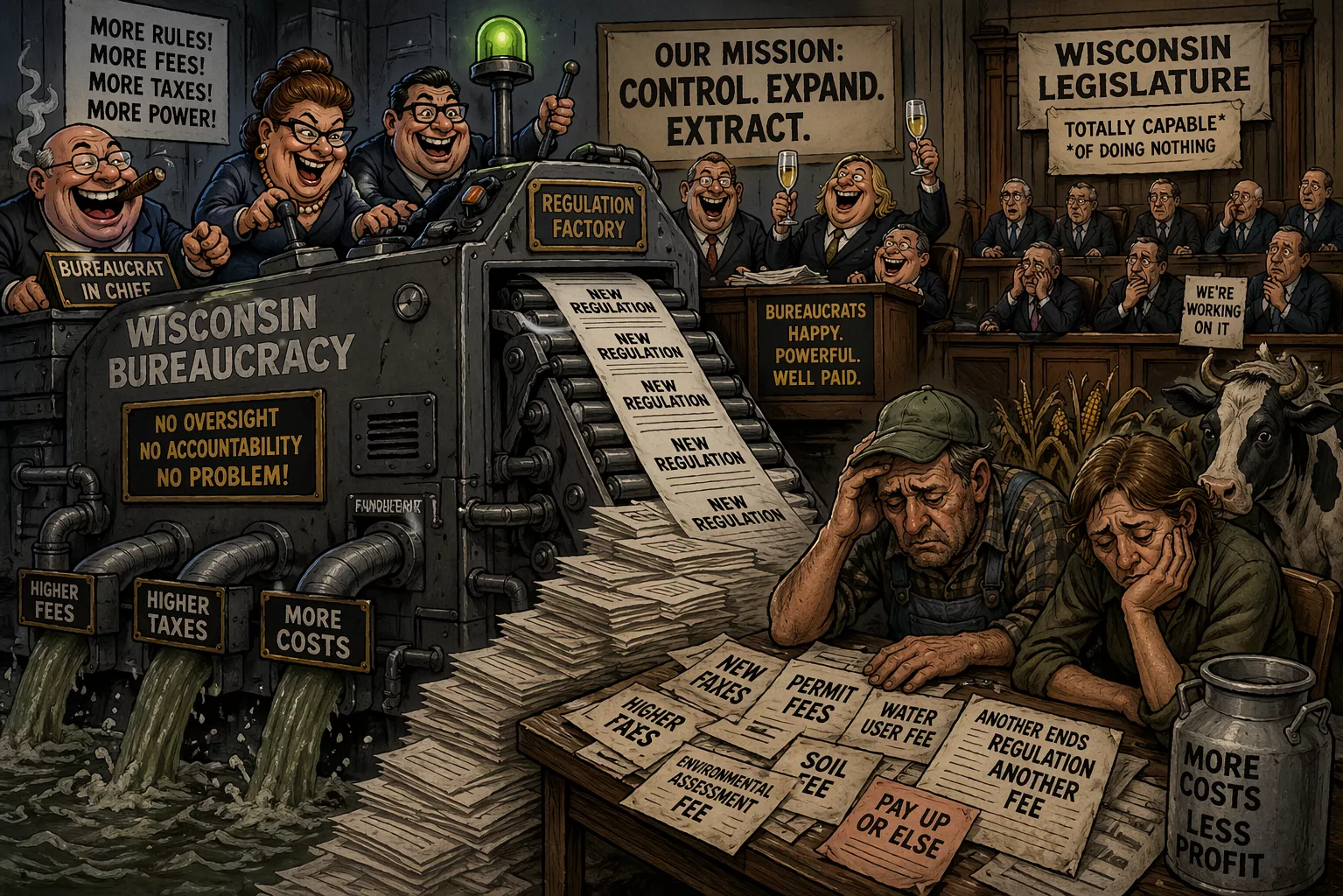
Earlier this month, Governor Tony Evers vetoed a bill that would have done something both simple and essential: take certain fee-setting authority away from bureaucrats and put it back into statute, where elected lawmakers and ultimately the people control it. It was necessary because the Department of Agriculture, Trade and Consumer Protection (DATCP) proposed fee increases so extreme that they bordered on economic sabotage.
We’re not talking about marginal adjustments. Under the original plan, animal dealer licenses would have risen from $220 to $670, a 205 percent increase; livestock trucker registration fees would have jumped from $60 to $370, a 517 percent increase; and—brace yourself, here comes the commissar’s cocktail—an animal market class A license would blossom from $420 to $7,430, nearly a 1,700 percent increase.
Yes. Seventeen hundred percent. And no one you voted for approved it.
Such an increase would shock a Fortune 500 boardroom, but in Wisconsin, it was just another day in the life of a bureaucracy given unaccountable power. As Sen. Romaine Quinn (R-Birchwood), the author of a bill to end such nonsense, put it: “Last year the liberal state Supreme Court handed down a ruling to remove legislative oversight from the Evers’ administration rulemaking power. It did not take long to see the consequences of this unchecked power.”
Unchecked power was exactly the point because the proposed fee increases came in September 2025, right after the July 2025 court ruling. Later, after public backlash, the agency “dialed back” its proposal to something closer to an inflationary adjustment. In effect, the Supreme Court had given DATCP bureaucrats a baton and told them to take it to the moon, and, the bureaucracy being the bureaucracy, they took it and flew straight to the sun.
That is what the law of rule looks like, both in theory and in practice. Sometimes, the agencies end up playing Icarus; more often, it’s we who are burned. In any event, none of us had nary a formal say in even the dialed-back numbers. That made Quinn’s bill more than necessary, but, naturally, Evers seized on the entire process as proof that the system works and killed the legislation.
“I am also vetoing this bill because I believe the current process relating to rule promulgation and setting, increasing, or creating fees works, including ensuring adequate public input and accountability for agency decisions regarding fees,” he wrote in the veto message.
Let’s translate that for a second. In said process, you could comment, you could testify, you could plead until the livestock came home, but, in the end, because the Supreme Court benched the legislature’s direct oversight of rules and any ability to stop or modify whatever the bureaucrats decided, you lose. Because the same agency that proposed the rule is the one that finalizes it.
And so in doing the “people’s work,” they could ignore people like Curt Larson of Equity Cooperative Livestock Sales, who, as I reported at the time, told Brownfield Ag, “the only way any of us can recoup that cost is we have to go back to the producer and charge, you know, increase our fees to the producer in order to cover this, and we just don’t believe that this is all a producer item that the producers should be shouldering the full cost on this.”
DATCP dialed back the fees, but they did not have to and likely did so for two reasons and two reasons only. The first is that they realized later that the new fee structure would bankrupt too many businesses. The second is that it became apparent that major farm associations would sue over the arbitrary and capricious nature of the increases, and, given how extreme they were, might prevail after a long, protracted battle.
Rules for Radicals
That is not accountability or democratic process. That is Alinsky theater posing as civil service, governance reduced to authoritarian daredevils in cubicles, gambling with the future of farmers and producers. Even supporters of the regulatory structure acknowledged the disconnect. But here is the problem: it took a proposed 1,700 percent increase proposal to get to that point of recognition. Nothing in the system prevented that initial abuse of power.
Quinn’s bill was an attempt to restore something radical and rare: democratic control. His bill would have frozen current fee levels, required legislative approval for future increases, and moved decision-making out of agency rulemaking and into statute. It would have ensured that if fees were going to rise, elected officials would have to vote on it, and defend that vote to the people.
In other words, his was an attempt to restore the rule of law over the law of rule and bureaucratic hegemony, and in proposing the legislation, Quinn made the stakes explicit, both economically and democratically.
“Unfortunately, under the new unilateral power given to state agencies, the legislature can no longer object to such rules, so the bureaucratic deep state is free to make these changes all on its own—with the blessing of Governor Evers,” he said. “In the midst of this debate, we watched the Equity Livestock barn in Barron, a Class A dealer, close its doors.”
Something else struck Quinn in the governor’s veto that deserves attention, namely, the governor’s proclamation that bureaucrats, not elected officials, are the vessels of the people’s will and the rightful claimants of legislative authority. He was right to call Evers out, for it was a brazen and clear call for usurpation of power by the unelected:
“I am vetoing this bill in its entirety because I object to the Legislature’s ongoing efforts to encroach on the administrative rulemaking authority of the executive branch. Even before I took office in January 2019, Legislative Republicans spent significant time, energy, and effort attempting to curtail and impede the authority of executive branch state agencies to promulgate administrative rules. Though the Wisconsin Supreme Court recently issued decisions that helped restore the separation of powers in Wisconsin and rebalance rulemaking authority, the Legislature’s efforts apparently persist. The Legislature is asking me, in effect, to undo this section, enabling the Legislature to go right back to indefinitely obstructing the People’s Work and returning state government to inaction, delays, and gridlock.”
Quinn denounced the governor’s notion of the people’s work:
“In his veto message he had the audacity to say that freezing the fee increases amounted to ‘enabling the Legislature to go right back to indefinitely obstructing the People’s Work.’ I find it offensive that the governor would consider it the ‘people’s work’ to target those who work hard to survive in our ag industry.”
Evers was indeed saying that it was “the people’s work” to put a target on their own backs, but then that’s what happens when the “people’s work” is handed to collectivists who aren’t actually accountable to the people.
Give Evers credit for one thing, though. In his veto message, he was blunt about his mission to bestow almost complete power on the administrative state. He said the quiet part out loud, that, in his view, unelected bureaucrats are the superior beings in government, and their “rulemaking” authority is paramount.
Unfortunately, while bureaucrats stay cocooned in Madison, many of them apparently still afraid to even go to their offices, their decisions do not stay in Madison. They drive on over to the farmer, the trucker, and the consumer, and roll right over them. The people who sent the steamrollers on their way never have to face those being steamrolled.
And if Wisconsin shows how this system can hit your wallet and decimate businesses, well, buckle up because Washington shows how it can take something even more fundamental.
When the Government Silences You for Life
The Wisconsin example shows how bureaucracies wield economic power, but the federal case shows something even more chilling: They can control your speech.
Forever.
Illuminating this issue is a case involving the U.S. Securities and Exchange Commission’s (SEC) so-called “Gag Rule,” now potentially before the Supreme Court in Powell v. SEC. In a nutshell, the rule forbids anyone who settles with the SEC from ever—ever—publicly criticizing the case against them.
Specifically, in 1972, the SEC adopted a rule that requires people who settle a regulatory enforcement case with the agency to remain silent about it. If they make a public statement about it at any time in the future, the SEC may reopen it. Now, several citizens censored by the gag rule want to tell their stories, and two media outlets want to report those stories. The Ninth Circuit Court of Appeals ruled against them, and the New Civil Liberties Alliance (NCLA) has brought a lawsuit on their behalf, asking the Supreme Court to take up the case.
A central argument is that the rule is designed to prevent the SEC from looking bad and that it unfairly silences Americans, violating their First Amendment rights.
“In place for more than 50 years, the Gag Rule forbids every American who settles a regulatory enforcement case with the SEC from even truthfully criticizing their cases in public for the rest of their lives,” the NCLA asserts.
So the government can act like a thug—which it often does—and harass a person for years, maybe even bankrupt them, and finally settle, but only if their targets sign a “contract” giving up their right to tell the world what the government actually did.
Defenders of the rule say, well, people “consent” to it, but it’s not consent in any meaningful sense—it is an agreement extracted under pressure, where refusal comes with consequences most people can’t afford. Here’s how Peggy Little, senior litigation counsel of NCLA, which brought the suit, puts it:
“What kind of government says, ‘We can bring ruinous charges against our citizens, imposing millions in defense costs and consuming years of their productive life, but, if you want us off your back, the price of peace means you can never contest any allegation we made—even though we proved nothing against you’? No government has a monopoly on the truth. And in America, the First Amendment forbids it.”
As NCLA attorneys point out, when the SEC brings charges, the cost of fighting them can indeed be ruinous, so 98 percent of defendants settle, and in doing so, they are forced into silence.
That is explicitly coercive. And just like in Wisconsin, elected lawmakers did not create the rule. The agency itself created it—and imposed it with the force of law.
As it turns out, there are all sorts of constitutional problems with the rule. For one, as the Liberty Justice Center (LJC) argues in an amicus brief, it imposes a prior restraint on speech.
“It is an indefinite gag order that forbids individuals who have settled their cases with the SEC from communicating about their cases for the rest of their lives,” the brief states.
“They cannot talk about their experiences with their family, their friends, the press, or their elected representatives. They cannot discuss their situations, even when advocating for change—like in this case—and even when under oath, when the SEC is a party. Their perspectives and experiences must be kept hidden from everyone forever. Prior restraints on speech ‘are the most serious and least tolerable infringement on First Amendment rights.’”
What’s more, LJC argues, the gag rule infringes on the right to petition the government for redress of grievances.
“By preventing individuals from discussing their SEC cases, even with their elected representatives, the Gag Rule infringes on their right to petition,” the brief states. “This Court has recognized the right to petition is ‘integral to the democratic process’ because it ‘allows citizens to express their ideas, hopes, and concerns to their government and their elected representatives.’”
Indeed, LJC argues, the interest of the American people—and therefore the interest of the government, as the representative of those people empowered with the public trust—is precisely the opposite of what the SEC claims.
“The use of law enforcement authority should always be subject to question, to skepticism, and indeed to criticism, to ensure those stewards carry out the role we have assigned them in a sober and responsible manner that in fact furthers the public interest,” the brief states. “The SEC has a public duty to be embarrassed where appropriate—its recourse under the First Amendment is to not bring embarrassing cases or to explain for themselves why their cases are justified.”
It’s policy, but you can’t talk about it
In the end, as important as the free speech claims are in this lawsuit, so is the other issue lurking in the background, but which could rise up to gobble the entire docket: The SEC uses a regulatory rather than a statutory mechanism to erect a massive shield of its enforcement operations, investigations, conduct, and outcomes. What’s more, as Matthew Turk has written, it engages in brazen “regulation-by-settlement” tactics in which it uses settlement agreements to establish new industry-wide standards and policies rather than following the public rulemaking processes—settlements that are then sealed forever:
“Regulation by settlement has two defining features,” Turk wrote in Kansas Law Review.
“First, although regulatory settlements are nominally packaged in the form of particularized adversarial disputes, agencies now leverage those agreements in a manner that effectively establishes new legal standards of general applicability. They are a tool for setting policy. Second, the procedural posture of those settlements allows agencies to engage in a uniquely freewheeling mode of regulation, which sidesteps nearly all of the legal constraints that are familiar to the standard administrative model.”
Here’s how the U.S. Chamber of Commerce described it in its brief in Powell in the Ninth Circuit deliberations:
“Compounding this problem are the perils of the SEC’s pursuit of a regulation-by-settlement approach. Even when the Commission’s ‘legal theory is new and untested,’ ‘the pressure to settle is over-powering.’ Settlement thus affords regulators ‘extraordinary discretion’ to press ‘novel legal theories’ that ‘no judge will ever scrutinize’—since those regulators can simply ‘threaten the industries with the risk of such large penalties that they’ll agree to a deal[.]’ The SEC has made no bones about this; a former chair declared, ‘we must be aggressive and creative in the way we use [our] enforcement tools[.]’”
In other words, it is exercising brute rulemaking power that has overridden and even divorced any statutory relevance. In doing so, it has erected a scheme every bit as unjust and injurious as the DATCP fee schedule and in fact built a regulatory moat around a regulatory abuse of power.
It constructed its scheme by manipulating administrative procedural law, all under the radar, as a brief by the Manhattan Institute and Hamilton Lincoln law pointed out.
“Because the SEC has no power to seek an injunction restricting the discussion of enforcement actions, it has smuggled them in through the back door of its settlement authority,” the brief stated. “[T]he SEC’s enforcement authority acts as an in terrorem tool to impose speech-suppressing terms that it ‘could not lawfully obtain any other way.’”
Even whistleblowing former SEC attorneys have chimed in.
“Amici have spent their careers at the Commission,” they wrote in a brief. “They know from experience what the Gag Rule does: it does not protect markets. It protects the SEC—from scrutiny, from accountability, and from the voices of the thousands of defendants who settled not because they were guilty, but because they could not afford the price of the truth. That is not a disclosure regime. It is the antithesis of one.”
It is a system in which the final arbiter is the bureaucracy, just as in Wisconsin today. The Cato Institute perhaps labeled it best, calling the SEC an “escalating ecosystem of coercion.” The same could be said of bureaucracies that attempt to impose bankrupting fees.
Why the Bureaucracy’s Best Case Fails
What’s happening in Washington is not some distant constitutional abstraction. It is the same disease we are seeing in Wisconsin—just a different tentacle of the bureaucratic collective.
In Wisconsin, DATCP can propose a 1,700 percent fee increase because it holds the power to make rules with the force of law, insulated from meaningful legislative control. In Washington, the SEC can silence citizens for life because it has claimed the power to make regulations and impose speech restrictions through back-door settlements—again, insulated from Congress.
Different claims to power but the same anti-democratic structure. In both instances, the bureaucracy does not carry out the law but makes it. And in both cases, the people are cut out of the only part that matters, the final decision.
That is why the free speech issue in Powell v. SEC matters so much but is not the only issue. The deeper problem is that the SEC created this regime not through statute but through its own regulatory machinery and then enforced it through coercive settlements that create industry-wide policies that no legislature ever voted on.
The governing principle is identical in both Washington and Wisconsin: rule by regulation, not by representation. In Wisconsin, lawmakers tried to take that power back and got a veto for their troubles. In Washington, citizens are asking the Supreme Court to restore an important part of “the people’s” power: free speech.
The stakes are not complicated. These cases are not just not about livestock fees and not just about free speech. They are about who governs.

Interested in the content of this Article?
Reach out to the MacIver Institute to aquire more information


