
- Podcasts
 Podcasts
 - Videos
 Videos
 - Policy Issues
 Policy Issues
 - About
 About
About


Breaking bad
I hate to be the one to break the bad news, but it’s time we had a talk.
As if conservatives in Wisconsin don’t already have enough to contend with—vetoes that read like Marxist manifestos, Supreme Court elections that have become predictable progressive tsunamis—we now face something even more nightmarish.
And no, I am not talking about the possibility of a Gov. Francesca Hong. It’s even worse than that hell would be, an ongoing and unsustainable problem that Democrats want to make worse and that Republicans don’t like to talk about.
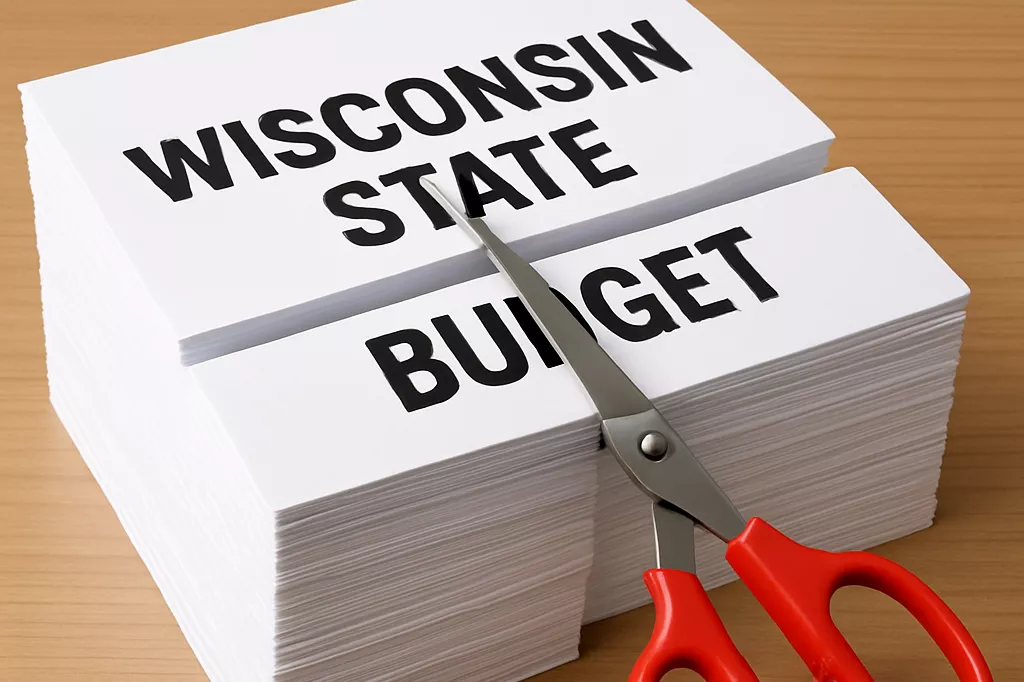
It’s the state’s addiction to spending we need to discuss.
Meaning, state and local governments spend too much—way too much—and the spending keeps rising year after year, budget cycle after budget cycle. Democrats, who keep winning statewide elections, keep calling for ever more spending. Republicans, who keep losing statewide elections, keep vowing to cut spending but never do, even when they win.
You can see the problem. As MacIver’s William Osmulski reported last August, all sorts of spending records were broken in the current budget alone. The previous state budget spent $99.3 billion, Osmulski reported, while, in the 2025-27 budget, the legislature flushed the toilet with $113.7 billion:
“Over the past twenty years, each state budget has grown 3 percent to 11 percent more than the previous one. … [t]hey [the legislature] went well above and beyond that by increasing total spending by 15 percent. That’s the largest increase in at least the past 20 years.”
Oh, but they did cut taxes, reinforcing the adage that Democrats are the party of tax-and-spend, while Republicans are the party of cut-taxes-and-spend.
Why do Republicans do this? one might ask.
Well, I get it. If you’re a Republican officeholder, it’s a lot more popular to cut taxes or tax rates than it is to cut spending. Actually, cutting spending is downright unpopular. Or, to say it another way, cutting spending generally sounds good until some GOP wunderkind up and tries to cut the program you use or like. That is why Republicans promise in elections to cut spending overall (voters: good) but avoid cutting anything specific in the budget (voters: bad).
So why is it, then, that Republicans keep losing elections, even when they cut taxes and avoid killing sacred cows at budget time?
Well, there are multiple factors, including, but not limited to, some lousy candidates, lower turnout among working-class voters (a problem that used to plague Democrats before they threw the working class out of their elitist party), special-interest grift, a fair amount of country-club incompetence, and Democratic shenanigans, to name a few, but here’s one that most people don’t factor in: Taxes may have been cut, but the true tax—the cost of government—has not.
Wait, you say, that’s insane. You point to any number of analyses showing that, since 2011, Wisconsin lawmakers have enacted well more than $10 billion in tax cuts, with some estimates placing the total above $20 billion when cumulative reductions are included.
That’s all true, but here’s the problem. Over that same period, General Purpose Revenue (GPR) spending—the portion of the budget funded by those very taxes—has grown from about $29 per biennium to $45.7 billion in the 2025-27 budget, an increase of more than $16 billion per biennium, or more than 57 percent. That’s not chump change, it is a much larger government footprint, financed differently.
Call it a tax increase in waiting because that is what it is, after adjusting for inflation. Because when government increases spending by $16 billion, or whatever the real spending increase is, it is effectively imposing that claim on taxpayers—whether that bill arrives today, tomorrow, or in a tin can that they kick to another day far away. The spending is the bill. The tax cut doesn’t cancel it—it just tells the government to collect it later. The only question is when, and who gets stuck paying it.
As Milton Friedman observed, and as I have cited in these columns ad nauseam, the true tax is not what government collects, but what it spends—and by that measure, the burden has not fallen. It has grown:
“Keep your eye on one thing and one thing only: how much government is spending, because that’s the true tax … If you’re not paying for it in the form of explicit taxes, you’re paying for it indirectly in the form of inflation or in the form of borrowing. The thing you should keep your eye on is what government spends, and the real problem is to hold down government spending as a fraction of our income, and if you do that, you can stop worrying about the debt.”
Since our elected representatives have not chosen that path, they have to keep worrying, and likely they will also keep on losing: They keep telling us they’ve cut our taxes by billions, but we don’t feel like a billion bucks as we struggle to pay the bills and keep our small businesses open.
The surging spending adds to pressures average families already feel. It contributes to a higher tax burden and adds to the overall cost of doing business. The result is a steadily tighter pinch on pocketbooks, felt at the grocery store, on property tax bills, and in rising insurance premiums. Voters may not be able to isolate the precise mechanism, but they know something isn’t right. People know how light their wallets are, and who the thief is, even if they don’t know the specific instrument the government uses to take their prosperity away.
Somehow, this reality rarely makes it into the stump speech, let alone the budget. They somehow forget to tell you that all this government spending is coming right out of your pocket, sooner or later. Campaigns are filled with promises to reduce spending overall, while budgets are filled with decisions to reduce nothing in particular. Republican voices fall silent.
Not so Democrats, who grab the bullhorn. Their message is clear, consistent, and unapologetic. Elect us, and we will spend more by giving you things. Your taxes might be higher, but we’ll give you more and better health care—meaning abortions—we’ll give you more and better schools—meaning government propaganda—we’ll give you your public sector unions back and repeal right to work.
Sure, Democrats will destroy the private sector and take away our civil liberties, but they’ll make sure we get benefits without having to look for a job or prove we can’t work. They’ll take care of us cradle to grave.
Or so they say.
Structural hocus pocus
There’s another point to toss out there, given that a new budget season—and a new opportunity to cut spending—will soon be upon us. With all that talk of a budget surplus, many of us may have forgotten that the state is actually running a structural deficit.
Now, to be fair, Wisconsin is not in immediate fiscal crisis. On paper, the state looks strong. There’s a projected multi-billion-dollar surplus that has only grown, and the budget is technically balanced.
But beneath that surface lies that structural deficit. Strip away the accumulated one-time surplus, and the math changes quickly. In the current projections, based on a January 15 report on the status of the state’s general fund by the Legislative Fiscal Bureau (LFB), Wisconsin is expected to bring in about $23.83 billion in revenue in the second year of the biennium. It’s expected to spend about $24.34 billion.
That leaves a gap of about $500 million (and it could go higher), with ongoing spending exceeding ongoing revenue. And that is the standard definition of a structural deficit: Recurring revenues are insufficient to cover recurring expenses. Or, to put it another way, the state is projected to spend about half a billion dollars more than it brings in once one-time balances are excluded.
Over the biennium, the state’s balance sheet also declines significantly. What began as a $4.6 billion surplus is projected to fall to around $2.5 billion by the end of 2026-27, nearly a 46-percent reduction as reserves are used to support ongoing spending, according to the memo.
Right now, because the state has a significant surplus, Wisconsin is balancing its budget in part by spending down savings. That is perfectly legal, but it still means that, once the surplus is gone, the primary options to pay for it is to cut spending—which lawmakers are loath to do—or raise taxes and debt.
Captains of the Titanic
So now what? our budget navigators might want to ask.
And just as important, how do we get out of the corner we’ve been backed into? Just how do Republicans overcome the conundrum that conservative and independent voters will shun them if they don’t promise to cut spending, but execute them if they carry through?
Ah, well, here’s a couple of ideas for the incoming governor and legislature to ponder, in no particular order. I’m not wedded to any of them necessarily, but clearly we had better start actually cutting government spending and getting voters to buy into it, or we’re in for a long stretch in political Siberia.
First, force state government into a constitutionally defined spending limit that not only balances the budget but keeps it from growing. Budgets can be balanced using all sorts of accounting wizardry—debt most of all, optimistic budget assumptions, one-time dollars, federal dollars, and so on—but that doesn’t mean government can’t still spiral out of control, as Wisconsin’s recent history attests.
And so, much like Americans for Tax Reform’s (ATR) Grover Norquist and budget hawks call for no-tax-hike pledges, conservatives could begin pressing candidates to sign no-spending-increase pledges, and to voice support for a constitutional amendment to cap state spending in much the same way the state uses levy limits to limit what local governments can tax. What’s good for the goose is good for the gander.
Vance Ginn, of Ginn Economic Consulting, has worked with ATR to develop what ATR calls the Sustainable Budget Project. The approach is simply this: Enact an appropriations limit with a maximum amount based on the rate of population growth plus inflation and a supermajority (two-thirds) vote to exceed it.
“While there are many measures to use for a spending growth limit, the rate of population growth plus inflation provides the best reasonable measure of the average taxpayer’s ability to pay for government spending without excessively crowding out their productive activities,” Ginn wrote last November.
“It is essential to look at this from the taxpayer’s perspective rather than the appropriator’s view, given that taxpayers fund every dollar that appropriators redistribute from the private sector. Population growth, combined with inflation, is also a stable metric that reduces uncertainty for taxpayers (and appropriators), essentially freezing inflation-adjusted per capita government spending over time.”
Ginn says research shows that the best fiscal rule is a spending limit based on the rate of population growth plus inflation, rather than gross state product, personal income, or other growth rates: “Population growth, combined with inflation, typically grows more slowly than these different rates, allowing more money to remain in the productive private sector, where it belongs,” he wrote.
Ginn further explains it this way:
“To get technical for a moment, personal income growth and gross state product growth are essentially equivalent to population growth plus inflation plus productivity growth. There’s no reasonable consideration that the government is more productive over time, so that term would be zero, leaving population growth plus inflation.”
Even if productivity growth in the private sector is considered, Ginn added, more money should be allocated to the more productive sector at the margin for the highest rate of return, leaving just population growth and inflation: “Population growth plus inflation becomes the best measure, no matter how you look at it.”
Ginn points to Colorado’s Taxpayer Bill of Rights, passed in 1992, as an early example of the concept, though Democrats have steadily whittled away at what it applies to.
In the real world, the rule would look like this, Ginn observed: From 2015 to 2024, aggregate state spending nationwide increased by more than 54 percent, twice what would have been allowed under the population growth plus inflation principle:
“Had their spending grown by the maximum rate of 27.6 percent in population growth plus inflation from 2015 to 2024, state governments would’ve spent $328 billion less than the $1.90 trillion in 2024. Cumulative spending across that decade would have been $1.3 trillion less than what was spent, resulting in more money in people’s pockets.”
Wisconsin is no exception. Between 2014 and 2023, Wisconsin’s spending growth significantly outpaced its population growth plus inflation, according to data from Americans for Tax Reform and the Bureau of Economic Analysis, as published by the Club for Growth Foundation. The 2023 budget alone was $4.3 billion above the marker.
For the decade, that figure was $18.3 billion.
In other words, had spending been $18.3 billion less than what it was, all those tax cuts Republicans were touting would have been real.
Backseat driver
From here, the state spending story goes even deeper. That’s because, in Wisconsin, county government—counties, municipalities, school districts—are not independent actors in the way people often imagine.
Counties may be the most obvious administrative arms of the state, but Wisconsin’s entire system of local government—from school districts to municipalities—operates within the authority and under the tight structure granted by state law. When their budgets grow, government grows. Calling it ‘local control’ doesn’t change who ultimately designed—and who ultimately pays for—the system.
County and local government spending is growing, from around $14.5 billion in 2020 to $17.8 billion in 2024––a per capita increase of more than 20 percent. To be sure, inflation and Covid drove some of that, but that’s still way above the sustainable budget marker, and now they are clamoring for even more. As I wrote two weeks ago, the Wisconsin Counties Association is one of the leaders of the scam. In addition to a higher local-option sales tax, in addition to raising taxes by raising the levy limit to 3 percent minimum, they are advocating for allowing counties to engage in short-term borrowing for operational expenses—reckless fiscal policy if ever there was one—and they are also pushing to exempt economic development and public safety expenditures from those relaxed levy limits.
In many counties, public safety expenditures account for a quarter of the budget.
The state needs to tighten its grip on county budgets, not loosen its control, and to repeal the statutory authority that allows groups such as the WCA, the Wisconsin Towns Association, and the League of Wisconsin Municipalities to exist.
Finally, there is the easiest and most effective way to reduce state spending, not to mention the most politically palatable approach: roll back the administrative state, especially by repealing as many of the state’s 165,000 regulations as possible.
It’s politically attractive because candidates can campaign on reducing regulatory overreach instead of cutting government spending. But that is what curbing overreach does. Regulation is spending by another name. Every rule on the books imposes compliance costs, usually financial, on small businesses and consumers, but it also imposes a cost on taxpayers. Every mandate requires enforcement, and that means personnel.
Bottom line is, the more rules and government you have, the more state spending you have. So reducing the regulatory burden doesn’t just free up businesses and consumers. It shrinks the size of government itself.
That’s why, as I wrote last week, proposals to give the legislature greater authority to suspend or block administrative rules matter, and a now-vetoed bill to force state agencies to have not only explicit but specific authorization to promulgate a rule is essential. That latter bill would have taken away the administrative state’s ability to create regulations out of thin air without legislative direction.
Evers’s veto message
for of this legislation was part fiction, part delusion:
“Ironically, for a Legislature fraught over purported concerns of inefficiency, regulations, and any ‘growth’ of government, the legislature asks me to sign a bill that will do just that. Instead of working to improve processes, providing the necessary staff and funding for agencies to appropriately implement laws, or working in earnest to pass bipartisan bills containing the necessary clarity for implementation, the legislature seeks to simply make the rulemaking process as arduous and unworkable as possible.”
First, the governor says stopping agencies from writing rules from scratch would somehow grow government, then he says the bill prevents him from hiring the necessary staff to appropriately implement laws. The bill did neither. It had nothing to do with appropriately implementing laws that the legislature directed the agencies to implement. It was a directive to agencies to stand down from rogue lawmaking that would have helped reverse the growth of government.
These efforts, along with a pending constitutional amendment to restore the legislature’s ability to suspend rules that it finds do not meet legislative intent, must be taken up next session, as well as sunset review of rules, meaning they would expire after seven years unless reviewed and reapproved by the legislature.
Those are the real keys that could gut the administrative state and shrink government, for overregulation and overspending go hand in hand.
Finally, when a new, hopefully conservative governor takes over next year, let’s hope he and the legislature have a far-reaching appetite for reform, both of civil service laws that underpin a bloated state payroll and of mechanisms to review every agency, DOGE-style, as Gov. Ron DeSantis is doing in Florida.
In 2025, Florida launched a Department of Government Efficiency initiative aimed at rooting out waste, auditing local spending, and even sunsetting entire boards and commissions. The goal was to reduce the size and scope of government not just at the state level, but across the entire system. That kind of approach requires political will that our next governor must have. Those measures—some type of statutory or constitutional cap on spending, preferably tied to population growth plus inflation; tight controls on local government spending; and a rollback of regulations and unnecessary agencies, boards, and commissions—are the keys.
The bottom line, Wisconsin doesn’t have a tax problem so much as it has a huge spending problem. Or rather, Wisconsin’s tax problem IS its huge spending problem. Until that problem is addressed, nothing else changes, not the overall tax burden or our economic health. If spending keeps rising, the burden on prosperity will, too, and voters, whether they can articulate it or not, know it.
It’s way past time to act.

Interested in the content of this Article?
Reach out to the MacIver Institute to aquire more information


