
- Podcasts
 Podcasts
 - Videos
 Videos
 - Policy Issues
 Policy Issues
 - About
 About
About


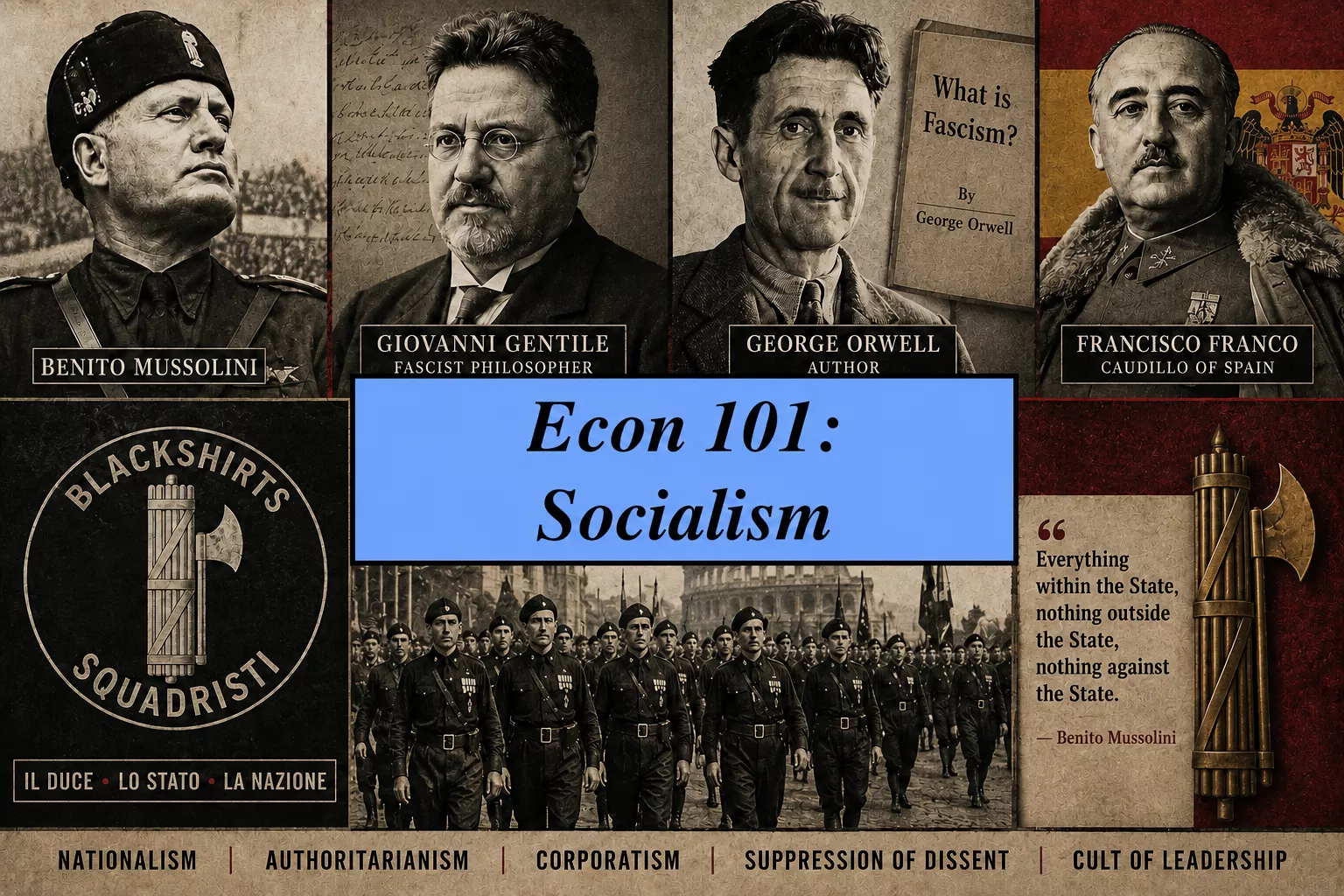
Like other terms that have changed their meaning, such as conservatism and liberalism, fascism has been applied so arbitrarily that it may be difficult to deduce what it means without knowing the mindset of the speaker. Fascism now stands for a host of iniquities that progressives, multiculturalists, and libertarians all oppose, even if they offer no single, coherent account of what they’re condemning. Some intellectuals and publicists may be demonstratively antifascist but feel no obligation to provide a historically and conceptually delimited definition of their object of hate.
––Gottfried, Paul. Fascism: The Career of a Concept
Nobody Knows What Fascism Is
Like Nazism, Fascism refers to the socialist policies of a political party––in this case, the Italian Fascist party founded and led by Mussolini (Partito Nazionale Fascista). At the same time, there is also fascism, which refers to a particular kind of national socialism instituted by the Italian Fascists, but many others too. Since the Nazis were, officially, National Socialists who believed in national socialism, and since the Fascists were, officially, national socialists of the fascist variety, the terms 'Nazi' and 'Fascist' are often used (incorrectly) as synonyms.
The way in which the term 'fascist' is used today would lead one to believe that a fascist is anyone opposed to the cultural Left. Those who favor restrictions on immigration and naturalization, support the conservation of Christianity and its role in society as the dominate ethic, and who are generally supportive of Capitalism, to name a few examples, are all equally subject to the charge of engaging in "fascist" behavior.
But views such as these have almost nothing to do with fascism, Italian or otherwise. Fascism was first and foremost a political-economic doctrine, and has only been framed as a race-based ethno-nationalist regime because of the Italians' alliance with the Nazi government. But until Hitler forced their hand, the Fascists were utterly uninterested in "race purity," "semitic influence," and every other ethno-precept of the Nazi program. Not least because Italy's Fascist leader, Mussolini, had been romantically involved with one Margherita Sarfatti, his Jewish mistress of 27 years and a vigorous Fascist herself (Nicholas Farrell, Mussolini: A New Life, pp. 75, 227, 229 & 302); but also because "More than 10,000 Jews, about one-third of adult Italian Jews were members of the PNF in 1938" (Farell, p. 302).
The world's foremost scholar of fascism, A. James Gregor, explains in his book Mussolini's Intellectuals that:
"None of the major Fascist intellectuals were racists of the sort one found in National Socialist environs..." (p. 207)
He continues:
In fact, since many, if not most, of the principal ideologues of Fascism were Actualists, they had principled objections to attributing human behavior to material––that is, biological––causes. They simply could not accept the proposition that an entire population, characterized by ill-defined 'racial' traits, could be held, as a body, guilty of anything....
The form of anti-Semitism adopted by Fascist Italy, as a consequence, was singularly different from that of National Socialist Germany. However indecent, it shared few of the genocidal traits that have horrified the civilized world. Italian Jews suffered innumerable indignities and material losses, but there is scant, if any, evidence that between 1938 and 1943, any Jews died at the hands of Fascists simply for having been Jewish.
The belief to the contrary among intellectuals stems in large part from the work of the German historian Ernst Nolte who had previously described Nazism as "radical fascism," which had the effect of drawing a great deal of separation between Nazism and fascism. But later, Nolte "denied the 'uniqueness' of Nazi tyranny...making a linkage between fascism and Nazism" (Gottfried, p. 1) that persists today.
This new understanding was paraded about by Marxists and communists hoping to dissuade socialists from nationalist forms of socialism and to instead adopt international "revolutionary" socialism. As a consequence, the Marxists' propaganda efforts to divorce fascism from the socialist enterprise have been largely successful.
The Soviet Union, for example, published in its Short Philosophical Dictionary (1967) that Fascism:
"is an overt terroristic dictatorship of the most reactionary, most chauvinistic and most imperialistic elements of finance capital... In Germany Fascism was masked under the name of National-Socialism."
The effect of these efforts were even visible outside the Soviet bloc. The socialist and legendary author of 1984, George Orwell, wrote in his 1944 essay What is Fascism? the following regarding how the term 'fascism' was already being misused and abused in his day:
In this country if you ask the average thinking person to define Fascism, he usually answers by pointing to the German and Italian régimes. But this is very unsatisfactory, because even the major Fascist states differ from one another a good deal in structure and ideology.
...Or again, antisemitism is supposed to be one of the distinguishing marks of Fascism; but some Fascist movements are not antisemitic.
...It will be seen that, as used, the word ‘Fascism’ is almost entirely meaningless. In conversation, of course, it is used even more wildly than in print. I have heard it applied to farmers, shopkeepers, Social Credit, corporal punishment, fox-hunting, bull-fighting, the 1922 Committee, the 1941 Committee, Kipling, Gandhi, Chiang Kai-Shek, homosexuality, Priestley's broadcasts, Youth Hostels, astrology, women, dogs and I do not know what else.
...But Fascism is also a political and economic system. Why, then, cannot we have a clear and generally accepted definition of it? Alas! we shall not get one — not yet, anyway. To say why would take too long, but basically it is because it is impossible to define Fascism satisfactorily without making admissions which neither the Fascists themselves, nor the Conservatives, nor Socialists of any colour, are willing to make. All one can do for the moment is to use the word with a certain amount of circumspection and not, as is usually done, degrade it to the level of a swearword.
In the main, fascism's conflation with Nazism among laypeople was ultimately the result of the second world war. As Gregor explains:
In the course of that war, the term “fascist” was employed to refer indiscriminately to both Mussolini’s Fascism and Hitler’s National Socialism—irrespective of the fact that serious National Socialist theoreticians rarely, if ever, referred to their belief system, their movement, or their regime as “fascist.” Similarly, Fascist intellectuals never identified their ideology or their political system as “National Socialist.” The notion of a generic fascism that encompassed Italian Fascism, German National Socialism, Spanish Falangism, Portugese National Syndicalism, the Hungarian Arrow Cross, and the Romanian Legion of the Archangel Michael, among an indeterminate number of others, was largely an artifact of the war.
––A. James Gregor, Mussolini's Intellectuals (p. 17)
Yet despite the ubiquitous and long-standing confusion surrounding the meaning of fascism, a definition does exist because fascism did not originate as an epithet to be hurled at totalitarian regimes or cultural conservatives dubious of radical social transformation.
It originated as a serious intellectual project within the socialist movement:
Where, at one time, Fascism was simply dismissed as a phenomenon understood to be without intellectual substance, a right-wing excrescence that invoked violence and war, it is now more and more regularly understood to be a movement, and a regime, predicated on a reasonably well articulated belief system that engaged the rational commitment of many.
––A. James Gregor, Mussolini's Intellectuals (p. 9)
The significance of all this is not only that it's true, but that it also reveals a great irony about the self-described Anti-fascists of the political and cultural Left.
When you understand fascism and the Fascists of old, it becomes incredibly hard to deny that the bulk of the Anti-fascists, Socialists, Democratic Socialists, and other like-minded people in America are themselves fascists. When it comes down to it, there really isn't much daylight between run-of-the-mill American socialists and the Fascists––not that they'd admit, anyway.
Proving this first requires defining the system, which can be easily accomplished by looking at the policies and writings of the fascists who, for our purposes, consist of the Italian Fascists (since 'fascism' today is used mostly as a reference to that regime) and the intellectual progenitors of fascism––Giovanni Gentile, in particular.
Fascism Is Socialism
Fascism is a socialist doctrine based on nationalism, syndicalism, and Actualism.
Of these three elements, syndicalism is the most important. Syndicalism is a variant of socialism in which the workers own the means of production. But unlike certain "democratic" or national forms of socialism, workers do not become the owners of all the means of production. Only those in a particular industry control the means of production employed in it. Syndicalism is also sometimes known as "Guild" socialism, but there are some key differences in that syndicalism is a more "intense" and nationalized form of guild socialism.
Under guild socialism, workers own the means of production of their respective industries and elect their managers and bosses who, in turn, determine the methods and aims of production. In this system guilds are still subject to the dictates of the state, which does not determine production directly, but indirectly through its labor laws, rules of commerce, and taxation policy. This kind of socialism dominated England throughout the aristocratic era until the development of the modern bureaucracy, and resurfaced there after the Great War.
In contrast, syndicalism recognizes these "guilds" as corporate bodies of the state. "Corporations" are "corpses", "bodies" or "organs" of the state. The result of this is that the "guilds" of guild socialism become syndicates recognized as "organs" of the state with state power. A "syndicate" is a trade union or "group," "bunch," or "bundle" of workers. In Italian, a "bundle" (like a 'bundle of sticks') is called a "Fascio"––hence, the Italian syndicalist system is called "Fascist." The syndicates of Italian Fascism, therefore, are incorporated trade unions which act as organs of the state.
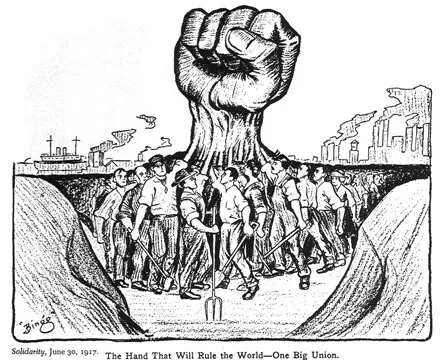 Published by Solidarity, an American Syndicalist newspaper founded by the IWW of Chicago, Illinois. Click image for link to the IWW.
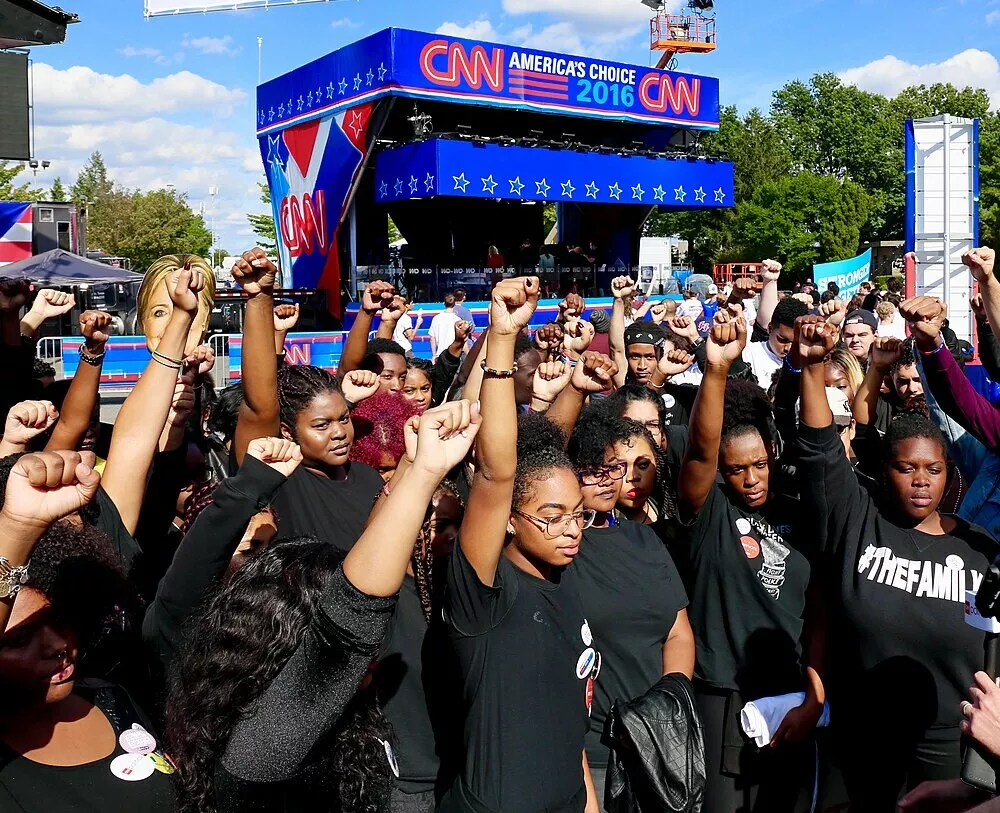 BLM protestors demonstrating the "raised fist" and dressed as Italian Fascist "Blackshirts." Click image for link to "Blackshirts" encyclopedia entry.
Ghostwriting for Mussolini in 1932, Giovanni Gentile wrote in The Doctrine of Fascism (p. 2) that:
...when brought within the orbit of the State, Fascism recognizes the real needs which gave rise to socialism and trade unionism, giving them due weight in the guild or corporative system in which divergent interests are coordinated and harmonized in the unity of the State.
For Gentile and Mussolini, democratic-Liberalism (i.e. classical liberalism and representative democracy) failed to capture the will of the people because it did not recognize people as they really are:
"...as a specialized producer whose tasks moved him to associate himself with others of the same category, all belonging to the same unitary economic organism that is the nation."
In contrast to Classical Liberalism, Fascism treats man not as an individual but as a productive entity whose real will can only be found in the work of the syndicate, meaning the fascist system must recognize the syndicates as the real expression of the national consciousness (p. 2, ¶4). Alfredo Rocco, Mussolini's Minister of Justice, put it this way:
Instead of the liberal-democratic formula, “society for the individual,” we have, “individuals for society” with this difference however: that while the liberal doctrines eliminated society, Fascism does not submerge the individual in the social group. It subordinates him, but does not eliminate him. . . . For Fascism, society is the end, individuals the means, and its whole life consists in using individuals as instruments for its social ends.
With an understanding that true democratic representation could only be effected by an incorporation of the economy's syndicates––the real social units of the nation––Mussolini and the Fascist regime set out to do just that.
In April 1926 Italy legally recognized the association of workers and the association of employers, and prohibited strikes and lockouts by workers.
In 1927 the Charter of Labor was written by Mussolini. Later, it is granted legal status. Among other things, it required collective labor contracts which applied to all members of an industry, prohibited strikes, regulated the number of hours in the workweek, and guaranteed that "wages shall correspond with the normal demands of life..."
In 1929 after the Great Depression hit, Italy seized banks' stock holdings and acquired corporations in "iron production, naval construction, and shipping, and large positions in many other sectors."
In June 1933 businesses were required to attain a government license to build new industrial plants. Around the same time, the government bailed out a number of banks. The state also created the IRI which would later take control of ship construction, shipping lines, and steel production.
In February 1934, "Corporations...came into being as liaison organs between the associations of employers and of workers." Florinsky says, "In theory the officers of the associations are elected, but in practice only men acceptable to the Government and the Party are nominated." In the face of price controls on wages, unions (syndicates) offered family subsidies, increased sick pay, instituted a 40-hour workweek, and extended health insurance.
In 1935 the Fascists "set prices, established production quotas," controlled the agricultural sector, instituted tariffs, and "regulated the distribution of raw resources."
In mid-1935 the Fascists "regulated the distribution of coal, coke, tin, nickel, and copper."
In 1936 the Banking Reform nationalized the Bank of Italy, previously a private bank. The Banca Commerciale was also acquired, and the state began financing its expenses via a policy of inflation, and also became the source of commercial credit. Toward the end of 1936 the state removed the controls it had placed on foreign exchange rates and announced that the currency (the Lira) had been devalued by 40%. Prices skyrocketed and the state imposed even more price controls.
By 1939 the state's IRI "controlled 77% of pig iron production, 45% of steel, 80% of naval construction, and 90% of shipping."
The interventions go on and on.... Books dealing with these interventions––and which can be accessed for free––have been linked to in the examples above.
Why American Socialists Are Fascist
When one looks at the ideological pronouncements of fascism and the specific policies instituted by the Fascist regime, American socialists inevitably find themselves in a difficult position: not only is the idea of incorporating worker- or union-owned businesses controlling their respective means of production into the state apparatus literally advocated by them, but many of the policies the Fascists implemented are also advocated by the socialists.
For example, when it comes to incorporating worker-owned businesses, the DSA says that in a world without capitalism,
"you would control your own labor and see it going to good use."
In their 2016 strategy article, Resistance Rising, they say that:
Under democratic socialism, this authoritarian system [capitalism] would be replaced with economic democracy. This simply means that democracy would be expanded beyond the election of political officials to include the democratic management of all businesses by the workers who comprise them and by the communities in which they operate. Very large, strategically important sectors of the economy....would be subject to democratic planning outside the market, while a market sector consisting of worker-owned and -operated firms would be developed for the production and distribution of many consumer goods.
This means that large firms are subject to the democratic control of the collective, but consumer-oriented firms are self-governed by the workers within. They become autonomous enclaves of production recognized by the state as organs of the democratic system at large. The Italian Fascists conferred similar degrees of autonomy to their syndicates to allow them to express their "collective will."
As for specific policies, the DSA is in full agreement with the Italian Fascists on all of the following policies:
While not necessarily syndicalists proper, the DSA and other American socialists' calls for widespread unionization and firm-wide worker control of consumer goods firms (which is just the same as unionization) is undoubtedly fascistic. They and the DSA are explicitly calling for a tiered system of government in which the nation controls "vital" industries (which can only mean steel, farming and wood, in addition to energy which they explicitly mention) while leaving the day-to-day operations of the other firms in the hands of their respective workers. This was the model of the Fascists.
As was observed in Italy, when the day-to-day operations and activities of these firms came into conflict with the "national" interests of the state, however, the Fascists expanded their control by issuing new regulations regarding inputs, prices, quotas and wages, or nationalized these firms entirely––the democratic will of the firm was replaced by the democratic will of the nation.
What will the DSA do when a consumer goods firm requires more inputs? Will the national government which controls the raw resources sector give them their inputs, or will the government declare that the expansionist goals of the firm are monopolistic, and counter to the democratic spirit of the "cooperative" economy? To what extent will the democratic voices of these firms be heard?
Evidently, the prerogatives of the national government will have to take precedent over local concerns which, in this case, consist of entire regions of the United States. Since the national government controls the raw resources, the democratic process will devolve into a sectional conflict for inputs which will inevitably be awarded to those places with the most people, rather than on the basis of "need." Despite the "democracy of the workplace" all coercive power ultimately lies with the national government, so democracy at the local level will exist in name only. As the DSA wants to eliminate the Senate and impose House representation in proportion to population while also sticking to a simple majoritarian concept of democracy, there are no safeguards in place to protect the minority. And, as the DSA will no doubt agree, the United States is a selfish and predominantly white, Christian, racist, sexist ethno-state that violates the rights of their countrymen every chance they get. Right, DSA??? And yet, the system as proposed by them would give these people absolute power over the very classes the DSA wishes to help.
Because of the primacy of the will of the majority, true democracy precludes placing limits on state power, so the DSA can do nothing to limit the power of the voting public unless they are willing to admit that they aren't actually democratic absolutists. But fear not! They could establish, say, a committee of "executives" with the power to veto decisions made by the voting public––call them a body of "watchmen," or "guards," why don't we? If the DSA goes that route, then suddenly democratic socialism would appear to be much less "democratic" and strikingly similar to...Oops––fascism.
Is this really the world the DSA wants to usher in?
This is but one of the many consequences that will result in the event of a majoritarian socialist system such as the one the DSA describes. In the next part of this series, I will explain the three insoluble problems that all socialist systems face, and which none of them are capable of solving––ever.
**Part I can be read HERE. You are reading Part II.**

Interested in the content of this Article?
Reach out to the MacIver Institute to aquire more information


