
- Podcasts
 Podcasts
 - Videos
 Videos
 - Policy Issues
 Policy Issues
 - About
 About
About


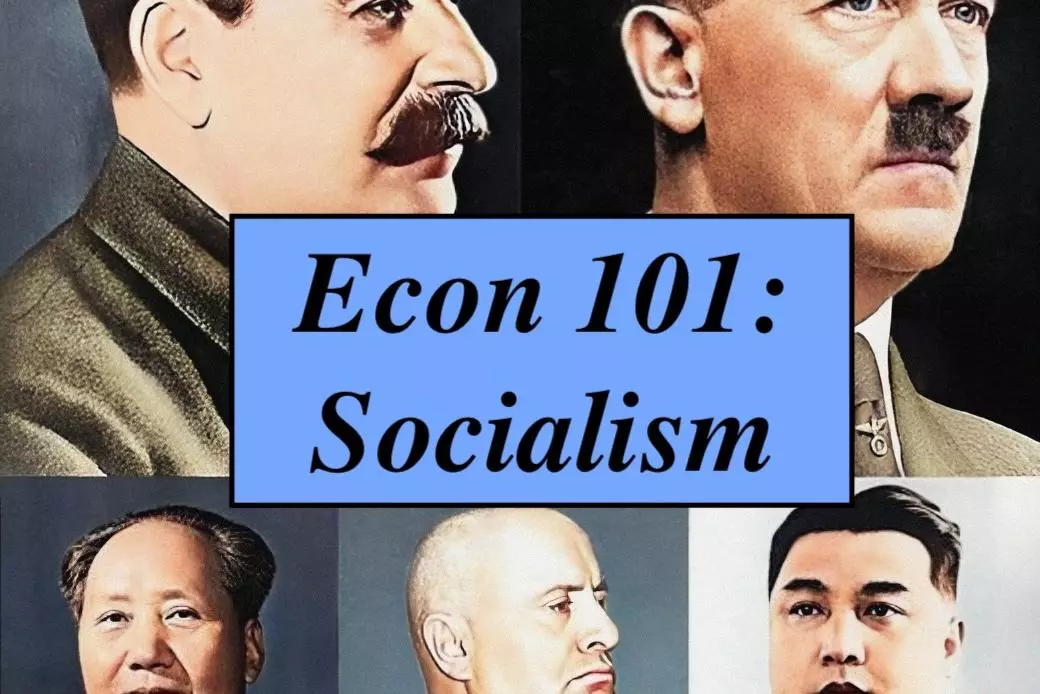
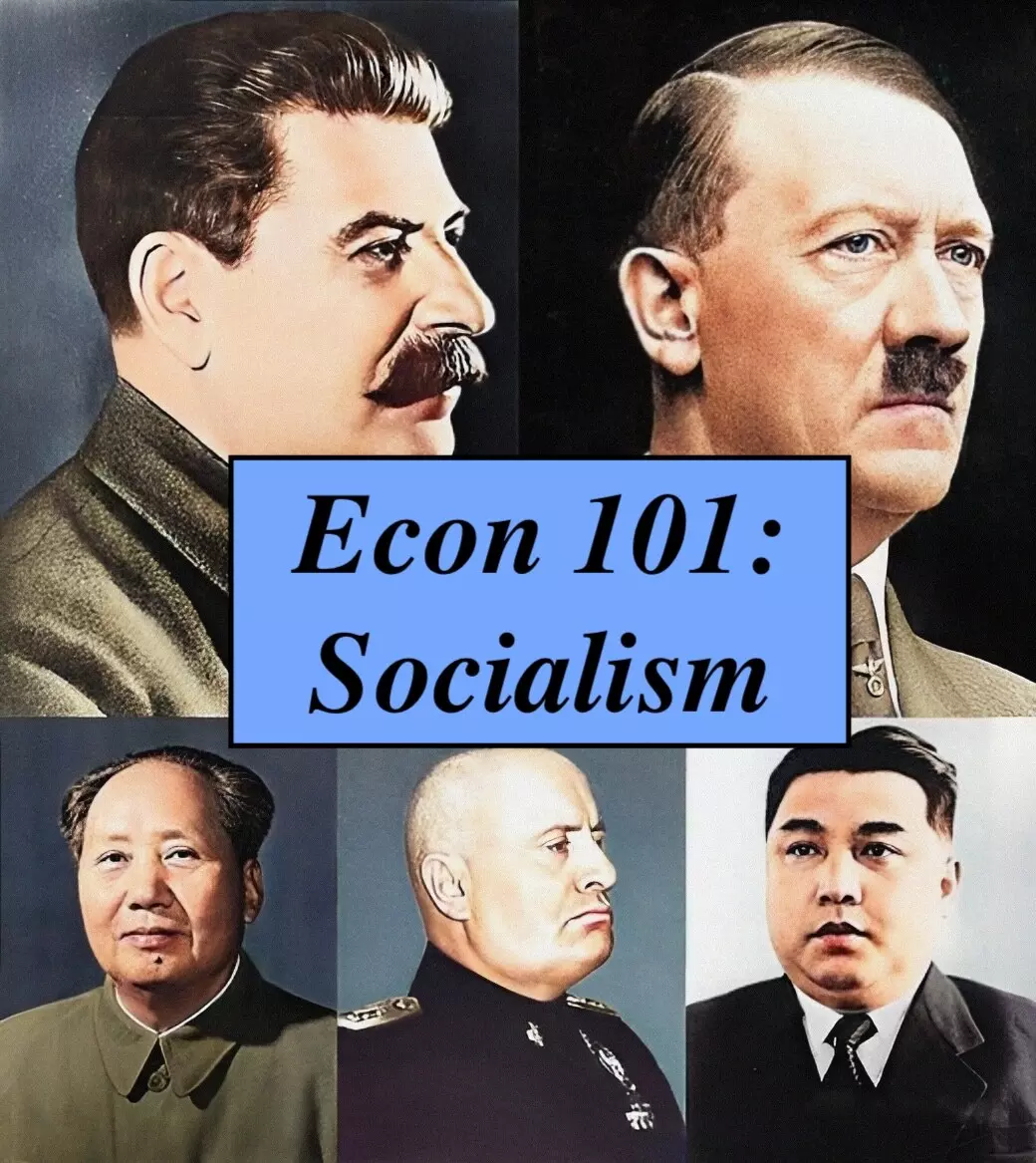
What Is Socialism?
Socialism is an economic system in which the means of production are owned by the public.
Socialists and other fellow travelers will not be satisfied with this definition. The definition above is the "classical" definition of socialism and is not always the way in which socialists define their version of this economic system. Nevertheless, it is a good working definition to get us up and running, and I will do my best to convince the few socialist readers among you that I understand your philosophy and intend to frame it as honestly as possible. Let's begin, first, by providing some alternative definitions to better understand what is intended by those who advocate for socialism...
1) Socialism is government ownership of the means of production;
2) Socialism is collective/communal ownership of the means of production;
3) Socialism is worker ownership of the means of production
The above are some alternatives to the classical definition which, when viewed together, give us a much better understanding of what socialism is really about. But if I can provide one final definition that unites all of these into one coherent view, then socialism is this:
Socialism is the forcible curtailment of private ownership of the means of production.
It is this––the forcible placing of limits on the extent of private ownership––that is at the heart of socialist doctrine. With respect to each of the foregoing definitions, all of them differed on one word and one word only––"government," "collective," "communal" or "worker." But what is relevant in each of these is not which word they use, but rather, the word they do not use––"private." Socialism is fundamentally an economic system that forcibly curtails private ownership of the means of production. Whether that consists of international, governmental, national, state-wide or firm-wide ownership of an economy's productive goods depends on what kind of socialist you're dealing with. But in all cases, private ownership of the means of production must be curtailed.
For this reason, every society which regulates or hampers private ownership of property is socialist to a degree. Only in the fictional "state" of Ancapistan, or perhaps in some remote areas of Alaska or the Amazon, is there a pure market economy. Even in those societies which we deem "Capitalist" are there elements of socialism, because so long as economic decision-making is not purely the product of voluntary decisions on the part of individuals, then socialism exists. Laws, regulations, government programs and taxation are all examples of this sort of regulation. But what matters here for us is recognizing the various degrees of socialism, and understanding how the socialist principle––and its further application to more and more aspects of human life––makes a society less capable of attaining socialism's stated goals.
Importantly, understand that most so-called socialists are not actual card-carrying Socialists, but merely advocates for an active and involved government which ensures that no member of society gets left behind. In general, these people support large welfare states, subsidized education and healthcare, and other social safety nets. They are not Stalinists. Neither are they Maoists, Leninists or Nazis. Most fancy themselves champions of the Scandinavian or Canadian model of government––a mix of markets and socialism. These kinds of socialists are much less Socialists and much more social-istic. They don't desire tyranny or oppression any more than you or me. Want they want, ultimately, is equality and prosperity for all.
If I could tell you one thing to help you better understand these people it would be this: these folks' favorite congressman is Bernie Sanders; they admire Justin Trudeau; they voted for Andrew Yang in 2020; and they dream of living in Denmark. But they have never read Das Kapital. Most Marxists haven't even read that! Instead, they look to model after countries who have nationalized healthcare, like the U.K., and to those which provide free college to their citizens as Germany, Iceland and Norway do. And when they look at these societies they see not only a better alternative to the American way of doing things but wild success. No, these folks are not really Socialists. But they are, nevertheless, instrumental players in helping to advance the socialism of the true believers.
Like the true believers, they believe capitalism to be a flawed system that disproportionately benefits the rich at the expense of everyone else. But where they part ways is in their belief that Capitalism can be reined-in and "managed." It is the welfare-minded socialist who dominates the socialist scene. They are the folks who attend rallies and protests and occupy Wall Street movements after a billion dollar bailout, but they are not wedded to the socialist program in the same way that the true believers are. It is the true believers––the bona fide Socialists––who burn dollar bills, spit on "the 1%" and wear Che Guevara t-shirts and red berets. It is this latter group who are the Marxists, Leninists and Social Democrats. And it is because of them that the preceding definitions of socialism become especially important.
#1 Socialism is government ownership of the means of production.
First on the list, those who subscribe to definition #1 are most likely National Socialists or Democratic Socialists. They believe that through representative government the means of production ought to be controlled by society at large, orienting production toward people, not profits. As Marx said, capitalists know how to produce, but not what to produce (p. 17, ¶3). But note: National and Democratic Socialists can be more or less extreme when it comes to government direction of the economy. Most of the casual socialists I mentioned earlier would likely align more closely with Fascism than Nazism or Bolshevism in this regard. That is, they'd prefer significant government intervention to total government control. The DSA, for example, is one such group that is explicitly nationalist.
#2 Socialism is collective/communal ownership of the means of production.
Second on the list, those who subscribe to definition #2 are likely Marxists or Communists. The Marxists believe that socialism is an intermediate period of history that eventually brings about communism––an anarchic, socialist utopia. After the perfection of socialism, any governmental oversight of the economy becomes unnecessary. There would be a "new man" as Marx said. While many communists may not subscribe to Marxism per se, this sentiment is more or less representative of all communists. They believe that the institutions of Capitalism are corrupting, and that by changing them, man will change too.
However, note that Marxists were the first to draw a distinction between socialism and communism. Prior to 1917, socialism and communism were perfect synonyms. For Marx, communism was "perfected" socialism, but the economic system was still socialism. Communism was simply the name he gave to the period that came at "the end of history." Only with the beginning of the Russian Revolution did a distinction come about, and only for tactical reasons. So be careful––because many folks on the Right are not––when drawing a distinction between socialism and communism. Many will say the difference is that socialists are crazy while communists are batshit. But non-Marxist communists are sometimes peaceful agrarians who mostly support the voluntarist principle. That is, if you are a member of their society then you're subject to the governing rules of the society, but you don't have to be a member––you can leave at any time. These sorts of communists can be found in the likes of the Amish, Mennonites and Hutterites. Going further, it's also the case that every family unit is communist. Many a child receive "according to their need" with little output to show for it. Yet, most people would attest that family-communism is actually pretty sensible.
Therefore, do not fall prey to the idea that a communist is just a super-socialist. That is sometimes the case, but not necessarily. For example, virtually all of the socialist heads of state of the 20th century were Marxists (and therefore Marxist communists), but their policies were sometimes less extreme than their non-communist peers. Even the likes of Mussolini, who is often regarded as a right-wing, "state-capitalist", considered himself a Marxist. Hitler, on the other hand, frequently denounced Marxism as a "Jewish doctrine," and said that "Our adopted term 'Socialist' has nothing to do with Marxian Socialism," (Carsten, The Rise of Fascism, p. 137). Most would agree that Hitler's variety of socialism was far more radical than Mussolini's.
#3 Socialism is worker ownership of the means of production.
Lastly, definition #3 is likely subscribed to by Syndicalists––a kind of "local level" socialist. However, many Democratic Socialists might also find this definition appealing. As opposed to "government" or "communal" ownership which some socialists might deem too domineering or vague, syndicalists advocate for worker- or union-owned businesses; i.e., socialism administered at the local level.
Instead of society at large deciding what factory A will produce, the workers within factory A will decide what to produce. Contemporary examples of this sort of organization would be worker co-ops like Mondragon Corporation, Dairyland Power Cooperative and Land O'Lakes (yes, the butter company). Noam Chomsky, famously, was an anarcho-syndicalist who advocated for this particular brand of socialism, as does the economist Richard Wolff (although he is explicitly a Marxist).
Despite this lengthy attempt to define socialism as broadly as possible, no doubt some Socialists are still dissatisfied. I apologize. Perhaps the Socialists would do well to focus on defining the principles of their ideology rather than specific policies, as the Capitalists have done.
In any event, understand that socialism is fundamentally about reorganizing ownership of the means of production. It demands that decisions regarding what to produce are taken away from the individual, and put in the hands of a collective. Remember, this new system of ownership can manifest in a myriad number of ways: government representatives can effect the will of their voters by directing production processes; publicly-traded companies could have their shares redistributed equally to their employees, each with equal voting rights; an autocrat could unilaterally command the economy; or government could simply nationalize a few industries, regulate some, and leave others alone entirely. In every case, economic planning results in individual planning being curtailed.
No matter the vehicle the destination is the same: businesses which are owned and operated privately must become owned and operated "publicly", "communally", or "socially."
In the following sections, I will show that the distinction between left- and right-wing authoritarianism is nonexistent, and that Nazism was a genuine form of socialism.
*Watch Marxist economist Richard Wolff define Socialism and Capitalism in the video below.*
DEFINITIONS
Socialism––an economic system where private ownership of the means of production has been replaced by public ownership of the means of production.
Means of Production––goods used in production to create consumer goods; i.e. land, raw resources, equipment and capital.
Why Socialists Reject Nazism & Fascism
Decades of propaganda and educational malpractice have created a myth that the previous century's worst dictators were not ideologically committed to socialism.
The reason for this is because the socialists of today want to argue that these were a failure of execution, not merit: "Socialism was good on paper, but not in practice" (spoiler: it's not even good on paper).
This myth is best represented by the so-called "political spectrum" below. Images like this are widely, if not universally, shown in schools throughout the country and function to promote the idea that socialism and the tyranny of the 20th century were mutually exclusive phenomena––that the one had nothing to do with the other. For example, the spectrum shows on one extreme, Mao and Stalin; on the other extreme, we have Adolf Hitler and Benito Mussolini. But in what way are the policies of these men substantively different from one another?
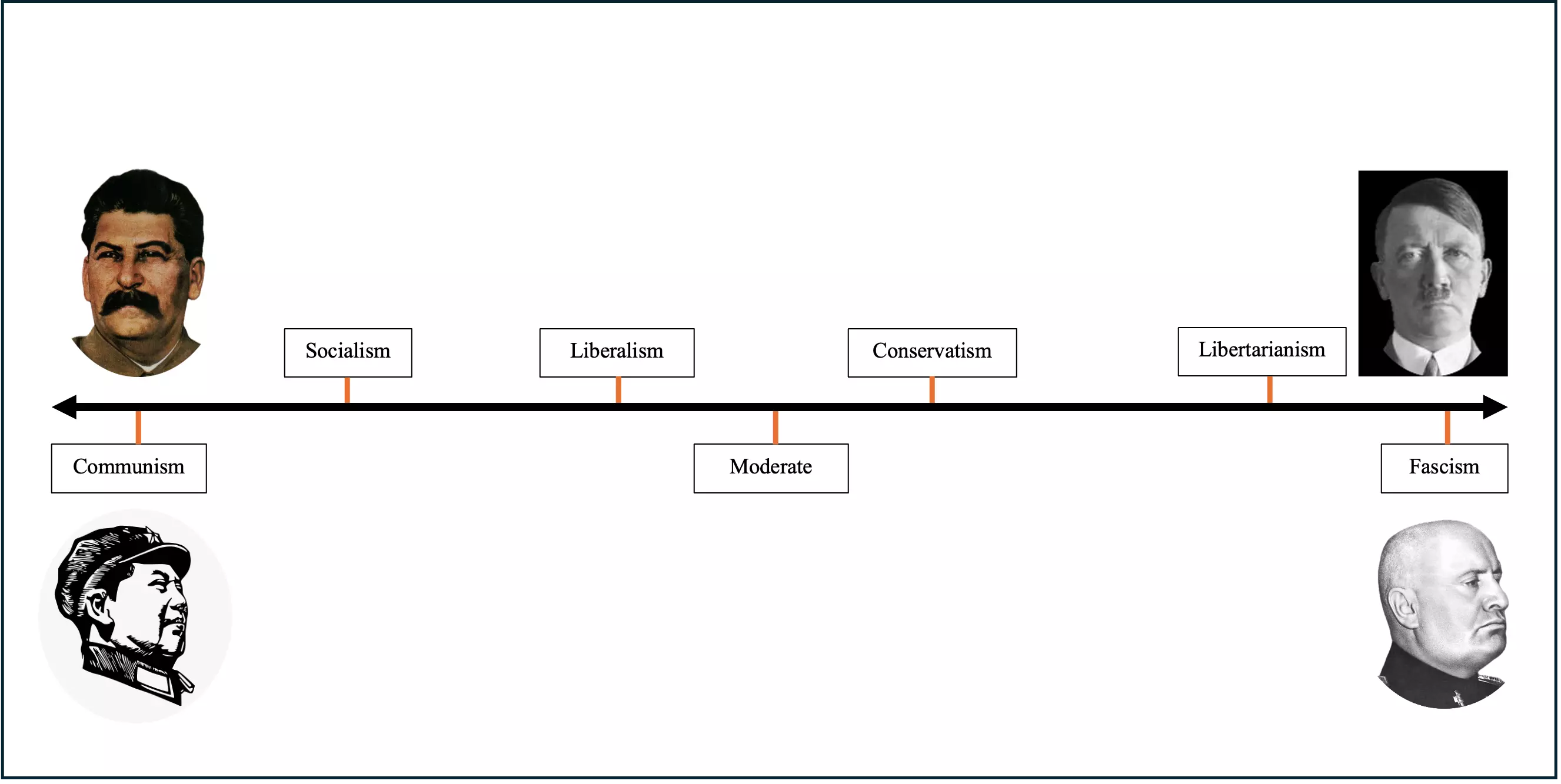
As the purpose of a spectrum is to represent a continuum of varying degrees, the "Extremes", by definition, must be diametrically opposed. One extreme must represent the "most" intense version of a thing and the other must be the "least" intense version of that thing. Common sense would lead us to believe, then, that Hitler's Nazism and Stalin's International Socialism are exact opposites, and share no semblance at all. But Nazism is hardly the opposite of Sovietism. Where the Soviets exercised complete control over the economy the Nazis exercised only incredible control. Where the Soviets murdered more than 20 million people on the basis of being Kulaks the Nazis murdered 11 million people on the basis of Jewishness and political dissidence.
The propaganda that has since emerged in the aftermath of the second world war has effectively barred these socialist regimes from socialism proper for one very important reason: Mussolini's alliance with Hitler, and Hitler's subsequent Holocaust, is so unambiguously evil and well-known that it is better to simply disown them. But the fact that the Allies also included Stalin's U.S.S.R. somehow means that Soviet Socialism gets a pass, and since the Allies never found themselves at war with Mao's China (which slaughtered 60-120 million people) it's easier to simply ignore the policies of the eastern empire.
Americans and the West are so ignorant of European and Asian history that lying about the events of these regions (if they are mentioned at all) is an easy task for revisionist historians and teachers sympathetic to socialism. This becomes abundantly clear when you realize that Leftists are quick to slander "Right-wing" people with the pejorative labels of "Fascist" and "Nazi" while simultaneously excusing the atrocities in Vietnam and Cuba and defending Vladimir Lenin and Pol Pot.
Rest assured that the Nazism, Fascism and Republicanism of the 20th century––as expressed by Hitler, Mussolini, Stalin and Mao––were all socialist parties in name, ideology and deed.
True believers universally reject Nazism and Fascism and go to great lengths to explain that these began as genuine socialist movements, but were co-opted by bad actors. Ironically, they don't understand that their demand for greater state control of the economy merely increases the probability that bad actors co-opt the movement. They could mitigate this risk by proposing a super-majority direct democracy (they don't), but it still wouldn't address the problem that bureaucrats with guns will be the ones enforcing the will of the majority, meaning those with the guns will have the power to enforce their will.
So long as socialists attempt to remake the world by means of expanding the state's power––as opposed to persuading individuals to join a commune––the problem of "the worst getting on top" will never be solved.
But the reason they reject Nazism and Fascism is straightforward: the Nazis killed millions of people in brutal ways and the Italian Fascists were their allies. Since the West is ignorant of Russian history (by virtue of allying with the Soviets in WWII) and utterly uninterested in Asia (by virtue of it being too far away), the Holocaust is all-important. Everyone is taught about its horrors so all morally-conscious people distance themselves from it. But the same standard does not apply in the case of the Soviet Union or The Great Leap Forward: "Stalin wasn't perfect but he helped us defeat Hitler." "Mao may have killed people but it was the United States who fomented revolution in China."
When it really comes down to it, socialists reject these "right-wing fascist dictatorships" because they disagree with the outcomes. But the don't disagree with the means.
They have no issue with giving power to a Bernie Sanders or a Zohran Mamdani, or with the state taking ownership of price-gouging, wage-cutting, extortionary firms on the S&P 500. They have no issue with quotas for cars, houses and food; or with price controls for labor and consumer goods; or with the redistribution of profits to workers; or with the nationalization of healthcare and education and the creation of a craddle-to-grave welfare state.
Their problem is with the malevolent dictators that take control of the institution they intended only for benevolent dictators.
Nazism Is Socialism
Nazism is the name given to the policies of the German Nazi party––a national socialist movement that nationalized the economy and directed production.
That the Nazis were socialists is the easiest case to prove. In fact, "Nazi" is simply an Anglicized acronym for the party's much longer name: Nationalsozialistische Deutsche Arbeiterpartei––the NSDAP. "Nationalsozialistische" means "National Socialist," "Deutsche" means "German," and "Arbeiterpartei" is "Worker's Party"––the National Socialist German Worker's Party.
In terms of policy, there is no conceivable way to argue that the party's name is a misnomer seizing on a popular political movement. The slogan used by the Nazi party to summarize their economic policy was "Gemeinnutz geht vor Eigennutz"––the common good before private gain. It is a slogan which finds its contemporary analogue in the phrase, "People, Not Profits," and emphasizes the supremacy of the collective over the individual. Below are some of the points from the party's 25-point plan, the 25-Punkte-Programm, which demonstrates quite clearly the socialist principles of the Nazis:
10. The first obligation of every citizen must be to work both spiritually and physically. The activity of individuals is not to counteract the interests of the universality, but must have its result within the framework of the whole for the benefit of all. Consequently we demand:
11. Abolition of unearned (work and labour) incomes. Breaking of rent-slavery.
12. ...we demand the total confiscation of all war profits.
13. We demand the nationalization of all (previous) associated industries (trusts).
14. We demand a division of profits of all heavy industries.
15. We demand an expansion on a large scale of old age welfare.
16. We demand... immediate communalization of the great warehouses and their being leased at low cost to small firms...
17. We demand a land reform suitable to our needs, provision of a law for the free expropriation of land for the purposes of public utility, abolition of taxes on land and prevention of all speculation in land.
19. We demand substitution of a German common law in place of the Roman Law serving a materialistic world-order.
20. The state is... to enable every capable and industrious German to obtain higher education... We demand the education at the expense of the State of outstanding intellectually gifted children of poor parents...
24. The Party as such advocates the standpoint of a positive Christianity without binding itself confessionally to any one denomination. It combats the Jewish-materialistic spirit within and around us, and is convinced that a lasting recovery of our nation can only succeed from within on the framework: common utility precedes individual utility.
25. For the execution of all of this we demand the formation of a strong central power in the Reich. Unlimited authority of the central parliament over the whole Reich and its organizations in general. The forming of state and profession chambers for the execution of the laws made by the Reich...
––NSDAP Party Platform, 24 February 1920
The language of the platform is telling enough: phrases like "rent-slavery," "communalization," "nationalization" and "materialistic spirit" are all pulled directly from the socialist lexicon.
Of course, the Nazi party did much more than make promises––they followed through on them. The first instance of this was Hitler's successful attempt to persuade President Hindenburg to issue the Reichstag Fire Decree––an order which suspended rights guaranteed by the Weimar constitution and abolished private property:
§ 1
Articles 114, 115, 117, 118, 123, 124, and 153 of the Constitution of the German Reich are suspended until further notice. Thus, restrictions on personal liberty, on the right of free expression of opinion, including freedom of the press, on the right of assembly and the right of association, and violations of the privacy of postal, telegraphic, and telephonic communications, and warrants for house searches, orders for confiscations as well as restrictions on property are permissible beyond the legal limits otherwise prescribed.
––Reichstag Fire Decree, 28 February 1933
Not only did this have the effect of abolishing private property, but it meant that the Nazi regime could nationalize businesses. And that's exactly what they did. As Peter Temin wrote in Soviet and Nazi Economic Planning in the 1930s:
"The Nazis reorganized industry into 13 administrative groups with a larger number of subgroups to create a private hierarchy for state control. The state could therefore direct a firm’s activities without acquiring direct ownership of enterprises."
Once nationalized, these industries were still allowed to earn profits, but the prices they charged were subject to controls, or they were otherwise dissuaded from earning profits by jailing businessmen for "price-gouging" when the party felt that prices were too high. When profits were made, they were further subject to regulations regarding profit-sharing which dispersed them among workers.
In every case of nationalization, planning was ultimately done by the Nazi party members assigned to each company. In Gunter Reiman's book The Vampire Economy (p. 23), a letter from a Nazi-era German businessman to an American friend explains just how much control the state had over materials, prices, and daily operations:
"The difference between this and the Russian system is much less than you think, despite the fact that officially we are still independent businessmen.
You have no idea how far State control goes and how much power the Nazi representatives have over our work. The worst of it is that they are so ignorant. In this respect they certainly differ from the former Social-Democratic officials. These Nazi radicals think of nothing except 'distributing the wealth.'
Some businessmen have even started studying Marxist theories, so that they will have a better understanding of the present economic system.
How can we possibly manage a firm according to business principles if it is impossible to make any predictions as to the prices at which goods are to be bought and sold? We are completely dependent on arbitrary Government decisions concerning quantity, quality and prices for foreign raw materials. There are so many different economic agreements with foreign countries, not to mention methods of payment, that no one can possibly understand them all. Nevertheless Government representatives are permanently at work in our offices, examining costs of production, profits, tax bills, etc.…”
The Nazis had total control over prices, set quotas, and decided which materials were used in production. Reiman writes thusly (The Vampire Economy, p. 69):
"AT LEAST half the time of a German manufacturer is spent on the problem of how to get scarce raw materials. These cannot be obtained without a certificate from one of the supervisory boards which distribute the available raw materials..."
This was the natural result of the Nazis' policy of de facto nationalization of key industries. As Peter Temin explains, Nazi quotas applied to "industrial goods, including pig iron, steel, aluminum, magnesium, gun powder, explosives, synthetic rubber, all different kinds of fuel, and electricity." In the event of a business failing to meet these quotas, or outright refusing to cooperate with the Nazi regime, the state would effect nationalization proper.
Famously, the Nazi nationalization of I.G. Farben (a chemical company) and the airplane manufacturer, Junkers, were two such examples of non-cooperating businesses that had their boards completely replaced by Nazi party officials (Temin, p. 17):
"Prof. Junkers of the Junkers airplane factory refused to follow the government’s bidding in 1934. The Nazis thereupon took over the plant, compensating Junkers for his loss. This was the context in which other contracts were negotiated."
One of the fiercest critics of socialism and the Nazis' particular brand of National Socialism was Austrian economist Ludwig von Mises. Mises, himself, was persecuted by the Nazis and forced to flee to America. In 1941 Mises penned a column for the New York Times (p. 2) which succinctly described the socialist economy of Nazi Germany:
The German pattern of socialism (Zwangswirtschaft) is characterized by the fact that it maintains, although only nominally, some institutions of capitalism. Labor is, of course, no longer a “commodity”; the labor market has been solemnly abolished; the government fixes wage rates and assigns every worker the place where he must work. Private ownership has been nominally untouched. In fact, however, the former entrepreneurs have been reduced to the status of shop managers (Betriebsführer). The government tells them what and how to produce, at what prices and from whom to buy, at what prices and to whom to sell. Business may remonstrate against inexpedient injunctions, but the final decision rests with the authorities. . . .
Market exchange and entrepreneurship are thus only a sham. The government, not the consumers’ demands, directs production; the government, not the market, fixes every individual’s income and expenditure. This is socialism with the outward appearance of capitalism—all-round planning and total control of all economic activities by the government. Some of the labels of capitalistic market economy are retained, but they signify something entirely different from what they mean in a genuine market economy.
Today, Nazism is rarely acknowledged as a socialist regime. This is of course because of the moral implications, but also because the Nazis referred to their nationalization of industry and near-total control of the economy as "Privatization."
Socialists today are grateful for this confusing use of terminology, and for obvious reasons, are eager to take the Nazis at their word: "The Nazis said they were 'Privatizing,' therefore it is privatization. The Nazis were Capitalists!" Curiously, they do not apply this logic to Hitler and other Nazis' many pronouncements that they were ideological socialists hell-bent on implementing socialism.
Per Hitler from a 1937 speech (p. 11):
"There is no economic concept or economic view which can claim to be gospel. What is decisive is the will to always assign business the role of servant of the people and capital the role of servant of business. National Socialism is, as we know, the sharpest opponent of the liberalistic point of view that business existed for capital and the people for business. We were therefore also determined from the very first day to break with the mistaken concept that business could lead an unbound, uncontrollable and unsupervised life within the state. A free economy, in other words one completely left to itself, can no longer exist today."
When one looks at the statements and policies of the Nazis, it becomes very difficult to frame Nazism as "not-socialism," let alone Capitalism.
Given that Capitalism (as Capitalists define it, not Marxists) requires both private ownership of the means of production and free exchange, socialists have their work cut out for them when it comes to explaining exactly how forced labor, price controls, and state-directed production upon penalty of imprisonment, torture or death align with the voluntary premise of Capitalism.
If socialists wish to disavow Nazism for the evils it produced then they are more than welcome to do so, but they cannot deny that socialism was the defining economic characteristic of the regime. They would do better to refine the means of their system rather than naively assume that "the right people" will exercise the powers of the state responsibly, or that the democratic process is sufficient to prevent further human rights abuses.

Interested in the content of this Article?
Reach out to the MacIver Institute to aquire more information


