
- Podcasts
 Podcasts
 - Videos
 Videos
 - Policy Issues
 Policy Issues
 - About
 About
About


Affordable Housing
Recently, a number of bills were introduced in the legislature as part of a housing package aimed at addressing the issue of affordable housing, or the lack thereof.
The state already takes steps to increase access to affordable housing with mixed results, and the prospects of the latest housing package are equally mixed. Part II will address these bills in detail.
The impetus for housing reform–or increased access to affordable housing–is a red-hot economic issue. National and statewide housing expenses are much higher than the historical average, the median age of first-time homebuyers is nearly 40 years old, and the proportion of household income spent on housing is nearly 50%–much higher than the recommended 30% of years past.

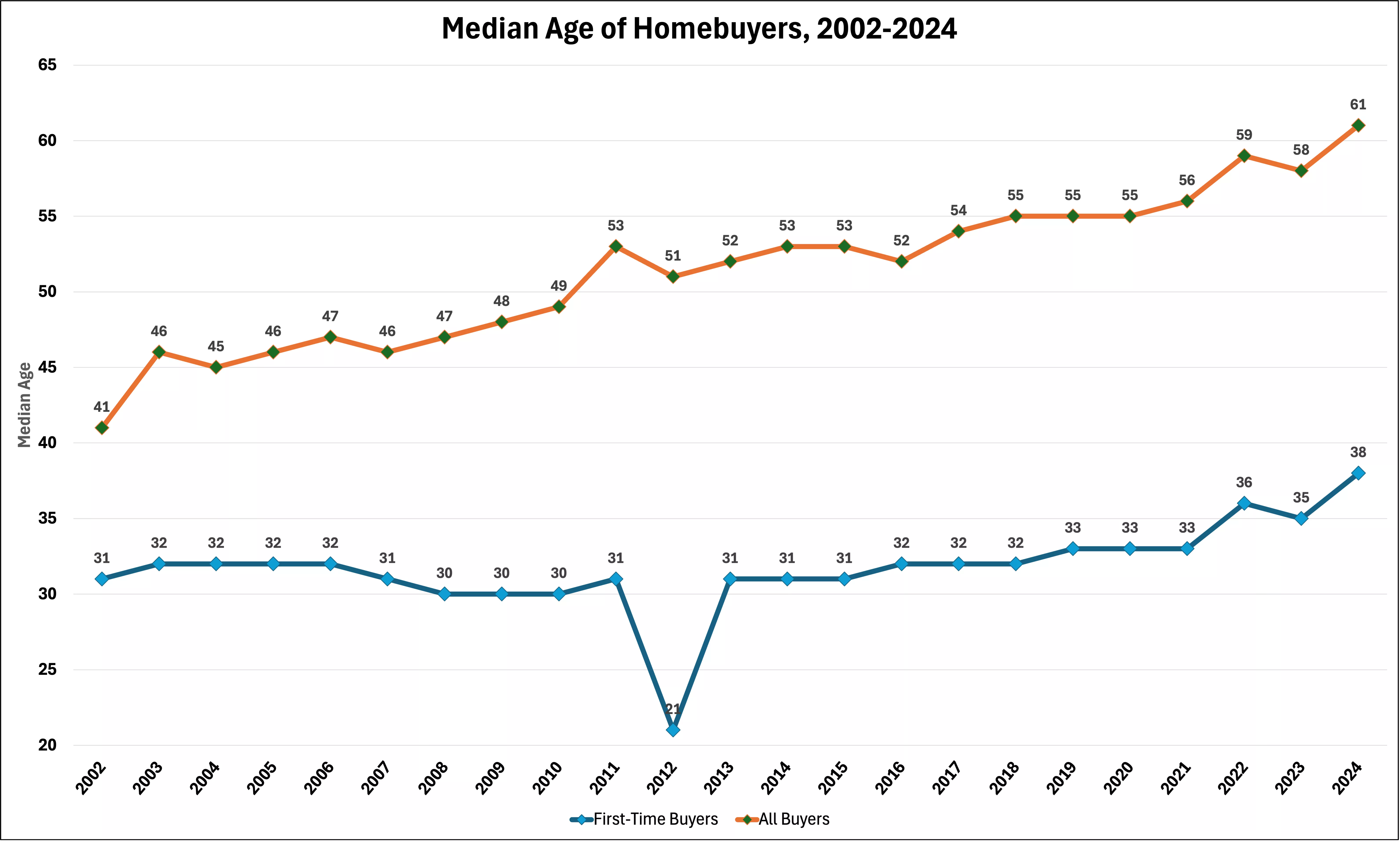 Source: Nation Association of Realtors, click image for data
Today, the typical home in Wisconsin is much more than 3 times the typical household's income. On average, the typical home costs 5.8 times more than what the typical household earns, even before taxes are taken into consideration.
Jim Bianco found that on the national level, the typical household spends 47% of their income on housing–a figure well inline with our estimates for Wisconsin.
 https://x.com/biancoresearch/status/1957122195630526540
So there's good cause to look into expanding access to affordable housing. But of course, affordable housing initiatives are mostly geared–not toward lowering housing costs for all, but increasing homeownership among low income people.
To achieve this, the state of Wisconsin has mostly taken a backseat, passive role; instead delegating this responsibility to WHEDA–the Wisconsin Housing and Economic Development Authority.
The DOA's Housing Programs
The DOA has an active but relatively small role in affordable housing programs.
In 2023, just $86 million All Funds was used to support the DOA's Housing Assistance programs, and $77 million of that came from the Federal government (p. 2).
The funds are disbursed primarily in the form of grants, as opposed to subsidizing mortgage rates or paying for housing outright.
When it comes to those housing assistance programs with which people are most familiar–like Section 8, downpayment assistance, and subprime lending–these are administered by WHEDA.
WHEDA's Housing Programs
While the legislature created WHEDA, WHEDA is actually an independent entity. It is only occasionally included in the State's budgets when the legislature decides to grant it money. But most of the time, it is entirely funded by individuals' purchase of taxable and tax-exempt bonds (p. 1).
According to the LFB, the Wisconsin Constitution prohibits the state from issuing bonds (as WHEDA does) for private purposes, and "internal improvements" (p. 1, ¶3). Thus, WHEDA was created as a de facto agency to circumvent this constitutional restraint, and to take advantage of a number of federal housing programs.
What makes WHEDA different from other organizations that issue bonds to finance their private purposes is that WHEDA's capital reserve fund is backed by the state:
"To assure the continued operation and solvency of the authority...[the state], Recognizing its moral obligation...the legislature hereby expresses its expectation and aspiration that, if ever called upon to do so, it shall make such appropriation" (§234.14(4)).
What this means is that should WHEDA's reserves ever fall short of their legal reserve requirement, the state will step in to provide liquidity (cash or bonds, most likely). This relationship between WHEDA and the state is precisely the reason why WHEDA is able to incur relatively higher risks in the housing market as compared to other financiers. The bonds issued by WHEDA to finance its grants, downpayment and mortgage rate assistance are effectively government-backed securities. And this relationship is also the main way in which the state advances its affordable housing goals.
WHEDA's activities are essentially threefold: it administers its own programs, it administers some Housing and Urban Development (HUD) programs, and it administers state and federal tax credits.
While WHEDA focuses mostly on mortgage assistance for its revenue, WHEDA does not write loans. WHEDA partners with a number of banks throughout the state who underwrite mortgages according to WHEDA's terms, then sell them to WHEDA who either holds them or sells them to Government-Sponsored Enterprises like Fannie Mae and Freddie Mac in exchange for mortgage-backed securities guaranteed by Fannie and Freddie.
In its most recent annual report (2024 Annual Report, p. 9), WHEDA lists its asset level at slightly more than $4.1B, with $2.7B of that in Mortgages and Mortgage-backed Securities.

They also, in 2024, issued more than $380M in general obligation single-family bonds and $280M in non-general obligation multifamily bonds (p. 28).
So what's WHEDA's share of the market?
If we look at their loan activity for single-family homes in 2023 (Appendix V) and compare that to the aggregate home sales data from the Wisconsin Realtors Association (Number of Home Sales), of the 64,530 homes sold in Wisconsin, WHEDA acquired 2,402 single-family home loans, or 3.7% of all home sale activity.
The total loan volume for just these single-family mortgages, therefore, comes in at $475,461,578 while downpayment assistance loans numbered 1,177 at a total volume of $10,705,472 for an average of $9,000 in assistance per loan.
Conclusion
If we look at the affordable housing initiatives administered by the DOA (and other agencies, although their involvement is even less significant), the state is rather hands-off in terms of total state spending.
If we look at the impact of WHEDA, here, too, the state is only implicitly involved. Apart from occasional GPR appropriations like the $525M given to WHEDA in the 2023-25 state budget, Wisconsin has more or less decided to abdicate its role and let the Federal government handle affordable housing.
This is demonstrated by the fact that the state created WHEDA to administer federal housing programs and tax credits, and also by the fact that 33% of WHEDA's assets are in the form of Mortgage-backed Securities (MBSs) guaranteed by federally-sponsored enterprises like Fannie and Freddie.
The MacIver Institute recommends a state-led initiative to tackle the root problem of housing un-affordability–zoning and building code reform.

Interested in the content of this Article?
Reach out to the MacIver Institute to aquire more information


