
- Podcasts
 Podcasts
 - Videos
 Videos
 - Policy Issues
 Policy Issues
 - About
 About
About


The State of Wisconsin has always had a problem with deficit spending, but government officials have at least tried to take steps in the past to avoid disaster. Unfortunately, over the past several years, they’ve thrown caution to the wind and the state’s annual deficits have grown to gargantuan proportions that threaten to plunge the state’s finances into absolute chaos the next time the economy merely slows down.
The State of Wisconsin just passed its 2025-27 budget. It includes a $2.4 billion deficit for this fiscal year and a $1.2 billion deficit for next year. That means that the state’s net appropriations exceed its total revenue projections both years by a total of $3.6 billion.
Believe it or not, this is a slight improvement over the last budget. In FY24, the state planned for $4.6 billion deficit, followed by a $1.7 billion deficit in FY25, for a total of $6.3 billion over the biennium. Two factors staved off a crisis. First, tax collections were 11% higher than originally estimated. That generated an extra $2.1 billion in FY24. The Legislative Fiscal Bureau (LFB) estimates that they were 8% higher last year, bringing in an additional $1.6 billion, for a total of $3.7 billion of unanticipated revenue over the biennium. It still wasn’t enough to cover the shortfall. Fortunately, the state also had a $6.9 billion balance in the general fund at the start of the biennium. Combined with the additional tax revenue, that covered the $6.3 billion deficit, and left the state with about $4.4 billion in the general fund.
Currently, that $4.4 billion in the general fund is what will pull the state through its current budget’s $3.6 billion deficit. That will leave a balance of $714 million for the start of the next state budget. That will not be enough to cover another multi-billion-dollar deficit, and the state will have to make deep cuts to, what has become, permanent spending.
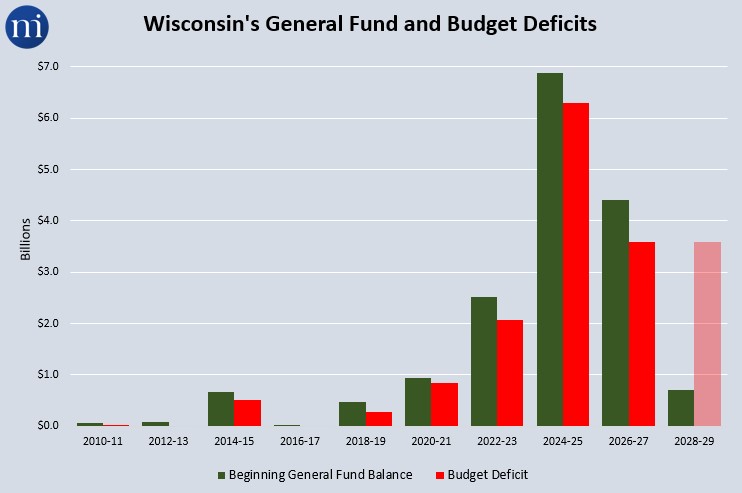 Budget planners always ensure that the deficit will not exceed the initial fund balance. That could be a very difficult task during the next budget cycle.
However, state officials don’t think the situation is all that bad. They believe that a growing economy will yet again increase tax revenue well beyond their initial expectations and solve the problem. That would require tax collections to again exceed expectations by 11% in the first year and then 5% in the second year. It’s possible, but it depends on the state continuing its winning streak, and the state keeps pressing its luck.
Between 2002 and 2027, state budgets included 15 years of planned deficits and 10 years of planned surpluses. However, it’s been 12 years since the last time the state planned for a surplus. Also, the deficits keep getting bigger. The average annual deficit for the seven years after Covid was $1.8 billion. For the seven years leading up to Covid, the average was $120 million.
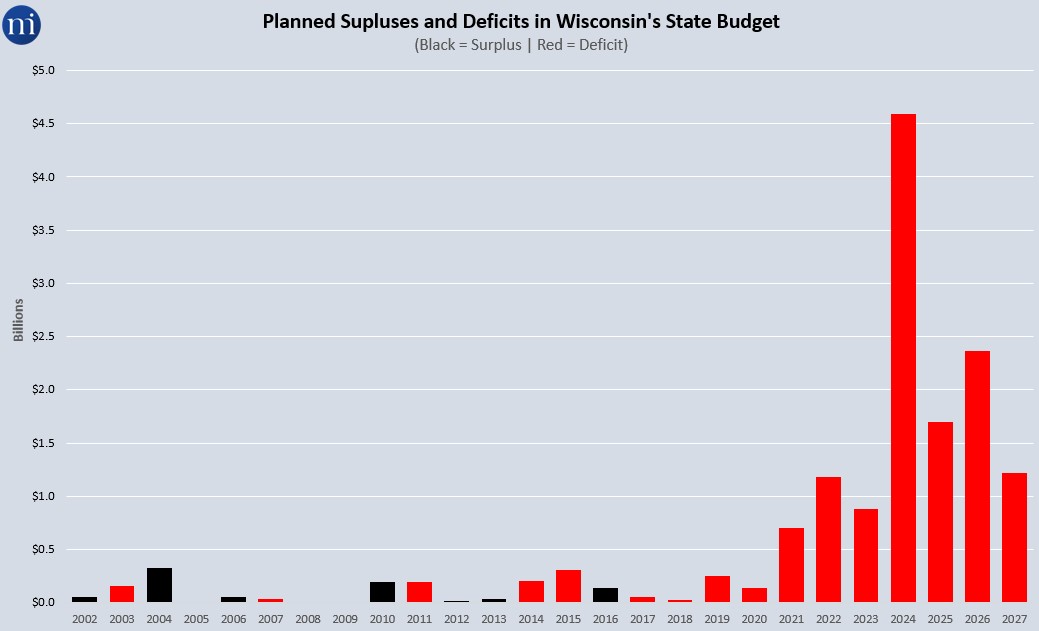 Before 2020, Wisconsin's average annual deficit was $120 million. Since then, the average has grown to $1.8 billion.
Somehow, at the same time Wisconsin’s deficits started to get out of control, it was also starting to greatly underestimate its future tax collections. Since Covid, actual tax collections have exceeded predicted tax collections annually by an average of 11%. In the seven years leading up to Covid, the average was only 0.5%. While that has been instrumental in closing the state’s budget gaps, it’s also fueled record deficits by lulling state officials into believing everything will always work out in the end.
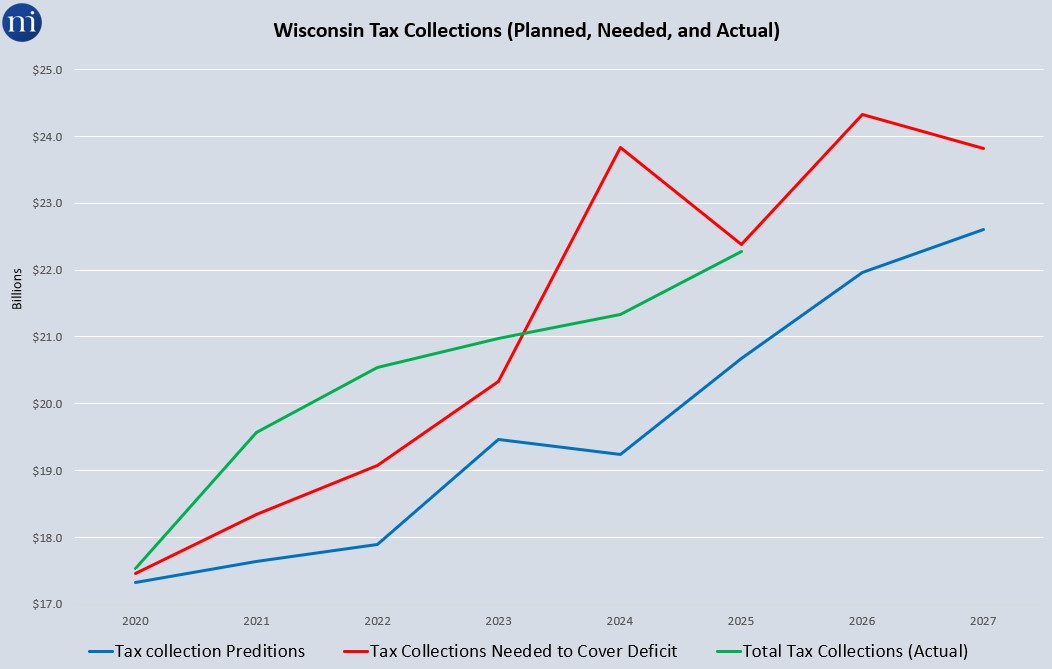 Alarm bells should have gone off in 2024 when tax collections failed to cover that year's deficit. Instead, Wisconsin chose to continuing going for broke in the new state budget.
However, even if these unusually bountiful tax collections continue, it won’t be enough to keep up with the state’s spending trends forever. For example, although tax collections were 11% higher than expected in FY24, they needed to be 24% higher to cover the deficit that year. That should have been a wakeup call.
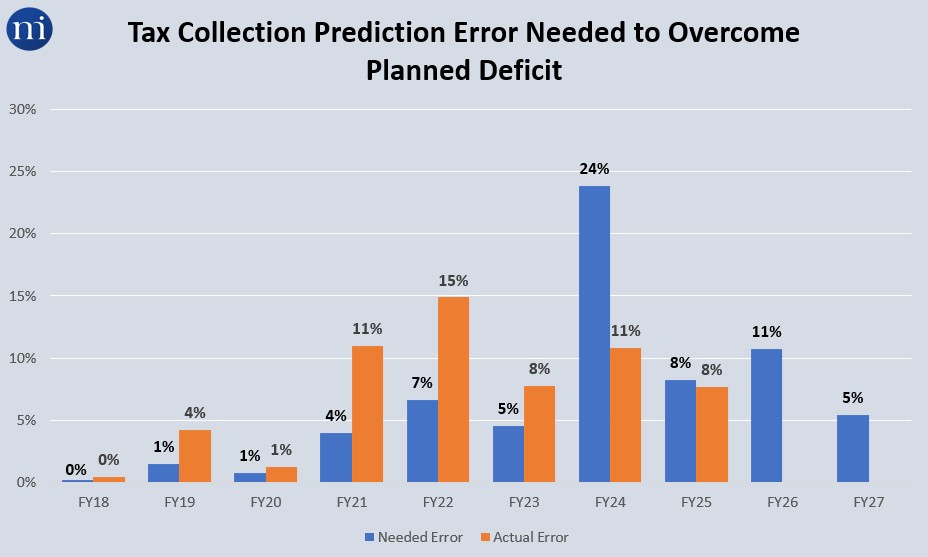 Budget planners always expect that tax collections will come in higher than they estimated, which will cover the deficit. It's usually a safe bet, but Wisconsin's luck ran out in 2024 and 2025. That's done little to dampen the state's optimism in its newest budget.
In the past, Wisconsin’s elected officials recognized the urgency of reducing deficits when tax collections fell short. In FY09, the state had planned on ending the year with a $1.9 million surplus. Unfortunately, that’s the year the Great Recession hit, and tax collections fell by 11%. The state responded by building in a $193 million surplus into the budget for FY10. It turned out that the state needed every penny. Tax collections came in $193 million under expectations that year. The state made it through the year by the skin of its teeth. Unfortunately, it returned to deficit spending in FY11 betting on an early economic recovery that didn’t happen. That miscalculation created the crisis that directly led to collective bargaining reform in Act 10.
The state faced another economic slowdown in FY14. The FY14-FY15 state budget included a $500 million deficit. That could have been overcome if tax collections had just been 1-2% higher than originally planned. Instead, the predictions were spot on. The actual error was 0% both years. That drained the general fund balance down to just $254,400. In response, the next state budget built in a $138 million surplus for FY16. That prudence combined with an economic recovery quickly turned the situation around, and the state began the next budget with a $467 million surplus.
Today, unfortunately, state officials seem completely oblivious to the danger of deficit spending. In the past, dipping into the state’s general fund balance to address a budget deficit sent off alarm bells. It resulted in immediate corrective action in both 2008 and 2014, which included plans to build budget surpluses. That’s what should have happened in 2024, when the deficit had grown so large that tax collections would have needed to grow 24% higher than expected to fill the shortfall. Instead, the deficit spending continued into FY25, followed by our current budget that includes massive deficits for both years. What once could have been considered betting for higher tax collections has turned into a reckless gamble.
By next June, the state will know whether or not that gamble is paying off. Gov. Evers will still be in office, as will this current legislature, and they will take the first steps in writing the 2027-29 state budget. If tax collections are falling short of repeating their historic levels, the state will be facing a serious financial crisis going into the summer of 2027. Of course, that will be a problem for the next governor and legislature. And if the gamble pays off this time, the problem is likely to keep growing until the economy finally deals the state the inevitable and catastrophic losing hand.

Interested in the content of this Article?
Reach out to the MacIver Institute to aquire more information


