
- Podcasts
 Podcasts
 - Videos
 Videos
 - Policy Issues
 Policy Issues
 - About
 About
About


Xcel's Talks With St. Croix County End
For more than a year Xcel Energy has been in talks with St. Croix county to reach an agreement on a 300MW solar project. But after negotiations between the utility and the county reached an impasse, Xcel has announced it will no longer pursue negotiations with the county board.
This was a welcome result for those opposed to the development; that is, until Xcel revealed that it doesn't need to strike an agreement with the county, and would simply get the project approved by the PSC.
Now, questions abound on what exactly the purpose is of informing communities of utilities' plans to develop projects if their assent isn't required to proceed.
The First Proposal
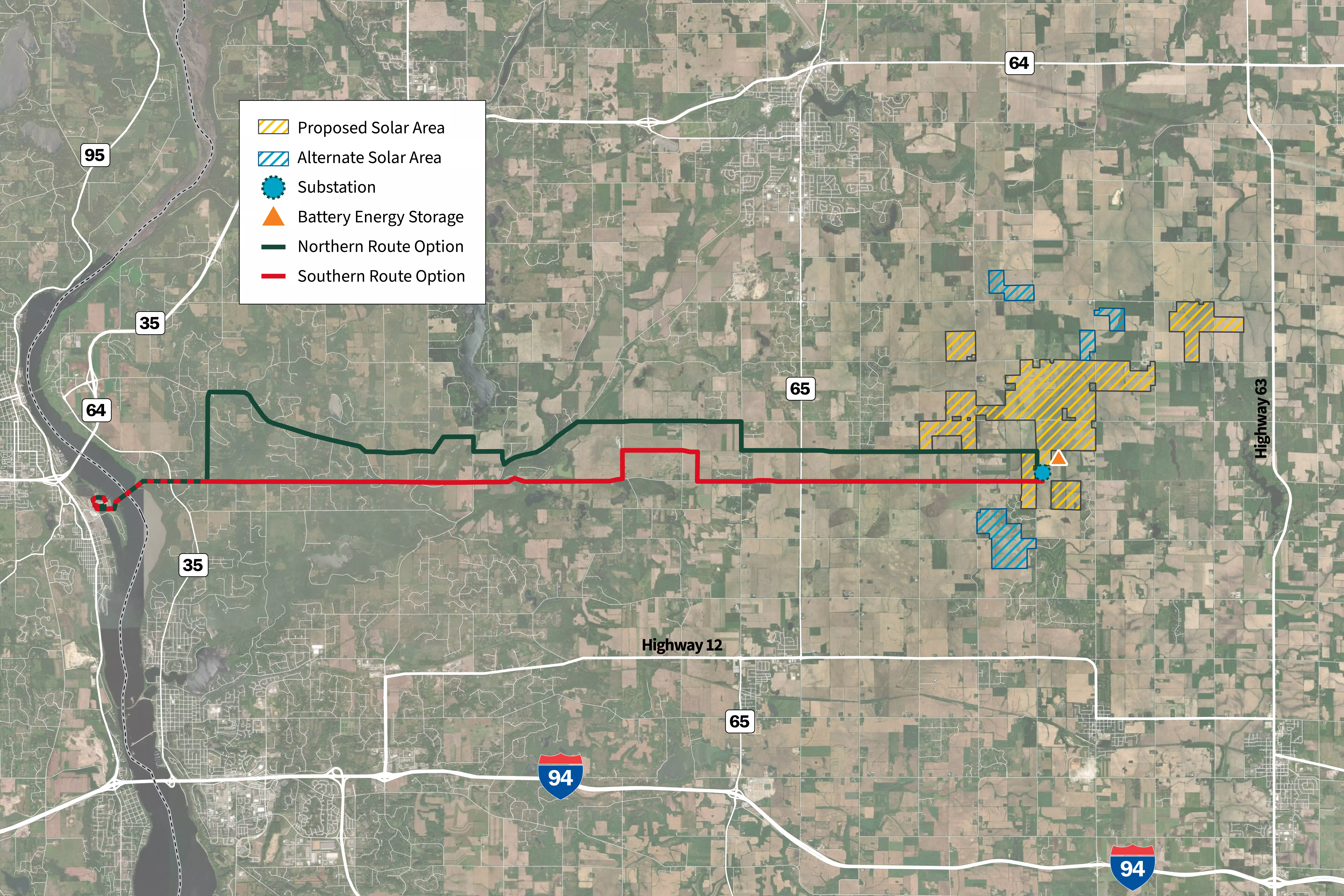
In January of 2025, the Ten Mile project was initially proposed as a 650 MW solar farm spread across 5,000 acres in St. Croix county. According to Xcel's information hearing testimony (watch here), the project would also require the construction of a 17-19 mile long 230 KV transmission line.
The justification for the project was to replace the 598 MWs of capacity of the soon-to-be-closed Allen King coal plant across the river in Washington county, Minnesota.
(click here to download the EIA's 860M spreadsheet of all power plants in the U.S.; click here to visit the webpage for the 860M)
The King plant has been in operation since 1968, but despite producing electricity at a capacity factor of 67% in 2010, Xcel has gradually rolled back its output––now only producing 17% of its rated potential––to help achieve the utility's goal of eliminating coal from its energy mix by 2030.
The benefits of the Ten Mile project were straightforward: carbon-free renewable energy, additional shared revenue for the county, and lucrative lease payments to property owners agreeing to site the solar panels on their property.
But the county board was anything but eager to approve the project given that community members made their opposition well-known by amassing more than 5,300 petition signatures. Negotiations to ratify a developer agreement were drawn-out, and the county actually made progress in convincing Xcel to modify their project.
The Second, and Current, Proposal
By November of 2025 the Ten Mile project had undergone significant revision.
No longer a proposal to construct 650 MW of solar panels, it became a proposal to construct 300 MW of solar panels with 300 MW of battery backup storage, sparing precious land. The transmission line remained unchanged.
But that too was met with opposition. In December of last year and February of this year, at least two towns in St. Croix county passed resolutions voicing their objections to the project. As of last week, Xcel has stated that negotiations with the county have completely broken down, and that they will move to file their application with the PSC by the end of the year. This, despite the fact that St. Croix has stated they are still willing to negotiate a developer agreement with the utility.
But there's a good reason why Xcel has given up on talks with the county...
Utilities aren't required to get the assent of local governments to develop projects.
Any developer agreement a utility signs is, quite honestly, out of the goodness of their heart. They usually make guarantees to a community which the utility is required by law to fulfill anyway, and sometimes include sweeteners to help mitigate public pushback: new jobs in construction, repaved roads, increased revenue from the state (which the utility has nothing to do with)...
But the important thing here is that community involvement is purely procedural. Locals' feedback is collected by the utility, but it doesn't actually carry any weight in the decision-making process. Additionally, reaching out and informing the local community of a planned project isn't even required:
"...a project applicant that wants to build a new construction project might host a public information meeting" (p. 3)
Once an application is filed, the burden to inform the public is put on the PSC:
"The PSC notifies the public that the review process has begun by sending an environmental scoping notification letter. This letter is sent to all property owners near the proposed project locations, as well as to local government officials, libraries, media, and other agencies and interested persons" (p. 3).
The utility's obligation to interact with the public does not extend beyond the requirement to engage in good faith negotiations to acquire any necessary property in the form of easements or fee simple purchases of land. In short, once the utility decides it wants to build something, it's case closed.
The extent to which local governments can prohibit the construction of renewable power plants is so limited as to be meaningless.
What's Next? And Why Solar Fails
As of now, Xcel has only notified the PSC of its intent to file an application. They have submitted their Engineering Plan which is the most detailed account of the proposed project so far. Those interested in following the project's progress through the PSC approval process can refer to Docket 4220-CE-190 for further submissions.
Unfortunately, the project is essentially guaranteed to be approved. As of right now, Wisconsin law encourages the development of renewable energy power plants which, although seemingly loved universally, always seem to provoke the ire of residents when they come to their town.
Hmmm....
But communities are right to object to these projects. Wind and solar are the worst forms of power generation available. Across all metrics, these power plants consistently rank at the bottom.
When it comes to power generation, solar's capacity factor (actual output / rated output) in Wisconsin is a measly 18.3%. Only eleven states have lower capacity factors than this, and the lowest recorded was Alaska at 11.5% (duh). For comparison, combined cycle (combustion + steam) natural gas plants have a capacity factor of 70.6% in Wisconsin.
As for cost, 1 MW of solar capacity costs roughly $2 million (current projects under construction are about $2.2 million per MW). That's $200 million for 100 MW, and in the case of the Ten Mile project, $600 million. On the other hand, a combined cycle natural gas plant cost only $898 thousand per megawatt in 2023, or $90 million for 100 MW. That translates to only $270 million in the case of the Ten Mile project. Costs today are much higher. But even with the surging demand for power plants due to AI data centers and rising natural gas prices, combined cycle natural gas plants are still cheaper. Current estimates of CC natural gas plants are $1.55 million per MW. That means 100 MW would cost $154 million, and the Ten Mile project would cost only $463 million––a savings of $137 million on generation alone.
However, things get much worse for Xcel's customers even if we assume a natural gas plant costs just as much as a solar farm. Remember: Xcel is also building 300 MW of battery storage (p. 6).
Batteries are not only inefficient and unreliable sources of dispatchable power, they're also an unnecessary added cost. Current estimates put the cost of batteries at $1.36 million per MW, or $136 million for 100 MW. That puts the cost for Ten Mile's batteries at $408 million.
Altogether, the total cost for Ten Mile's solar and batteries is more than $1 billion.
How a utility ever convinces anyone that a project producing a quarter of the electricity at 168% of the cost of a natural gas plant is a good idea is truly mind-boggling.
Fortunately, the Senate attempted to address the problem of renewable energy projects during the last session by proposing Senate Bill 3. Unfortunately, the bill didn't make its way out of the Senate, but it would have required that solar and wind projects with rated capacities of 15 MW or more get the approval of local governments before they can take the project to the PSC:
"Under this bill, before PSC may approve a CA or a CPCN for the construction of a solar project or wind project, the person seeking the certificate must seek approval from each city, village, and town in which the solar project or wind project is to be located."
This legislation is likely the best bet communities have going forward.

Interested in the content of this Article?
Reach out to the MacIver Institute to aquire more information


