
- Podcasts
 Podcasts
 - Videos
 Videos
 - Policy Issues
 Policy Issues
 - About
 About
About


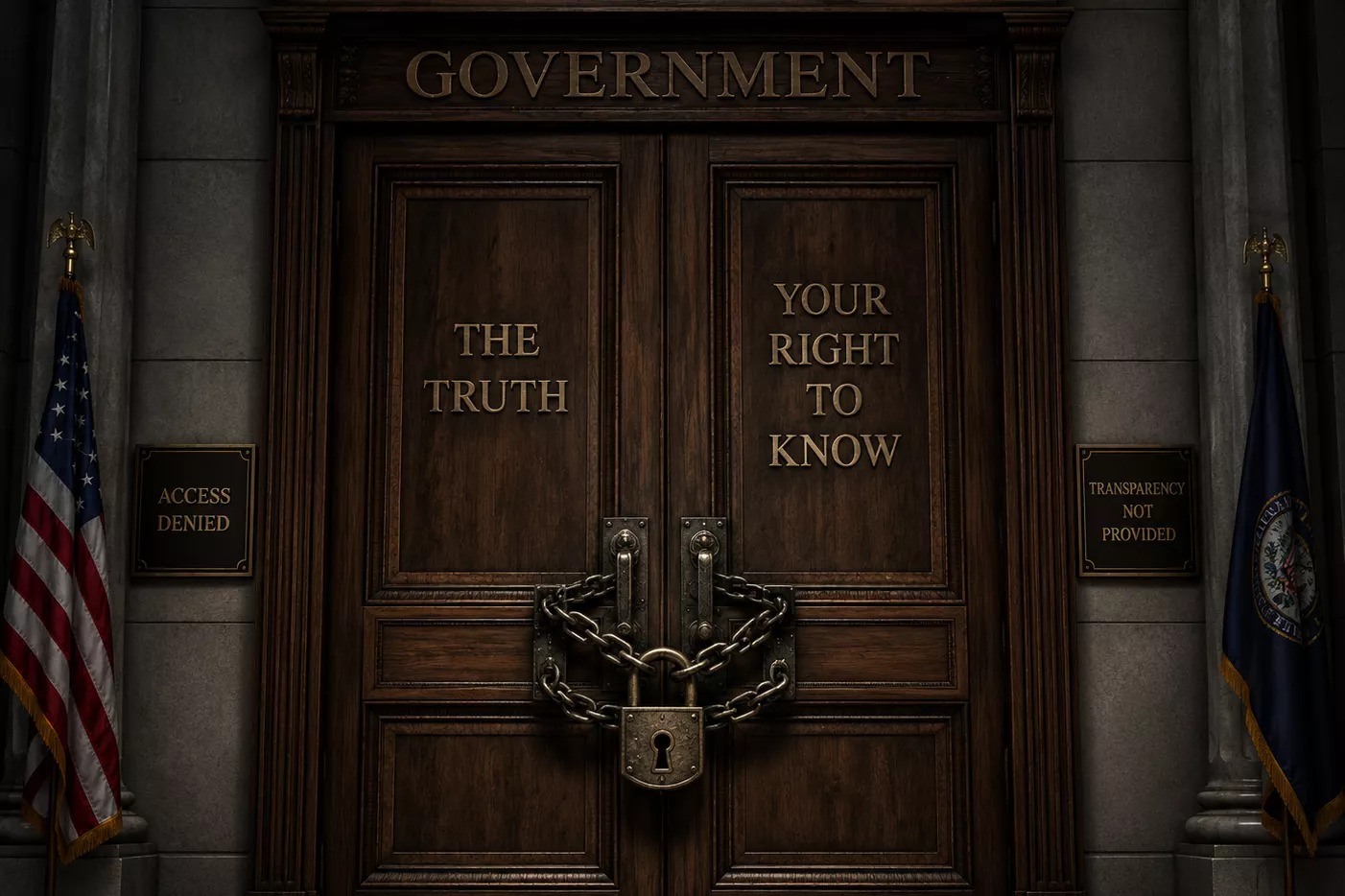
Close the door, you’re making me crazy!
Wisconsin government is shot through and through with TDS.
No, not that TDS. This one: Transparency Derangement Syndrome. There’s just something that makes government officials in this state— both elected and not elected—go absolutely berserk at the slightest thought of open government.
And no matter how many times it’s written about, or litigated, it never gets any better. In fact, it’s been getting worse for some 20 years now. Wisconsin was once a national leader in open government, but both political parties have spent decades weakening and evading transparency laws. That’s why, about five years ago, I wrote the book Dark State, and that’s why, five years later, I need to write about this sad state of affairs again.
It’s pretty annoying.
Just in the past month alone, three new lawsuits have been filed over open government, and in each case the outcome should be an easy decision. First, the Wisconsin Institute for Law & Liberty (WILL) has filed a lawsuit accusing the state Department of Public Instruction of effectively denying records by attaching a $34,014 price tag to electronic records that had already been located.
State law, of course, only allows agencies to charge the actual and direct costs of fulfilling a request and for location, and the latter at the hourly rate of the lowest-paid employee capable of doing the search. In this case, the agency had already located the records, not to mention that manual review of each record isn’t chargeable. Here’s how WILL explains what is going on with what it calls DPI’s “transparency tax”:
"On August 13, 2025, WILL requested records from DPI of applicants denied an educator license since 2018 for failing to complete an approved program. After months of silence, DPI finally acknowledged locating 1,381 denied applications but demanded an unauthorized $17,007 to ‘review them by hand’ at $49.26 per hour. WILL attempted to narrow the request, DPI raised the cost of the records from $17,007 to $34,014. …. WILL has filed a lawsuit asking a judge to step in and compel DPI to immediately release records regarding denied educator licenses."
The larger point here isn’t merely excessive fees; it’s that agencies have learned they can frustrate requests through cunctation and cost rather than outright denial, as WILL associate counsel Lauren Greuel put it, “After months of delay, DPI is attempting to price the public out of that access by imposing tens of thousands of dollars in unlawful fees. Government transparency cannot depend on whether citizens can afford to pay for it.”
Would it be that the agency’s antics were as rare as the use of the word ‘cunctation,’ but, alas, that’s not the case. It’s routine.
Accordingly, there’s more on the recent docket. Wisconsin Right Now and the Milwaukee Journal Sentinel are challenging redactions in Capitol Police reports involving Rep. Sylvia Ortiz-Velez (D-Milwaukee). That’s two dramatically different editorial viewpoints and one defense of transparency. In this case, according to Wisconsin Right Now (WRN), Ortiz-Velez was “charged with a crime for allegedly threatening to tell news media about blacked-out conduct by other Democrat legislators.” There was a plea and a fine, WRN stated, but the DOA redacted the police reports using multiple inadequate reasons, including that the information was “rumors and hearsay” and related to “mental health information.”
In other words, as WRN’s Jessica McBride said, the state released unproven allegations about Ortiz-Velez but redacted the allegations she made about her accusers.
Attorney Tom Kamenick of the Wisconsin Transparency Project filed the lawsuit on behalf of WRN and the Milwaukee Journal-Sentinel on July 8, saying, as WRN reported:
“A sitting legislator was criminally convicted based on an investigation that was kept entirely secret until the criminal complaint was filed. The criminal complaint itself was vague and obscured not only who had made the accusations against Ortiz-Velez, but what misconduct Ortiz-Velez had accused the other legislators of committing. The records DOA finally released redact the same information. This whole case is a travesty of transparency.”
A travesty of transparency indeed, otherwise known as TDS.
Don’t quit reading now, there’s even more (spoiler alert: There always is). In June, the Institute for Reforming Government (IRG) sued the state DPI over what it alleges is a 2024 secret meeting in the Dells costing $368,885, a meeting that it says led to a weakening of state testing standards. The posh closed-door sessions were not noticed to the public, were not open to the public, and participants were required to sign blanket non-disclosure agreements, IRG alleges.
Following the conference, The Dairyland Sentinel and IRG sought records after encountering a year-long delay. IRG filed a formal verified complaint in April, IRG reports, and, after the Adams County district attorney sat on her keister, refusing to take steps to compel the giant state agency to obey the law, IRG filed the lawsuit, which alleges that DPI violated the open meetings law and asks that any actions taken as a result of the meeting be declared null and void. Kamenick’s Transparency Project is also representing IRG in that effort.
Not to be outdone by Democratic bureaucracies, the GOP-controlled legislature managed to score high on the darkness meter with its own 2026 shenanigans, especially after WisconsinEye, the state’s long-running portal into state government proceedings, nearly failed and had to briefly shut down.
With WisconsinEye off the air, Republican leaders in the legislature naturally thought it would be a good time to shut down all opportunities for the public to see what they were doing, so they began enforcing an obscure internal rule that bars members of the general public—including lawmakers—from recording legislative proceedings unless they are credentialed members of the media or otherwise authorized.
The shutdown left Wisconsinites who could not personally attend legislative proceedings without remote access for the first time in nearly a score of years, and, against that backdrop, legislative leaders began cracking down on those who could attend. A January 7 memo from Senate chief clerk and director of operations Cyrus Anderson to Senate majority leader Devin LeMahieu (R-Oostburg) laid out the Senate’s position:
“No persons other than members of the chief clerk’s staff, members of the staff of the sergeant at arms, members of a senator’s staff, and accredited correspondents of the news media may engage in any audio or video recording of the proceedings of the senate or any committee without permission of the committee on senate organization. …Members of the public are generally prohibited from recording committee proceedings unless they are credentialed press or have received specific authorization by the Committee on Senate Organization.”
An Assembly rule imposed restrictions on recording and conduct in that chamber and the visitor galleries as well. In other words, you had better represent a government-approved media outlet if you wanted to make a distributable record of what they were doing, even though taxpayers were paying for the meetings and lawmakers supposedly work for the citizens. The message was simple: “Wisconsin is open for lobbyists and government propagandists. Citizen peasants not allowed.”
Especially seeing-eye citizen peasants.
Look around the 2026 Wisconsin political landscape, and it’s apparent that Wisconsin does not have a Republican transparency problem or a Democratic transparency problem. It has a government transparency problem. Taken together, it’s a continuing pattern of TDS—Transparency Derangement Syndrome.
A broken record of secrecy and lawlessness
Now all this over-zealous and irrational fear of openness did not simply pop up randomly like a cluster of summer thunderstorms. They are, in fact, part of a decades-long retreat from openness, as I wrote in Dark State. Wisconsin’s decline has been steep, bipartisan, and remarkably consistent. So let’s take a look at the most egregious examples, culled from the greatest hits album of the past two decades.
And there’s no better place to start than with the legislature’s own exemption of itself from state records-retention laws. Turns out, the renewed enforcement of recording restrictions is merely symbolic of the legislature’s broader exemption from state open government laws and its disdain for the public.
Unlike state agencies and local governments, the legislature is not subject to Wisconsin’s records retention law, which generally requires public records to be preserved for at least seven years under the supervision of the Public Records Board. That exemption—an effective exemption from the open records law itself—allows lawmakers to discard or erase records at any time before an open records request for the record is made, including communications with state agencies and interest groups.
So if you’re seeking a public record from a lawmaker, the lawmaker has to turn it over—unless, of course, the lawmaker shredded it the night before in a fever fit of Transparency Derangement Syndrome.
This year’s legislative epidemic of TDS also recalls a failed 2015 attempt by the GOP to repeal the entire open-records law, a move that, at the time, triggered an immediate and bipartisan backlash. The proposal, introduced quietly before the Fourth of July holiday, earned thousands of enraged email responses from across the political spectrum within days and was abandoned less than 48 hours after being approved by the Legislature’s Joint Finance Committee. But where there is a will, there is a way, as they say, and the legislature keeps trying.
At the same time, the Legislature has in the past resisted releasing records of internal investigations into alleged lawmaker misconduct, despite court rulings holding that records of closed disciplinary investigations of public employees are generally subject to disclosure under Wisconsin’s open-records law.
Also, over the years, lawmakers have continued to attempt to eliminate or restrict the state’s online circuit court database, narrowing the information it lists, specifically by removing records of charges when there is an acquittal or when charges are dropped.
And, by the way, if it looks like, on balance, the Republicans might be worse than Democrats, well, no. The collective behavior of predominantly Democratic state agencies can only be described as a universal outbreak of the TDS plague, in which they delay and delay and try to charge exorbitant fees. See the three latest lawsuits for a primer on bureaucratic intransigence.
When agencies are challenged, though, judicial decisions are increasingly hostile, such as in 2022’s Friends of Frame Park v. City of Waukesha in which the high court, in a 4-3 decision, threw out the standard at the time that, if a requester sued and the lawsuit caused the government to release the records, the requester could still recover attorney fees, even if the government surrendered the records before a judge formally ordered their release.
That rule discouraged agencies from simply stonewalling until litigation began. In Frame Park, the Supreme Court freed bureaucratic demons to simply sit on records requests until those seeking the records were exhausted financially and politically. After the Supreme Court narrowed what had been one of the principal enforcement mechanisms of Wisconsin’s open records law, legislation to reverse it was introduced, but—surprise, surprise—the statutory fix never crossed the finish line, leaving requesters with reduced leverage against agencies that choose to delay.
And, as I have written here before, Tony Evers is arguably the least transparent governor of all time, a governor whose administration has chipped away at the law here and there, trying to deliver death by a thousand cuts. To cite just one example, Evers’s office denied multiple records requests for the governor’s emails by television station FOX6 news reporter Amanda St. Hilaire on the grounds that they lacked a specific subject matter, even though each request met the legal standard by having a specific and reasonable timeframe.
He later released one day of emails but continued to insist he did so because he wanted to, not because he had to. In this ploy, the governor’s office was literally trying to rewrite the law to require both subject matter and a timeframe, even though the law plainly states otherwise.
In the legislature, there was MacIver v. Erpenbach, in which then state Sen. Jon Erpenbach (D-Middleton) tried to hide the identities of more than 25,000 pages of emails from people who contacted him during the state’s 2011 Act 10 controversy. He lost. The MacIver Institute successfully argued that it was critical for the public to know who was communicating with lawmakers on matters of public policy, including where those communications came from, and the court agreed.
I could go on and on. Not only has neither party defended transparency except in press-release rhetoric, but each has attacked it with lethal vengeance. In fact, there’s so much Wisconsin-style TDS out there that someone could write a book about it!
The real cure for TDS
I will say this. There are some true transparency advocates on the progressive left as well as on the reasonable right. There is likewise a host of needed reforms that the next governor and the legislature should immediately consider when the legislature convenes next year.
Or let’s say it this way. If the next governor and legislature truly want to preserve our democratic foundations, if they truly want a transparent system in which laws are enacted and rules promulgated based on citizen input rather than on special-interest manipulation, they will immediately enlist transparency advocates from across the political spectrum to restore openness to government.
In Dark State, I laid out a few ideas, and I repeat some of them here. I don’t claim these ideas as my own, for a multitude of reasonable observers have floated them over the years. Only now it is becoming crucial that these ideas stop floating and begin swimming toward the shore of actual reform:
#1 Convene a stakeholders’ group to reform and update open government laws
This idea has been advanced time and time again: a diverse group of stakeholders needs to be established to comprehensively revisit the open government laws and update them. Former Gov. Scott Walker promoted the idea during his first campaign for governor, and, in 2015, then-attorney general Brad Schimel hosted an open-government summit to address the law’s inadequacies, acknowledging that many in the public and media viewed the state’s open meetings and public records laws as outdated.
#2 Establish an administrative appeals process for citizens
When the open government laws were overhauled in the early 1980s, a critical piece of reform was proposed but deleted from the bill: the establishment of an Ethics and Open Records Board to provide oversight and accountability.
For average citizens who do not have the time or money to contest record denials or other open-government violations by government agencies and officials, this is a crucial reform. Among other things, the board should be able to review denials of access to a record, especially in an age when most district attorneys simply will not seriously prosecute transparency violations (as we see in the latest IRG case), and requesters are compelled to pursue expensive and burdensome litigation if they want their records.
It’s important that legal groups now exist to undertake those efforts on behalf of citizens, but it’s not nearly enough. It would be better still if citizens didn’t have to go to court in the first place.
To further those goals, state law should establish an administrative appeals process that must be responded to within a limited time prior to filing litigation, that could review and overturn record denials, and that could review proposed costs for fulfilling records requests, among other things.
The membership of the board should be split between those appointed by elected officials—the governor, the attorney general, the Assembly, the Senate—and members appointed by various ideologically balanced stakeholder groups, such as broadcasters and newspapers, and non-media groups that advocate for open government, such as the MacIver Institute, the Wisconsin Freedom of Information Council, Wisconsin Institute for Law & Liberty and others.
#3 Establish strict statutory deadlines for responding to records requests
Wisconsin’s records laws are simply too vague regarding the time allowed to respond to a records request, allowing government officials to substantially delay the production of records.
Let’s take a page from other states and add time specificity, with a mechanism that allows agencies reasonable time to fulfill complex requests. The state could impose a five-business-day deadline for an initial response, giving the body five days to provide the records, deny the records request with reasons, or request more time. If more time was needed, the government body could invoke a 10-day automatic extension, which would be unappealable.
Or the government body could say it needs even more time and advise the requester of the additional time required. That last action would be administratively appealable, and if the extended time was granted, the agency would relinquish any claim to costs. Under that proposal, no agency could delay fulfilling an open records request beyond three weeks without risking an immediate administrative appeal with possible penalties.
#4 Inserting consequences for violating open government laws
Right now, there simply is no accountability. Even in cases where officials are found guilty of breaking open government laws, the law doles out only a slap on the wrist.
Ideally, the solution would be to substantially increase penalties for intentional violations and criminalize certain infractions. Current penalties are laughably weak or nonexistent; for instance, an open meetings violation is simply a forfeiture of $25 to $300.
For purposes of records, currently any authority or legal custodian who arbitrarily and capriciously denies or delays a response to a request or charges excessive fees can forfeit not more than $1,000. In addition, a public records infraction may involve criminal penalties only for destruction, damage, removal, or concealment of public records with intent to injure or defraud, or for altering or falsifying public records.
All other infractions involve civil forfeitures.
Those laws should be amended so that capricious withholding of records, intentional charging of excessive fees, or intentional violations of the open meetings laws carry criminal rather than civil penalties, with the most serious infractions classified as felony misconduct in office.
#5 Enact laws to end excessive fee charging
Under the law, Wisconsin officials can’t charge copying fees greater than their actual cost, but there’s a loophole (the charge can be higher “if established by law”), and the statute is often ignored anyway, while authorities charge exorbitant fees for simply locating public records. Again, reference the latest WILL lawsuit against DPI.
In the first instance, the statutory loophole should be eliminated, and citizens should be able to appeal excessive fees administratively. Authorities should annually evaluate their copying costs, based on the actual costs of a copy machine or contract, and the actual cost of paper. Those itemized costs should be publicly posted as a per-page cost of copying.
As for location costs, how about doing away with them entirely, as one-time DNR consultant Helen Flores advocated long ago? After all, location costs are much lower in the digital age than they were years ago when paper files had to be physically searched. These days, location times are minimal and, in any case, should be seen as a cost of doing the people’s work, already paid for by taxpayers as a core function of government.
#6 Put the Legislature under the records retention law
This is the biggest no-brainer of all. The Legislature is the central elected body of our state government, its heart and soul. If that body does not take open government seriously, if it defiantly sets itself above the laws others must follow, then we simply cannot expect to have a broadly open government, not in state agencies, not in the governor’s office, and not in local governments.
#7 Establish a constitutional right to know
If you ask someone whether open government is fundamental, they will naturally answer in the affirmative, but it only runs tongue deep. It seems to be an easy decision, on the one hand, but most people don’t view it as essential as, say, the First Amendment, or freedom of religion. Sure, it’s essential, people say, but it’s not like it’s one of the Big Ten Amendments.
It can be argued that open government and transparency are implicit in the First Amendment, as both freedom of speech and freedom of association are implicated. The right to petition the government for a redress of grievances is especially implicated.
As such, open government is most often subsumed under the First Amendment. It’s there, to be sure, but it doesn’t get its own seat at the table like religion and the press. We need to create that seat at the constitutional table.
That’s exactly what Florida did way back in 1992. The Florida state constitution gives “every person the right to inspect or copy any public record made or received in connection with the official business of any public body, officer, or employee of the state, or persons acting on their behalf, except with respect to records exempted pursuant to this section or specifically made confidential by this Constitution.”
The provision applies to the legislative, executive, and judicial branches of government and to every agency or department created by the three branches, as well as to counties, municipalities, and districts; and to each constitutional officer, board, and commission, or entity created pursuant to law or the constitution.
The Florida Constitution allows exemptions, but they must be passed by a two-thirds vote in each house of the Legislature and signed into law. Use Florida as a model—which is usually a good idea—and create a constitutional right to know in the Badger state.
There are many other needed reforms: ending certain judicial and law enforcement system exemptions; statutorily requiring legislative drafting files to be public records; reform of attorney client privilege to make clear that the privilege applies only to confidential communications from the client to the lawyer, and more.
With all these issues on the table, the most important thing is for candidates committed to transparency in both parties to stand up and declare it a priority next year. Otherwise, special interests, not citizens, will continue to be the deciding force in Madison.
TDS in Wisconsin will not just be pandemic, or endemic, but hyperendemic, and that could be fatal to our democracy.

Interested in the content of this Article?
Reach out to the MacIver Institute to aquire more information


