
- Podcasts
 Podcasts
 - Videos
 Videos
 - Policy Issues
 Policy Issues
 - About
 About
About


Only One Side Is Playing the Game
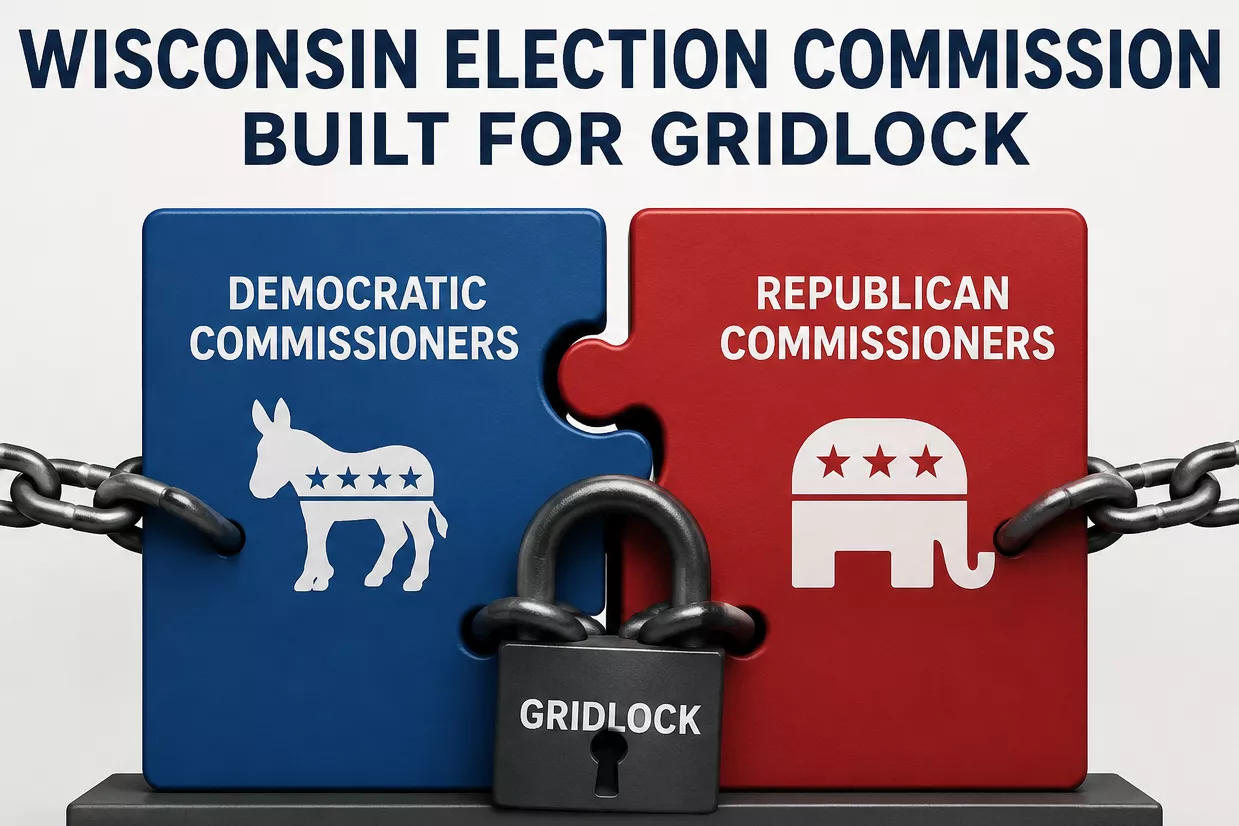
The Wisconsin Elections Commission was never meant to be a neutral referee. It was deliberately built as a 3–3 partisan body so that Republicans and Democrats would fight for their respective interests and only reach agreement when both sides could live with the outcome. That design, based on a theory of adversarial balance, written into the enabling statute when the agency replaced the old Government Accountability Board, is now producing the opposite of fair election administration: one party aggressively advances its agenda while the other largely refuses to fight.
The recent lawsuit over absentee ballot spoiling makes the imbalance impossible to ignore. Democratic voters sued to allow people who have already returned completed absentee ballots to spoil them and cast new ones, a change that would tilt the scale in favor of the Democrats, as candidates drop out or re-enter the race, as has happened repeatedly in the 2026 Democratic primary for governor. Commissioners Ann Jacobs and Mark Thomsen, both Democratic appointees, are seeking to intervene in the case on the side of the plaintiffs. At the same time, Jacobs has publicly endorsed candidates in that same primary, shifting her support from David Crowley to Sara Rodriguez and back to Crowley. A Dane County District Judge ultimately upheld WEC’s election rule barring absentee ballot revotes.
That combination, public candidate endorsements plus formal intervention in litigation that could benefit one party’s primary voters, would raise immediate conflict-of-interest questions in almost any other state agency. On the Wisconsin Elections Commission, it is treated as business as usual by one side.
Moreover, Wisconsin Statute 5.05 sets forth the duties of the Commission and some are quasi-judicial which would require an unbiased decision based on the record rather than biased partisanship. They have investigative duties which are police powers and must be conducted in a neutral and fair fashion or it becomes a political witch hunt with prosecutor power.
Designed for Combat, Not Neutrality
The original legislative intent was clear: three Republican commissioners and three Democratic commissioners were supposed to act as partisans. The structure was intended to force negotiation and prevent either party from unilaterally rewriting the rules. Democrats understood the assignment. Jacobs, Thomsen, and their colleagues consistently vote and litigate as advocates for Democratic priorities. For example, their recent efforts to allow voters to spoil already-returned absentee ballots and cast new ones (even though Wisconsin law contains no provision permitting a voter to obtain another absentee ballot after submitting a completed one, requires clerks to securely seal returned ballots and leave them sealed until Election Day). Even worse, they offer no rules or safeguards to verify that a person seeking to destroy a previously submitted ballot is actually the original voter or their designated agent.
Republicans, with the notable exception of Commissioner Bob Spindell, largely have not. Too many treat the commission as if it were a conventional administrative agency whose job is to stay above the fray.
That misunderstanding has consequences. When one side plays hard and the other plays nice, the “deadlock” becomes a one-way street. Guidance shifts, lawsuits are joined, and public messaging is dominated by the party willing to use every tool available.
On recent election-integrity votes, GOP Commissioners Don Millis and Marge Bostelmann voted with the Democrats.
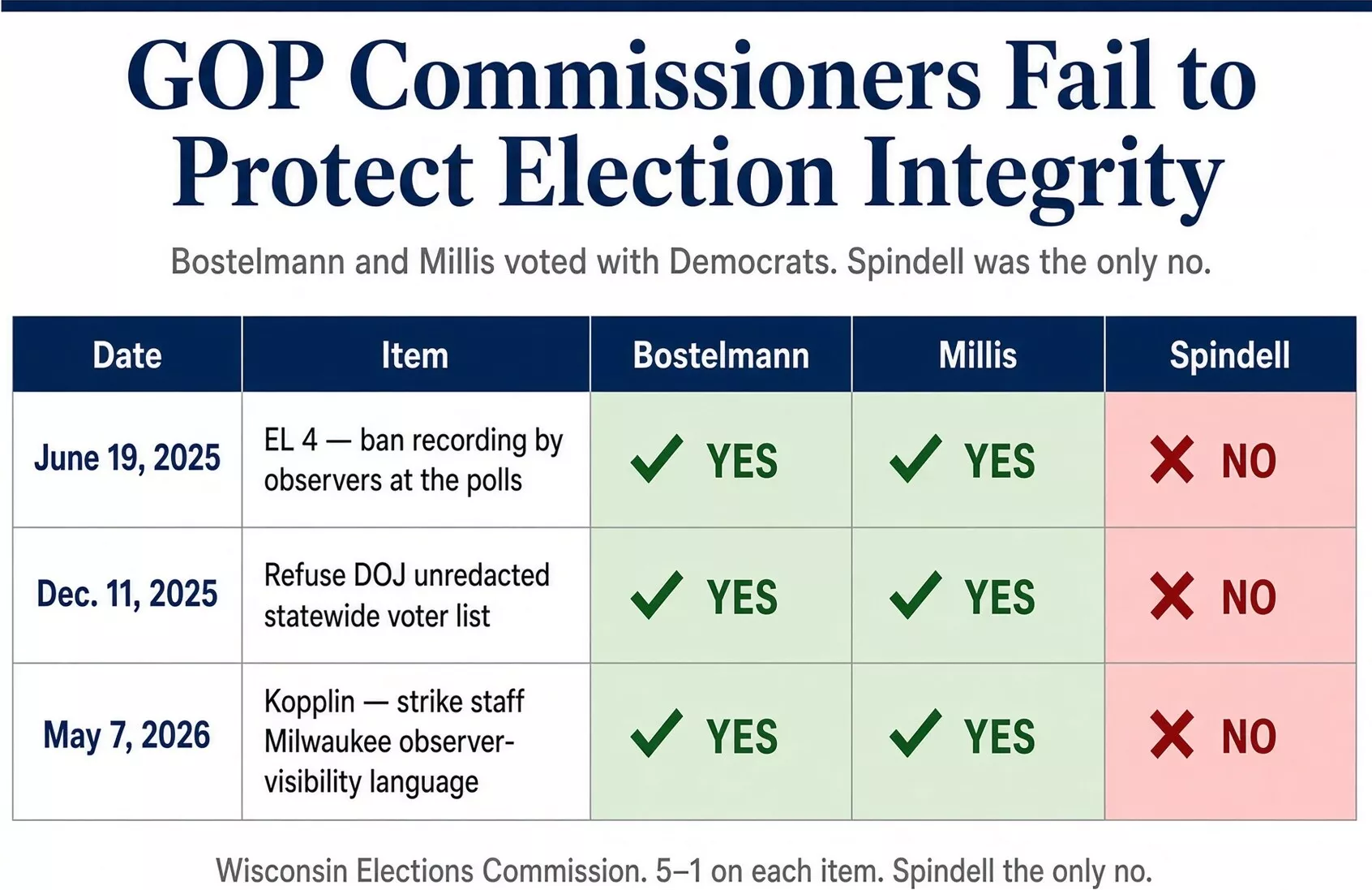
On June 19, 2025, WEC passed a new observer rule which prohibited any recording at the polls. Wisconsin law already lets the public watch every public step of voting. A recording is only a durable copy of that view, with the booth and the face of a voted ballot off-limits, so a reprint, a bad export, or a poll-book error can be proven later instead of argued from memory. If cameras are safe at central count and at a recount, they are safe at the ward.
On December 11, 2025, US DOJ asked for the full statewide list (including DL / last-four SSN) to check for non-citizens. Millis voted with the majority to refuse the unredacted file and argued the confidentiality statute is bipartisan consensus.
Wis. Stat. § 6.36(1)(bm) lets WEC share restricted voter data with law enforcement for law-enforcement purposes, and with other states for official purposes, and checking the rolls for non-citizens is a law-enforcement purpose. States that actually check keep finding non-citizens on the rolls, sometimes in the hundreds or thousands per state.
On May 7, 2026, WEC staff recommended more transparency at Milwaukee Central Count in Kopplin v. Gutierrez (EL 25-64), including observer view of absentee sorting and processing next to the canvass. Commissioners Millis and Bostelmann voted with the Democratic commissioners to strike that staff language. Wis. Stat. § 7.41and Wis. Admin. Code ch. EL 4 still require the count to be observable.
Not Like Any Other State Agency
Compare the Elections Commission to the Department of Natural Resources or other major state agencies. Those boards may be controversial, but the actual secretary or cabinet officer is appointed by the governor and is accountable through the normal executive chain of command. Agency rules are promulgated under Chapter 227 rather than by adversarial fiat from a part-time board. The Elections Commission is different. Its six part-time, low-paid commissioners (roughly $100 per meeting) select and oversee the state’s chief elections officer. That officer, currently Administrator Meagan Wolfe, holds substantial power under the Help America Vote Act, yet is insulated from normal democratic accountability by an unelected body of part-time commissioners that was never designed to operate as a neutral administrative and regulatory agency.
The result is an institution that is neither a true bipartisan check nor a professional nonpartisan administrator. It is a partisan battlefield on which only one army consistently shows up.
The Cost of the Imbalance
Wisconsin has experienced years of litigation, shifting guidance, and public distrust since the commission’s creation. The absentee ballot spoiling fight is only the latest example. When Democratic commissioners endorse candidates, join lawsuits that favor their party’s voters, and drive policy while Republican commissioners hesitate to act as the partisans the statute envisioned, the agency ceases to function as either a fair referee or an effective regulator.
Public awareness of this structural failure is essential. The Wisconsin Elections Commission was built for partisan combat. One side understood the rules of engagement. The other has spent years pretending it was something else. Until that imbalance is confronted, either by Republican commissioners embracing the role the law assigned them or by a fundamental redesign of the agency, Wisconsin will continue to have an elections body that serves neither neutrality nor genuine bipartisan accountability.
Correction: The earlier statement that Republican Commissioner Don Millis published an op-ed supporting Ann Jacobs’s position on ballot spoiling was incorrect. Millis voted against Jacobs on the July 9 WEC guidance and later wrote that once an absentee ballot is returned, the law does not allow a voter to retrieve it to change their vote. The revised article has removed this statement.

Interested in the content of this Article?
Reach out to the MacIver Institute to aquire more information


