
- Podcasts
 Podcasts
 - Videos
 Videos
 - Policy Issues
 Policy Issues
 - About
 About
About


EPA's $94 Million Lead Pipe Replacement Grant
In May, the Environmental Protection Agency (EPA) announced that Wisconsin would receive $94.3 million to identify and replace lead service lines, part of nearly $2.9 billion distributed nationally through the Drinking Water State Revolving Fund (DWSRF). The money comes from the 2021 bipartisan infrastructure law, which set aside $15 billion nationwide for lead service line identification and replacement.
That money is not sent directly to homeowners. Instead, it flows through Wisconsin's Safe Drinking Water Loan Program, administered by the Department of Natural Resources (DNR), which provides communities with a mix of low-interest loans and principal forgiveness. Principal forgiveness is essentially a grant—the municipality does not have to repay that portion of the loan. Under the infrastructure law, the EPA requires that 49% of lead service line funding be distributed as grants or principal forgiveness for disadvantaged communities.
Wisconsin is receiving another infusion of federal money to tackle its lead pipe problem, but some prominent Democrats have argued that the proposed federal budget will not provide enough funding for clean water initiatives and lead pipe replacement. While nearly everyone agrees that lead in drinking water is bad, where the money should come from to replace those pipes is another question entirely.
The source of lead pipe replacement funding has changed over time. As Richard Moore points out in a recent article, Congress has increasingly shifted funding away from State Revolving Fund (SRF) loans and toward one-time grants for specific projects. The tradeoff is that loan repayments, which would normally revolve back into the program to finance future infrastructure projects, disappear once the money is given away as grants.
Since Wisconsin's Lead Service Line Replacement Program began, the DNR and Department of Administration have provided more than $267 million to municipalities for lead service line replacement projects.
According to the DNR's funding tables, Wisconsin received $48.3 million in federal lead replacement grants in fiscal year 2022, $81.2 million in 2023, $83.3 million in 2024, and $101.4 million in 2025, with another estimated $101.4 million projected for 2026. Wisconsin has also received reallocated lead replacement funds from other states.
Despite those investments, the total cost of replacing Wisconsin's remaining lead service lines is expected to be far higher. According to the DNR, Wisconsin still has more than 132,000 known public side lead service lines, 128,000 known private side lead service lines, and more than 208,000 service lines of unknown material that could contain lead. While state funding has been substantial, the federal infrastructure law has become the state's largest current source of funding for replacements.
Contributing to the high cost is that replacing a lead pipe is labor intensive. Contractors often have to excavate streets, sidewalks, and private yards, replace the entire pipe, restore pavement and landscaping, inspect the work, coordinate between parties, etc. Depending on the conditions, replacing a single lead service line can cost several thousand dollars.
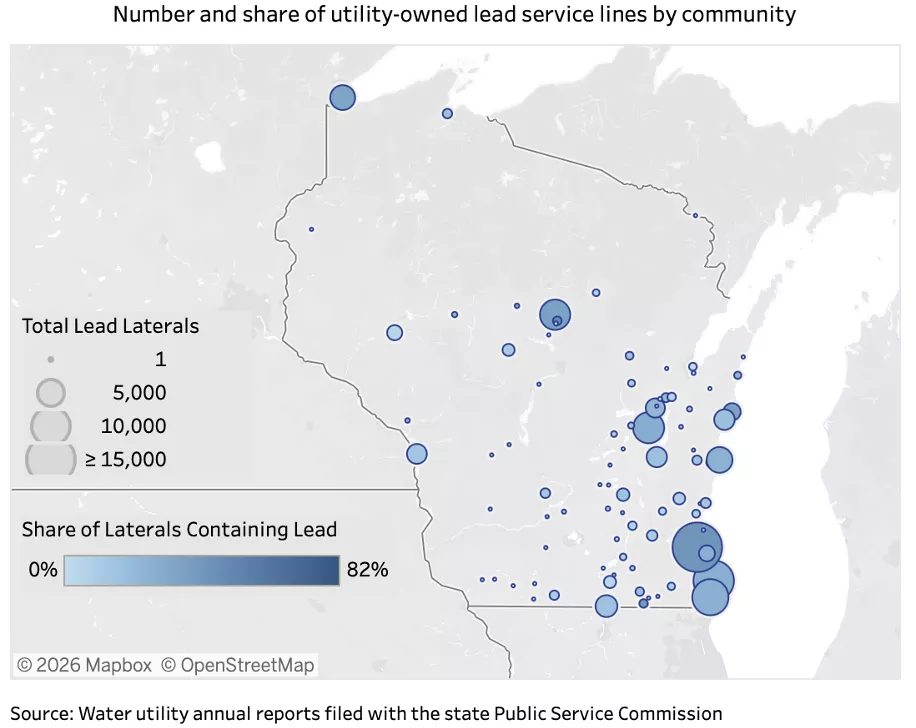 Wisconsin Policy Forum, Getting the Lead Out (click image for source)
Another factor complicating replacement is that responsibility for the pipes is often split between utilities and homeowners.
In most Wisconsin communities, the section of pipe running from the water main beneath the street to the curb stop is owned by the utility, while the portion running from the curb stop into the home is privately owned. For years, homeowners were often responsible for paying thousands of dollars to replace their portion of the line. Utilities also generally need a property owner's permission before replacing lead pipes on private property. More recent federal and state funding now allows municipalities to use public dollars to replace privately owned lead service lines, though those programs vary by city.
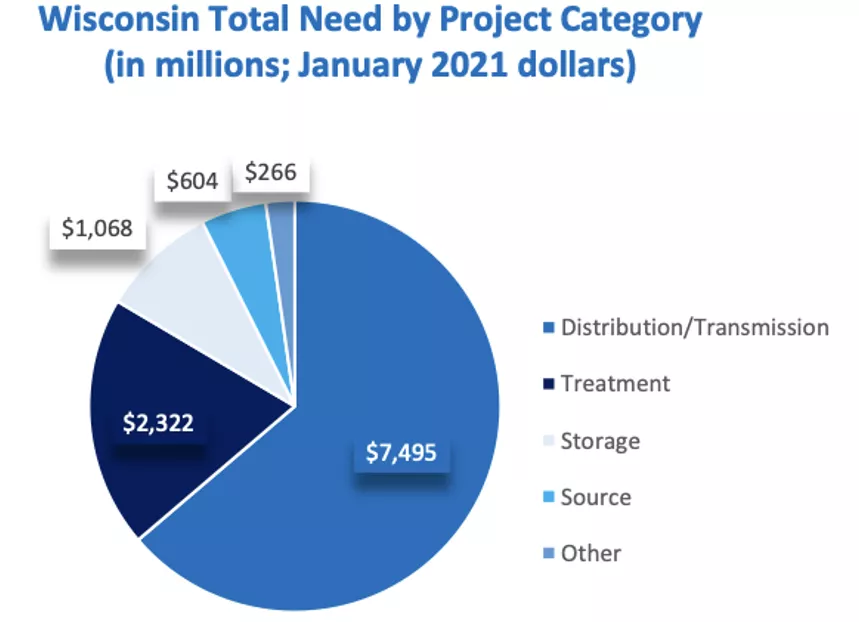 EPA, Seventh DWINSA Report to Congress (click image for source)
Despite the magnitude of previous funding, the problem remains large. According to the EPA's most recent Drinking Water Infrastructure Needs Survey and Assessment, Wisconsin's long-term drinking water infrastructure needs roughly $11.8 billion over the next 20 years, though that estimate is for more than just lead pipe replacement.
Wisconsin has now received and allocated hundreds of millions of dollars for lead service line replacement. But with more than 260,000 known public and private lead service lines still in the ground, along with more than 208,000 service lines of unknown material, Wisconsin's lead pipe problem is far from over.

Interested in the content of this Article?
Reach out to the MacIver Institute to aquire more information


