
- Podcasts
 Podcasts
 - Videos
 Videos
 - Policy Issues
 Policy Issues
 - About
 About
About


Doing Less With More
Jill Underly, the Wisconsin State Superintendent, criticized state leaders for failing public schools in her most recent State of Education address, and urged voters to choose leaders who will protect public education this November.
"For far too long, Wisconsin's public schools have been forced to do more with less," she said.
Unfortunately, Wisconsin schools are actually doing less with more.
Underly blamed the financial circumstances of today's Wisconsin public schools on "deliberate political choices" and criticized public officials for not providing "predictable, sustainable state funding that keeps pace with the cost of educating our children."
Because of this, Underly said, schools are forced to make the impossible choice to cut programs or increase class sizes, or to go to referendum to raise property taxes in their communities.
Underly told Wisconsinites to "just look at the numbers." But amidst all of the finger-pointing and claims about inadequate funding, Underly fails to actually address what the numbers show about the state of education in Wisconsin today.
According to a MacIver analysis of DPI's own Ratio of Students to FTE Staff data, Wisconsin lost roughly 70,000 students, or 8% of its enrollment, between 2016-17 and 2025-26. At the same time, administrative staff grew by 7.6% statewide.
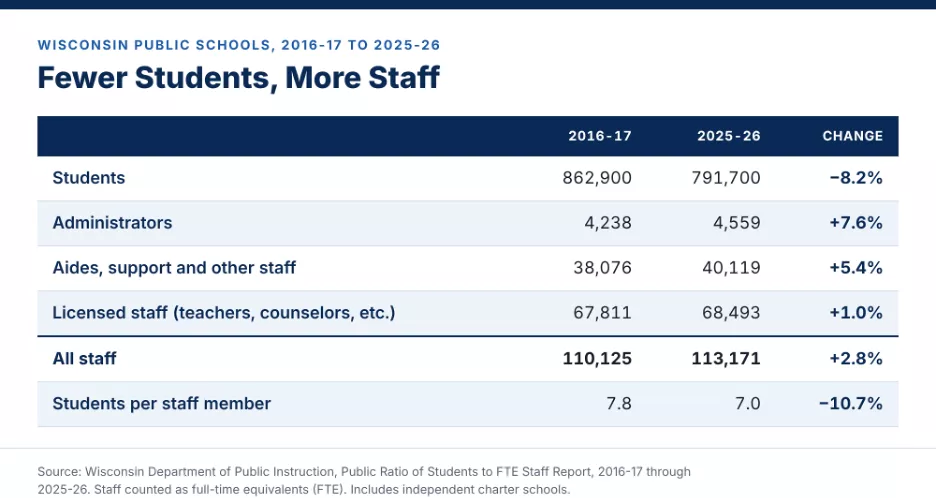
Every staff category grew while the number of students declined, but administration grew the fastest. Licensed staff, like teachers and librarians, grew by 5.4%, and aides grew by just 1%.
Of the 420 districts with comparable data, 81% now have fewer students per administrator.
During her speech, Underly said that over 90% of school districts have gone to referendum in the past nine years. Those are the same nine years in which Wisconsin schools lost 70,000 students and added administrators.
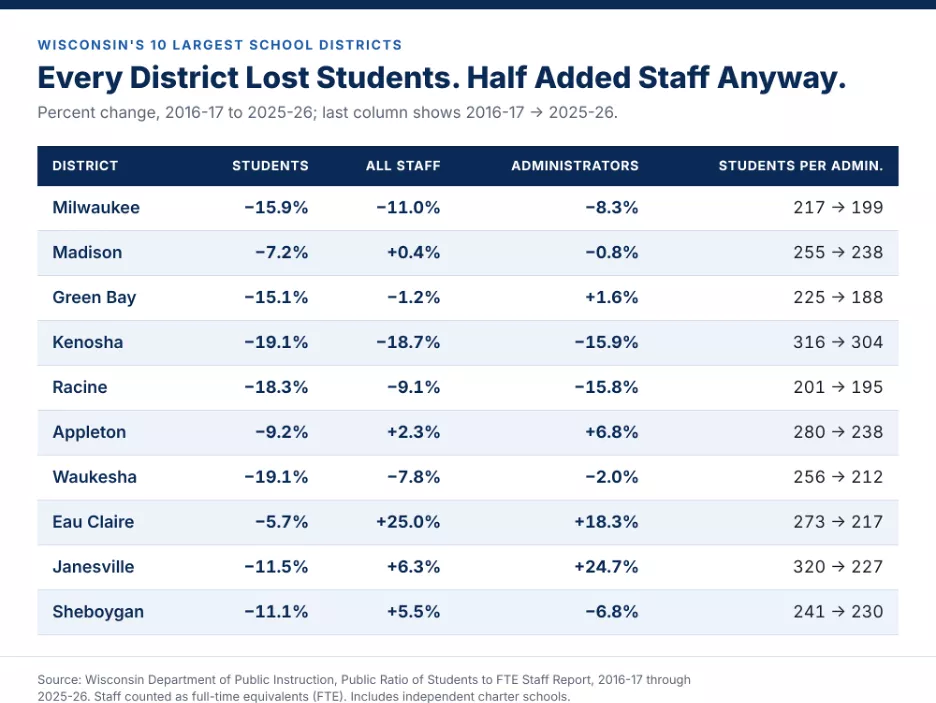
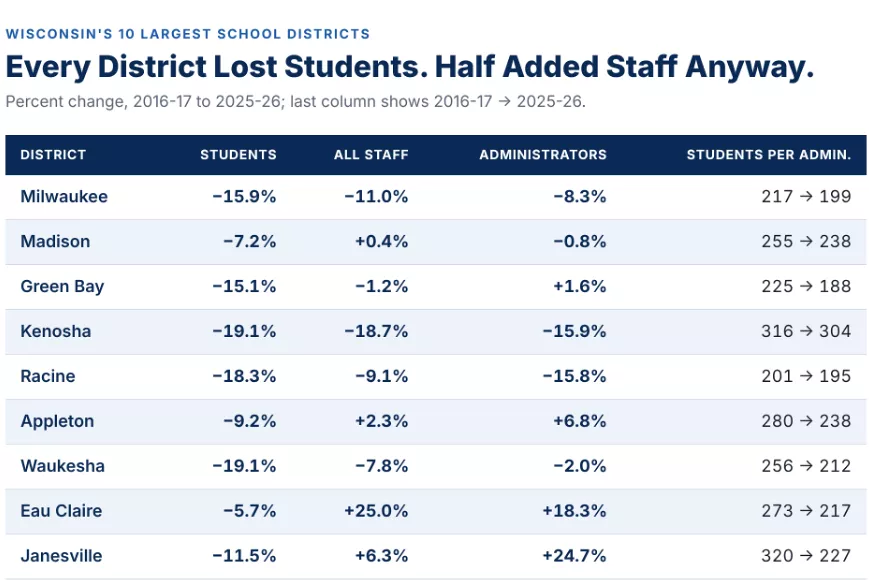
Eau Claire increased its administrators the fastest among Wisconsin's top ten largest districts with a 24.7% increase as its enrollment fell by nearly 6%.
Some districts have done a better job than others of adjusting their staffing, especially administrative staffing, alongside enrollment. Kenosha, for example, lost 19% of its students and accordingly reduced its administrative staff by close to 16%.
Education in Wisconsin today is marked by worsening academic achievement, near-record per-pupil spending, and declining enrollment, all while administrative positions have bloated.
The Wisconsin Institute for Law and Liberty found that on average, Wisconsin school districts spent nearly $19,000 per student in the 2024-25 school year. Meanwhile, Wisconsin fourth graders' average NAEP reading score fell as spending increased.
No one knows how much it costs to adequately provide Wisconsin students with a basic education. As MacIver senior fellow William Osmulski put it, "Public school advocates refuse to put a number on it." The answer, he wrote, is always simply "more."
If the public schools want more money in November, they should be able to prove that the money is going toward the betterment of Wisconsin kids' education, not toward bureaucratic expansion.
Interested in the content of this Article?
Reach out to the MacIver Institute to aquire more information


