
- Podcasts
 Podcasts
 - Videos
 Videos
 - Policy Issues
 Policy Issues
 - About
 About
About


Trump Fires BLS Commissioner
On August 1st President Trump fired Erika McEntarfer, commissioner of the BLS. In this White House press release, the administration cited "A lengthy history of inaccuracies and incompetence" as the reason for her termination.
The release goes on to list several examples of these inaccuracies, mainly tied to the BLS's monthly jobs report, the Current Employment Situation report. As the release says, the figures from the monthly jobs reports have been "consistently... overly optimistic."
Upon hearing that, all people should wonder, is that true? At the very least, we should want to know if they're inaccurate, first, before jumping to the same conclusion as the President that they're "rigged."
Are the Jobs Numbers Inaccurate?
Yes. Absolutely. Emphatically. Unequivocally.
But take note: this conclusion rests on the assumption that the revisions made by the BLS to their initial figures are accurate, or at least more accurate. So it is not the quality of the BLS's data or methods, or its ability that are cast into doubt, but of its leadership's political neutrality.
The Trump administration's claim is that the initial reports are political gimmicks providing cover for Federal Reserve Chairman, Jerome Powell, who continues to refuse to cut interest rates (by which is meant the Federal Funds rate).
Once the BLS releases the monthly jobs report showing high levels of job growth, low unemployment, and an overall healthy labor market, those initial jobs numbers are "quietly revised later."
There's a lot of credence to this claim. The revisions thus far made in 2025 are certainly suspect, but so are the final revisions for 2024––an important election year.
Let's dig in to the data...
Preliminary vs Revised Jobs Data
Nearly every month (with the exception being the end of the calendar year) the BLS releases a monthly jobs report called the Employment Situation. You can always find the most recent release of that report here. You can look at all of the BLS's jobs reports by visiting the archive here.
When that report is released there are two jobs surveys included: the Household survey (Table A), and the Establishment survey (Table B). It is the results of the establishment survey which make the headlines and receive the most scrutiny. The figures therein are considered the "official" jobs numbers, so we will focus on the Establishment survey. Accordingly, they are also the figures being criticized by Trump and his administration.
When the BLS publishes its jobs report for the month of, say, January, the number of jobs in each sector of the economy are Preliminary figures. One month later, January's job numbers will be Revised in February's report. This is the 1st revision. Then, again, when the jobs report for March is released, January's job numbers will be revised yet again. This is the 2nd revision. But at some point later that year, or early next year, January's job numbers will be revised a third time in what is called the Annual Benchmark Review. This is the 3rd revision.
Before President Trump started complaining about the BLS "cooking the books", ask yourself how many times you remember the legacy media reporting on any of these revisions. Did they even tell you the BLS conducted revisions? let alone three?
In any case, here's the data that has the Trump administration in a tizzy...

The chart above compares the initial, "Preliminary" jobs numbers to the 3rd and final revision of the jobs numbers from the 2024 Annual Benchmark.
What the Benchmark shows is that month-over-month job growth for the entire year of 2024 was overstated by 593,000 jobs!
How about this year? So far we have jobs reports through July, 2nd revisions through May, and the 1st revision of June. Spoiler: just half a year in, the revisions are already almost as bad as President Biden's last year.

What the chart above shows is that the BLS's initial "Preliminary" figures have overstated the number of jobs every single month this year by a combined 461,000 jobs! In other words, in just 6 months they've managed to create––from thin air!––78% of the jobs they created in 2024.
That is a truly staggering amount. Any president would complain about figures like that if they were used against him for political purposes. Remember: the BLS released very favorable jobs reports in 2024 for President Biden, but that didn't stop the Federal Reserve from cutting the Federal Funds rate three times in a single year.
President Trump is right to call out bureaucratic partisanship, even if his pursuit of artificially low interest rates is misguided.
For good measure, I've included a chart below that combines the 2024 and 2025 figures, and labels the revised figures by revision type. Below that, I've also included a chart that shows the average monthly revisions to the jobs data by year. To see tables that show Preliminary, 1st, and 2nd Revisions for every month of every year, click here.


But what's important to discuss now is whether the inaccurate jobs estimates are entirely the fault of the BLS...
Data or Politics?
The answer to the question of whether the BLS's inaccuracies are the result of partisanship politics or lackluster data collection is fairly straightforward: it's both.
How much weight should be given to either of these is unknown, mainly because we can't see the partisanship of BLS leadership as clearly as we can see how they collect and process their data. So with that in mind, I want to bring to your attention some longtime sampling issues that the BLS faces and suggest a few alternatives to how they collect their data.
First, the jobs report and many others rely on the voluntary reporting of survey participants. For many years, the response rate has been on the decline; particularly the Current Employment Situation survey.
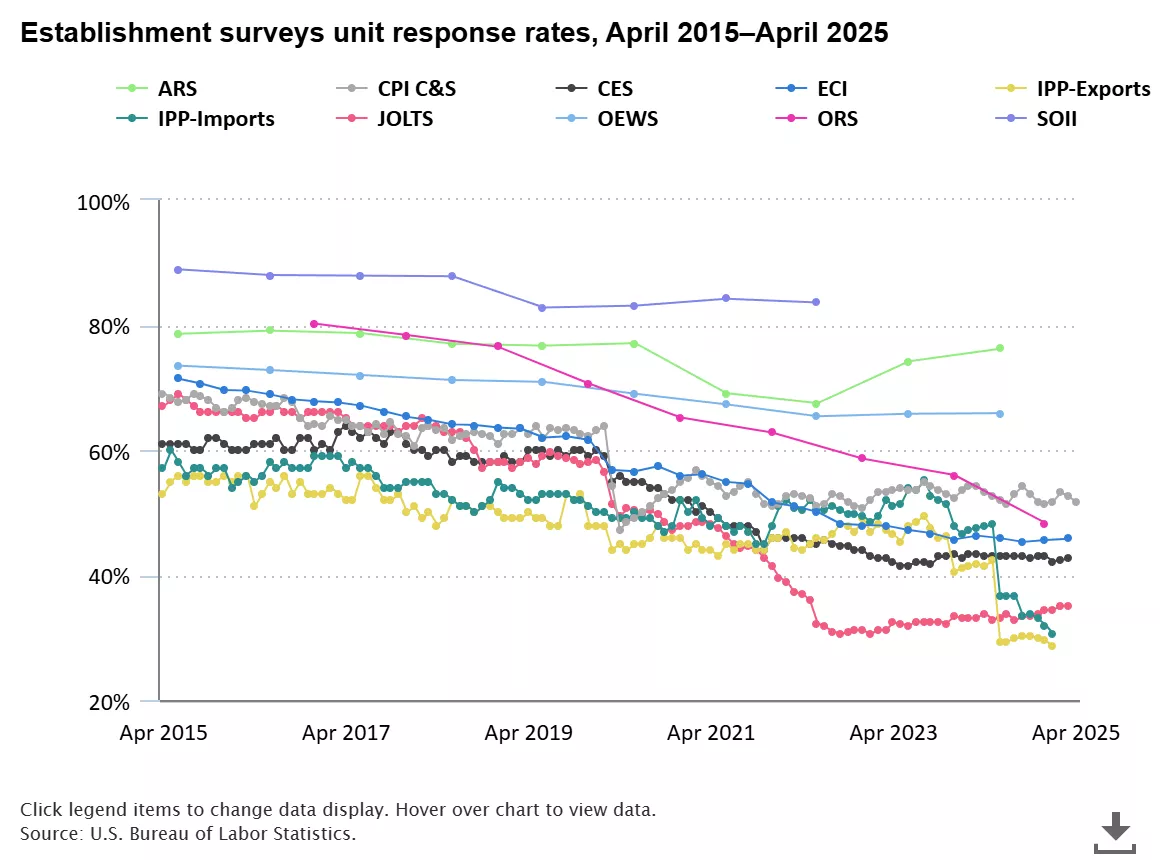
If you look at the black line for the CES survey, it's pretty much fallen off a cliff. In the span of 5 years it's gone from a response rate of around 60% to a little more than 40%.
Think about the implications of this... already you're dealing with a selective sample of private and public establishments who will only enroll if they have the time and manpower to respond. Then, a third of them stop participating.
Did they simply decide that they no longer wanted to be good citizens and help the Feds? Or were they marginal businesses who, due to worsening economic conditions, could no longer afford to dedicate their resources toward answering a voluntary survey which does not compensate them for their efforts?
Whatever the case, this turns a selective sample into a much more selective sample.
So what could the BLS do instead?
How to Get Better Data
First of all, the BLS could start by doing more of what they already do. They already conduct their Household employment survey which calls individuals at random. Yes, it still relies on self-reporting, but you don't have to worry about recruiting establishments to participate...you can just cold call individuals who can tell you their demographic info, number of jobs held, and their wages. This eliminates the problem of double counting that is present in the Establishment survey but absent in the Household survey (the establishment survey counts jobs, not the number of people employed).
Alternatively, offer an incentive to participate. Pay participants for their time. Give them the opportunity to enroll as a recurring survey respondent by creating an app or web portal. They can have individual accounts tied to their SSNs and receive a tax credit or debit to their bank account as payment. This also makes longitudinal studies more viable since you can track individuals over time (if you are worried that this will be used to spy on you, rest assured, law abiding citizens are already being spied on).
Secondly, BLS could avoid surveys entirely. They already do this when they conduct their Annual Benchmark Review by comparing their jobs estimates to the Unemployment Insurance data reported by the 50 states. Virtually every employer is required to report to the UI system already, and black market employers don't enroll in their surveys anyway. Further, the UI system collects and publishes UI data on a weekly basis.
Along these same lines, BLS could collect data from Payroll Service providers directly. Again, all of them collect demographic and personal identification data (e.g. addresses and SSNs) for purposes of reporting to the IRS. Pay them for their data (which is already digitized) and analyze it with SQL. Easy.
Or, finally, instead of all that, just go directly to the IRS! What the heck is W-2 for anyway! If you're gonna' shamelessly steal 30% of my income every year you might as well present your plunder in an easily accessible database so we all can have an easier time criticizing you.

Interested in the content of this Article?
Reach out to the MacIver Institute to aquire more information


