
- Podcasts
 Podcasts
 - Videos
 Videos
 - Policy Issues
 Policy Issues
 - About
 About
About


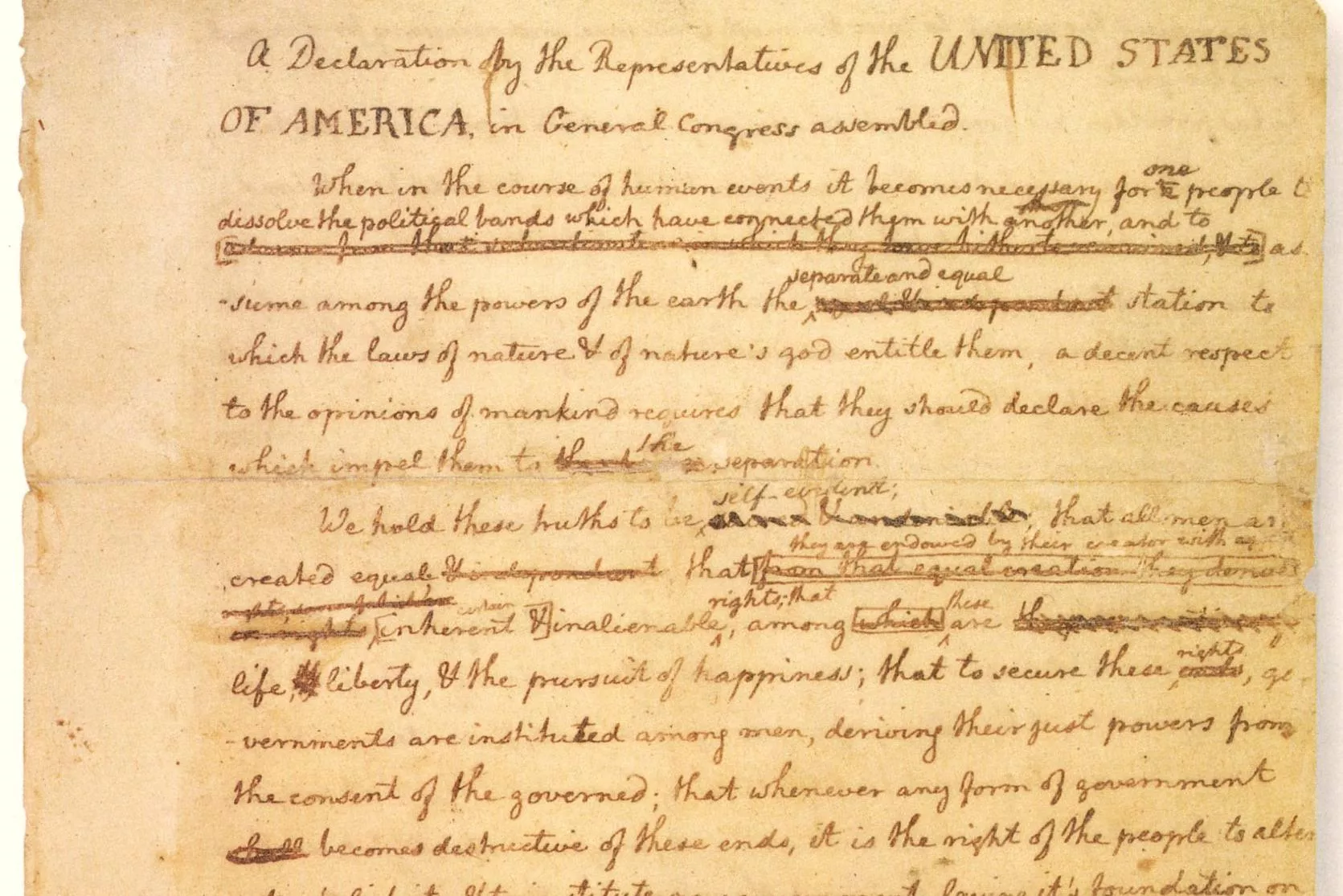
The Lead-up to the Declaration
Read the Declaration HERE.
On July 2nd, 1776 the states' deligates in the Continental Congress voted in the affirmative to become independent from Great Britain. On July 4th, the Congress voted to adopt and issue The unanimous Declaration of the thirteen united States of America explaining the reason for this separation.
But long before Congress's votes on July 2nd and July 4th, America had been at war with Great Britain. As both the Declaration of Causes (1775) and the Declaration of Independence (1776) describe, the King had impressed American sailors (merchants, primarily) into his navy, quartered troops in the homes of British subjects in America, plundered "our seas, ravaged our Coasts, burnt our towns," and hired mercenaries to complete the works of "death, desolation, and tyranny, already begun..."
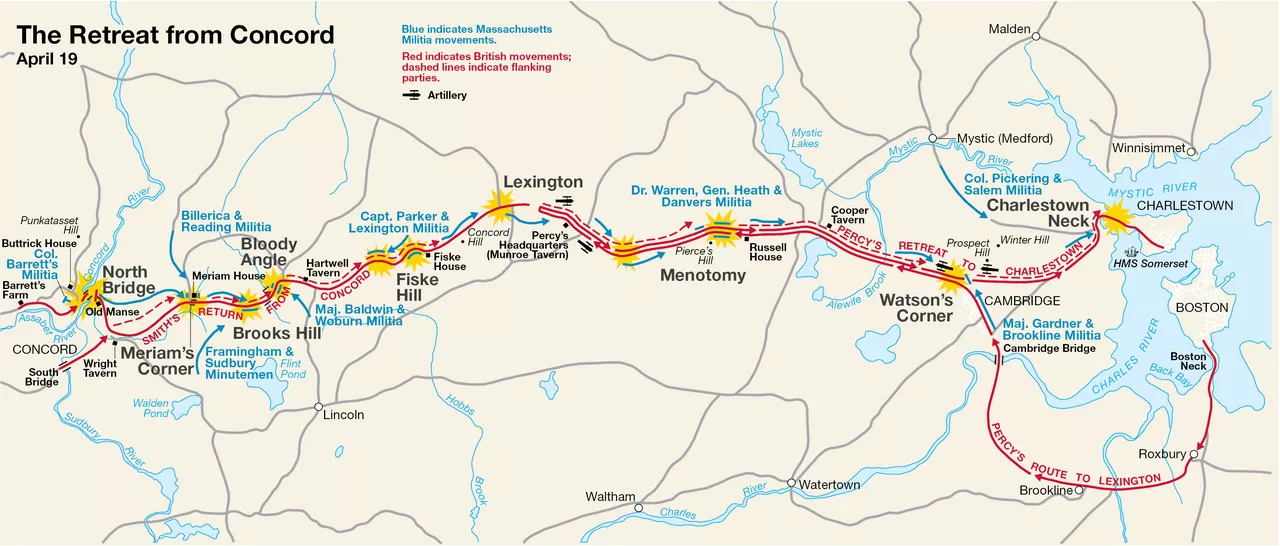
The war against Great Britain had begun more than a year earlier on April 19th, 1775 with the battle at Lexington and Concord. Suffolk County, Massachusetts had nullified the Massachusetts Government Act (May, 1774) with the passage of their own Suffolk Resolves (September, 1774)––Resolves later gaining the approval of the First Continental Congress.
In February, 1775 the King declared Massachusetts to be in a state of rebellion and sent some 700 Regulars to put down the rebellion. But after a seeming British victory at Concord, the 700 British troops found themselves routed and harassed by gunfire all the way back to Boston, and surrounded by 15,000 American militiamen.
A petty rebellion had sparked a total war.
On June 14th, 1775 the Second Congress created the Continental Army and made Washington its commander-in-chief. Between the battle of Lexington and Concord and the approval of the Declaration on July 4th, 1776, Americans had engaged in more than 30 military conflicts with British forces.
So the grievances listed in the Declaration not only recount the King's civil offenses over the last two decades, but the very recent military offenses that had occurred over the last year. The Declaration of the Causes and Necessity of Taking Up Arms (1775) passed by the Second Congress––and also authored by Jefferson––is proof of that. As the Declaration of Causes explains:
His [General Gage] troops have butchered our countrymen; have wantonly burnt Charlestown, besides a considerable number of houses in other places; our ships and vessels are seized; the necessary supplies of provisions are intercepted, and he is exerting his utmost power to spread destruction and devastation around him.
Despite the devastation described in the Declaration of Causes in 1775, Americans still weren't ready to secede. They had declared a state of war with Great Britain, but still sought a peaceful resolution...
Lest this declaration should disquiet the minds of our friends and fellow-subjects in any part of the Empire, we assure them that we mean not to dissolve that union which has so long and so happily subsisted between us, and which we sincerely wish to see restored.
As the war raged on, Americans realized a peaceful resolution was impossible, and that they would need to win the war outright. But such an outcome would require more than unity among the states––it would require outside help...
The Structure of the Declaration
Read the Declaration HERE.
After a year of war with Great Britain, America desperately needed foreign aid. Who better to petition, then, than Britain's greatest enemy, France?
To gain the support of France, the Americans understood that while a few colonies had already ratified their own constitutions and issued their own declarations of independence (Virginia and Maryland), America would need to present a united front. France was only interested in aiding a military conflict against Great Britain if the Americans had a fighting chance––meaning every state would need to declare its independence.
After the states' delegates voted to declare independence on July 2nd, 1776, a Five Man Committee was assembled to draft a document explaining this new legal situation. Those five men were John Adams, Benjamin Franklin, Roger Sherman, Robert Livingston, and Thomas Jefferson. The committee voted unanimously to delegate the task of drafting a declaration to Jefferson.
Below is the Declaration in its final form. It is organized clearly into five parts: the preamble, the premises, the evidence, the defense, and the legal declaration.
The Declaration begins with a statement on why the Declaration is necessary. This is the preamble.
The second paragraph––for which the Declaration is most well-known––declares the Rights of the People, and emphasizes their right to alter or abolish a government when a long train of abuses makes the proper ends of government unattainable. This paragraph contains the premises that justify the colonies' and states' separation from Great Britain.
The third paragraph lists the long train of abuses. Eighteen, in fact (or twenty-eight, depending on how you count them). Indeed, most of the Declaration is an account of the King's "repeated injuries and usurpations." Blame is cast upon him, specifically, because he is the chief representative of the government, and because he did nothing to veto Parliament's abuses when he could have, and actively engaged in oppressing the colonies through both his decrees and foreign policy. This paragraph presents the evidence that Great Britain has violated (or satisfied) the premises set forth in paragraph two.
The fourth paragraph defends Americans' actions by explaining that they had petitioned their king and countrymen repeatedly, but were given no course for redress. Its point is to demonstrate that America had dutifully pursued all possible avenues of recourse, and that this was their last resort. The Americans conclude that they have been abandoned by not only their King, but also their countrymen in Britain. These facts, therefore, justify what Americans will do next...
The final paragraph declares that the colonies "are, and by Right ought to be Free and Independent States..." That they are absolved from "all Allegiance to the British Crown," and all political connection with the "State of Great Britain." This is where the legal force of the document comes from. It creates the legal situation that all the previous paragraphs attempt to justify. As the only legally operative part of the document, it is the most important for understanding what the Declaration is actually trying to do.
Thus, with the publication and signing of this document, it is said that America was born; that July 4th marks the beginning of the United States, and the birth of a nation; that America announced to the world a revolutionary new way of governing.
All––and I mean all––of that is wrong and un-American.
How to Read the Declaration: The Founding of the United States?
Why doesn't the Declaration mark the founding of the United States?
Our first clue is the title. Here it is in the original, with all the capitalization preserved:
The unanimous Declaration of the thirteen united States of America
As was fashionable at the time, nouns were capitalized (although mistakes in the application of this rule were frequent). 'Declaration', 'States' and 'America' are all capitalized according to this rule. However, note that 'united' is lowercase. 'United' is an adjective, so had it been capitalized, the 'united States of America' would be a proper noun referring to a definite thing. But it doesn't refer to a definite thing––not yet, anyway.
What 'united' actually does here is describe a state of affairs: the States of America are "in agreement" on this Declaration, and "joined" together in a common cause. That cause was the cause of actively defending the colonies' declaration that they were now free and independent states separate from Great Britain.
Contrast this use of 'united' with America's first federal constitution, the Articles of Confederation, which reads:
The Stile of this confederacy shall be, “The United States of America.”
And contrast further with our second, and current, federal constitution:
...do ordain and establish this Constitution for the United States of America.
The point here is that The United States of America did not come into existence until the ratification of the Articles of Confederation in 1781. And the United States of America didn't come into existence until the ratification of the Constitution in 1788. America existed, and the United Colonies existed, but these did not.
But I'm not just being esoteric about the conventions of 18th century writing styles.
I'm trying to convince you that the importance of July 4th, 1776 has absolutely nothing to do with our federal government, and that framing it in that light actually destroys the significance of the Declaration.
It misses the entire point of the American project.
July 4th was not the birth of a nation or of America, and neither was it revolutionary. Least of all did it have anything to do with the creation of the United States government. Yet Americans often celebrate the 4th as if it does. There's a very important reason for that:
The tyrants want you to equate your independence with their government.
How to Read the Declaration: What's it About?
The unanimous Declaration of the thirteen united States of America is a legal document announcing the American colonies' unanimous decision to become free and independent states separate from, and on equal footing with the state of Great Britain, and with respect to the other newly-formed states of America. It puts in writing what was already decided on July 2nd.
It does not replace the centralized rule of Great Britain with the centralized rule of an American government––it explicitly rejects that, and so too do the Articles and Constitution. And yet, celebrations of this holiday consist of fighter jet fly-bys, waving Stars and Stripes, Pledges of Allegiance, and choruses of the National Anthem. All of these symbols are in direct conflict with the lesson of 1776.
Look at the concluding paragraph of the Declaration:
We, therefore, the Representatives of the united States of America, in General Congress, Assembled, appealing to the Supreme Judge of the world for the rectitude of our intentions, do, in the Name, and by Authority of the good People of these Colonies, solemnly publish and declare, That these United Colonies are, and of Right ought to be Free and Independent States; that they are Absolved from all Allegiance to the British Crown, and that all political connection between them and the State of Great Britain, is and ought to be totally dissolved; and that as Free and Independent States, they have full Power to levy War, conclude Peace, contract Alliances, establish Commerce, and to do all other Acts and Things which Independent States may of right do. And for the support of this Declaration, with a firm reliance on the protection of divine Providence, we mutually pledge to each other our Lives, our Fortunes and our sacred Honor.
The Declaration is made by the "People of these Colonies." These colonies are free and independent "States," and as states, they have the right to do all the things which "Independent States may of right do." Notice the frequent use of the plural form. The states are declaring not only that they are independent of Great Britain's sovereignty, but independent of each other's. Notice, too, that Great Britain is referred to as a 'State.'
In the 18th century, a 'State' was a sovereign political entity. The very fact that Jefferson refers to Georgia and Virginia and New York as 'States' means that the founders understood these to be like Germany, France, Russia and every other country in the world. They were not provinces, counties, or shires acting as the municipal agents of some higher authority.
Each of these were now on equal footing with Great Britain, and on equal footing with each other.
What the Declaration declares is that the states will rule themselves. They are insisting on local rule because only they understand the particulars of their societies. Great Britain had understood this between 1607 and 1763. During this period, London's responsibilities were to regulate commerce, operate the post office, and see to matters of war and foreign policy. But domestic policy was decided locally throughout the empire. If this sounds familiar, that's because the British empire was a federation––precisely the arrangement the Americans created after declaring their independence.
The idea of establishing nationhood and subsuming the colonies under a centralized authority in America was explicitly rejected at Philadelphia. Every state recoiled at the prospect of having their domestic policies decided by a central government because they recognized that the people of their respective states were different. That's why the powers of the general government were to be few and defined. That's why Article II of the Articles states:
Each state retains its sovereignty, freedom and independence, and every Power, Jurisdiction and right, which is not by this confederation expressly delegated to the United States.
It's also why a Bill of Rights was eventually proposed, and why it opened with this preamble:
THE Conventions of a number of the States, having at the time of their adopting the Constitution, expressed a desire, in order to prevent misconstruction or abuse of its powers, that further declaratory and restrictive clauses should be added: And as extending the ground of public confidence in the Government, will best ensure the beneficent ends of its institution.
The founding generations felt so strongly about state sovereignty that it became the basis for their political union. After all, a confederation was the form of government they were most familiar with. They were not united because they thought of themselves as one "people" (a "nation") agreed on every aspect of culture and politics and religion. Obviously they were not. But that was okay. Because they could still cooperate with one another despite their differences.
It was okay that Connecticut had a state religion and that Georgia did not. It was okay that New York engaged in manufacturing and that Virginia was agrarian. These differences resulted in deep divides between the peoples of these various states, but it didn't mean that they weren't all American, and it didn't mean that they were mortal enemies incapable of living alongside one another.
Although we might think otherwise, an American wasn't someone who believed in the liberal philosophies of Locke, Smith and Hume, or the superiority of capitalism to feudalism and slavery. An American was someone who believed in and defended federalism. Republicanism. Self-determination. Local self-government.
As Brion McClanahan puts it:
Most men in the founding generation viewed “provincialism” as a badge of honor. They were Virginians, New Yorkers, Pennsylvanians, Massachusettians, and Marylanders first and foremost and Americans second. They defended the rights of their sister States, but did not want another State, foreign or domestic, interfering in the concerns of their local community. In the rush to force “our” will on other Americans (or on the world), we forget this lesson. The American tradition, as exemplified by the Declaration of Independence and the founding generation, favors limited, decentralized government that has as its only charge the protection of life, liberty, and property, and the maintenance of the cultures, customs, conventions, and constitutions of the States and local communities.
Today that understanding of America is all but lost. The centralizers have grown the federal government so far beyond its intended scope that every election is a fight for survival. Every political cycle is an attempt to seize on a power that permits one faction to dominate another, and which redefines America in the process.
But this is an unnecessary and endless battle. America will never be united on ideology, religion, or culture. That fact is also true of our states, and it's even true of our families! But, by virtue of the fact that our federal government has exceeded its legal scope, we in Wisconsin are forced to address the advance of socialism in New York. An original understanding of 1776 would make such concerns wholly irrelevant.
Truly, every political problem in America could be solved by returning to the principles of 1776. For what does Wisconsin have in common with New York? What does Texas have in common with California? These places are vastly different from one another and always will be. As such, it is a mistake for conservatives to think that the people in these places are really just latent Jeffersonians waiting to be awakened to the magnificence of liberty. And similarly, it is a mistake for progressives to think that the people in red states just need a little bit of socialization before they realize the merits of an equity-conscious government dedicated to restorative justice.
The fact of the matter is: There is no reconciliation between the Mamdanis of New York and the Ron Pauls of Texas. And that's okay. That was the whole point of the Declaration, and of the Articles, and of the Constitution. What unites us is not some common vision or ideology, but a limited compact that respects the sovereignty of each state, allowing each people to pursue their separate interests.
The greatest thing about the American Experiment is that it truly is an experiment. Throughout America there are fifty countries, fifty experiments, and fifty opportunities to learn what makes for a good society. The urge to centralize American politics breeds uniformity and defeats the purpose of that Experiment.
How to Celebrate Independence Day Like It's 1776
As I said before, waving the Stars and Stripes, singing the National Anthem, saying the Pledge of Allegiance, and basking in the adrenaline rush of a low-flying F-15 all fail to capture the real meaning of Independence Day. The reason being: all of these are symbols of the federal government. A federal government which did not exist at the time of Independence, and which does not deserve even an ounce of credit for what happened all those years ago.
At the time of the War for Independence (the American "Revolution" is a misnomer), it was the 13 American states who banded together against a tyrannical empire. They did this despite their differences in nativity, religion, culture, upbringing, and politics. They did it because their rights to self-determination were essential. And they did it without being compelled by a central authority...
...with a firm reliance on the protection of divine Providence, we mutually pledge to each other our Lives, our Fortunes and our sacred Honor.
And as much as I like America's symbols, their meanings change with time. I no longer see them as representing the principles of 1776 given how often they've been used to undermine those very principles. Had the federal government not spent the last 237 years assuming powers not given to it, incorporating the states, or spending 99% of its time engaged in activities that are blatantly illegal, I might fly the United States flag as a symbol of a properly organized union.
Alas, America has a long way to go toward restoring the original understanding of the American project, so I'd like to make some suggestions for which symbols you can use to help reclaim that understanding.
If you fly the Stars and Stripes, be sure to fly your state's flag too. Remember what those stars represent: the People of the several States. Independence Day is an opportunity to remind everyone that the constituent parts of America are the 50 great American states, not the 50 emasculated municipalities.
In my experience, Wisconsinites are pretty good about this––I often see the state flag flying throughout Burlington and Lyons. Texans, on the other hand, are exceedingly good about flying the Lone Star, while California is downright awful. Ne'er have I see a Bear Flag flown from even a single house during my two decades as a Californian. That alone ought to tell you everything.

If you sing The Star-Spangled Banner you're in a great spot. It is an excellent song which beautifully tells the story of what happened at Fort McHenry. It is only too regrettable that it is about the War of 1812 and not the War of Independence. It's also too bad that it is known as the American National Anthem. America is no nation; we are a confederation of states.
As an alternative to this, play Yankee Doodle or Chester. These were the two most popular songs sung by Americans during the War for Independence.
But if you really want to channel the spirit of '76, play Wisconsin's State Song. Badgers fans will be intimately familiar with this tune.
Frankly, low-flying fighter jets are frickin' sweet. Keep 'em comin'. But also, remember that the first line of defense is our state militia. They are the ones who keep the peace in times of unrest, deliver aid and assistance in times of disaster, and make the Canadians think twice about invading us.
Unfortunately, even our militia has been sullied by the federal government which illegally transformed most militias into the National Guard. As Article I, Section 8, Clause 15 makes clear: the militias may only be activated by the federal government to "execute the laws of the union, suppress insurrections and repel invasions;" They may not be deployed for any other purpose, much less to serve overseas for duty in Iraq. Today, only 20 states have militias (called State Defense Forces) outside the reach of the federal government. So what can you do for Wisconsin's militia?
Help your militiamen who have fought in foreign wars, organize a parade, fly the Guard's flags, patronize their businesses, and create flags from their units' badges. Find a way to recognize their existence, because the founders intended for the militias to be prominent within the union.
 https://dma.wi.gov/wisconsin-national-guard/
I know we were all raised to begin our mornings by saying the Pledge of Allegiance, but let's be honest––it's really bad and no one should say it. What is more un-American than pledging undying fealty to a government?
If you need a little convincing that that's what's going on here, know that the author of the original Pledge, Francis Bellamy, was an avowed socialist. When was the last time you heard of a socialist who advocated for the "live and let live" principle? Wasn't that principle the basis for declaring state sovereignty and rejecting centralization? and doesn't socialism tend toward the exact opposite?
So let's think about what the Pledge actually says:
I pledge allegiance to the Flag of the United States of America, and to the Republic for which it stands, one nation under God, indivisible, with liberty and justice for all.
So first we're pledging allegiance to the flag of the United States. In reality, we're actually pledging allegiance to the United States government because we're pledging ourselves to its flag. But why? Can it do no wrong? Must we always abide by its rulings and "work within the system" to effect change? Our founders didn't do that. If anything, the United States government should pledge itself to you and me, and to our respective states.
Next, we're also pledging ourselves to the Republic it represents. No qualms there, but which is it? When the United States government is at odds with the Republic, whose side do we take? Or are we naively assuming that the United States government is always the same as the Republic? I'm pretty sure Benjamin Franklin said, "A republic, if you can keep it." And that sounds an awful lot like foreshadowing if you ask me...
Then we read that we are "one nation under God." Uh-oh. There's that "nation" thing again. Under God? Sounds good.
But then we learn that we are "indivisible." I'm sure Great Britain thought the very same thing with respect to the American colonies! But who was correct? They, who said we could not leave? Or we, who said our membership was conditional? Are we meant to believe that when Jefferson said the people have a right to alter or abolish a government that is destructive of the ends of life, liberty and the pursuit of happiness that that was just a metaphor? That it wasn't actually our "duty" to throw off despotic governments? Intellectuals may argue these questions, but real Americans know the answers.
It concludes with, "with liberty and justice for all." Everyone loves this part because everyone loves liberty and justice....for themselves. But it's contradicted by almost everything preceding it. What liberty or justice is there in forcing a state to remain in the union? What if 49 states decided that 1 should become a "national" landfill, and for everything within to be demolished and all the people displaced? If the "Republic" decided it's in the "national" interest, are the poor folks of Kansas (let's face it, it would be Kansas) meant to take it lying down? Or do they have the right to leave the union and resist these efforts?
And let's face it, would anyone really object to Hawaii or California leaving? Sure, some folks might lose their beach homes, but people's vacation homes in Mexico are doing just fine, and Hawaii ain't nothin' like Mexico. As for California, all of Red America wants them gone and most of California wants to leave anyway. They clearly don't like being called upon to defend the border, and every other state is tired of California dominating the House, misusing federal Dollars, and constantly threatening to turn an already powerful federal government into Leviathan.
Anyway, we'd all be better off without the Pledge, so let's retire it.
Misinterpreting the Declaration: Why it Matters
I would be remise if I didn't spend any time discussing the second paragraph of the Declaration. Throughout all of America––regardless of sex, race, religion, creed, or party affiliation––this passage (the premises) is the most revered and respected.
Occasionally a contrarian will rear their head and condemn Jefferson and America for their hypocrisy, but few people, if any, reject the truth of that passage.
In response, those on the Right will agree with the contrarian's assessment, but explain that the founders were men of their time; that while slavery was recognized by many of them to be an evil at odds with this pronouncement, they knew not how to eliminate the institution. Instead, they continue, Jefferson and the founders made a promise to future generations of Americans that this ideal would be realized in full, and slavery abolished. They argue that this passage establishes The American Creed––the same Creed that Lincoln would later call the Proposition Nation.
As you may recall, Supreme Court Justice Neil Gorsuch recently defended this view of America as a "Creedal Nation" in an interview with Reason magazine:
That paragraph of the Declaration is revered for good reason, though. Its assertion that all men are created equal and endowed with unalienable rights is honey to the liberty-minded and anathema to despots. The insistence that government's purpose is to secure men's rights or else be cast aside clearly articulates the subservient nature of government, the primacy of the human person, and the necessity of consent.
But the problem with this Creed is that its fulfillment looks different to everyone. Accordingly, both the Left and the Right can make it their own, and both can rightfully claim that the great American Promise can only be kept by implementing their respective political programs.
For the Left, those "unalienable rights" include positive rights. It is their duty, then, to expand the welfare state, redistribute wealth, pay reparations to disenfranchised groups, and ensure that no one falls behind––or gets ahead. For the Right, those rights are the supreme law of the land. It is not only their duty to ensure that the states do not infringe upon them, but to ensure that the people of the world enjoy them too––even if that means they must use force.
Consequently the American Creed becomes problematic no matter which faction holds power. Either the Creed results in abuses domestically, or it results in abuses abroad. But Jefferson did not intend for either interpretation.
What Jefferson was doing was restating the rights of British subjects. He was not attempting to found America on radical, revolutionary principles. As Jefferson wrote in a letter to Henry Lee in 1825:
When forced therefore to resort to arms for redress, an appeal to the tribunal of the world was deemed proper for our justification. This was the object of the Declaration of Independance. Not to find out new principles, or new arguments, never before thought of, not merely to say things which had never been said before; but to place before mankind the common sense of the subject; [. . .] terms so plain and firm, as to command their assent, and to justify ourselves in the independant stand we [. . .] compelled to take. Neither aiming at originality of principle or sentiment, nor yet copied from any particular and previous writing, it was intended to be an expression of the American mind, and to give to that expression the proper tone and spirit called for by the occasion. All it’s authority rests then on the harmonising sentiments of the day, whether expressed, in conversns in letters, printed essays or in the elementary books of public right, as Aristotle, Cicero, Locke, Sidney Etc.
So the Declaration's purpose was "Not to find out new principles, or new arguments, never before thought of," but was an "expression of the American mind." It was simply an account of the "sentiments of the day." Sentiments which Jefferson says were not only "agreeable to all," but also found in Aristotle, Cicero, Locke and Sidney. These principles, therefore, were anything but revolutionary––they were conservative principles long since established by the western tradition.
Jefferson's inspiration for that passage came most immediately from two sources: George Mason's Virginia Declaration of Rights, and the English Bill of Rights.
With respect to the former, Mason wrote in Section 1:
That all men are by nature equally free and independent and have certain inherent rights, of which, when they enter into a state of society, they cannot, by any compact, deprive or divest their posterity; namely, the enjoyment of life and liberty, with the means of acquiring and possessing property, and pursuing and obtaining happiness and safety.
As for the latter, the English Bill of Rights served as the template for the structure of the Declaration. Notably, much of King George III's offenses are the very same ones committed by King James II––offenses which led to his forced abdication in 1688:
Whereas the late King James the Second, by the assistance of divers evil counsellors, judges and ministers employed by him, did endeavour to subvert and extirpate the Protestant religion and the laws and liberties of this kingdom;
By assuming and exercising a power of dispensing with and suspending of laws and the execution of laws without consent of Parliament;
By raising and keeping a standing army within this kingdom in time of peace without consent of Parliament, and quartering soldiers contrary to law;
By violating the freedom of election of members to serve in Parliament;
And excessive bail hath been required of persons committed in criminal cases to elude the benefit of the laws made for the liberty of the subjects;
And excessive fines have been imposed;
And illegal and cruel punishments inflicted;
All which are utterly and directly contrary to the known laws and statutes and freedom of this realm;
The structure of the Declaration, then, is an homage to the Anglo-American tradition. It is carefully and intentionally crafted to parallel Britain's most important legal documents: the Charter of Liberties, the Magna Charta, and the English Bill of Rights. For this reason it is said that England had a constitution, but America wrote it down.
But none of this is to say that Jefferson, Mason or other founders were intransigent defenders of slavery, blind to its incompatibility with a free society––many Virginians believed slavery was an evil and said as much on many occasions. The point here is to recognize that the Declaration was not meant to express that opinion.
For example, Washington freed his slaves, Mason often argued against the institution, and Jefferson is well-known to have included strong anti-slavery remarks in his original draft of the Declaration:
he has waged cruel war against human nature itself, violating it’s most sacred rights of life & liberty in the persons of a distant people who never offended him, captivating & carrying them into slavery in another hemisphere, or to incur miserable death in their transportation thither. this piratical warfare, the opprobrium of infidel powers, is the warfare of the Christian king of Great Britain. determined to keep open a market where MEN should be bought & sold he has prostituted his negative for suppressing every legislative attempt to prohibit or to restrain this execrable commerce: and that this assemblage of horrors might want no fact of distinguished die, he is now exciting those very people to rise in arms among us, and to purchase that liberty of which he has deprived them, by murdering the people upon whom he also obtruded them; thus paying off former crimes committed against the liberties of one people, with crimes which he urges them to commit against the lives of another.
Yet this complaint against the King isn't included in our Declaration. Why?
As Jefferson remarked in Notes of Proceedings in the Continental Congress, [7 June – 1 August 1776]:
the clause too, reprobating the enslaving the inhabitants of Africa, was struck out in complaisance to South Carolina & Georgia, who had never attempted to restrain the importation of slaves, and who on the contrary still wished to continue it. our Northern brethren also I believe felt a little tender under those censures; for tho’ their people have very few slaves themselves yet they had been pretty considerable carriers of them to others.
In one of the great ironies of American history, a man considered to be one of the most despicable slavers authored the Declaration's longest and most forceful repudiation of slavery, but had it removed at the behest of southern and northern states!
The logical conclusion of this is that the Creed supposedly established by the second paragraph is not a promise to abolish slavery or even a condemnation of it. If it were understood as such, those states objecting to the "war against human nature" clause would also have objected to the "all men are created equal" clause.
The fact that the former was struck and the latter retained indicates that Jefferson and the states' delegates understood the "all men are created equal" clause to pertain only to citizens. This is a great shame, but it is not the shame of Americans today.
So where do we go from here? If Americans believe that the second paragraph establishes a Creed, there are only two ways that pans-out: with both sides endlessly fighting to impose their vision on the other, or with one vision emerging supreme. Who's to say what America will look like in the midst of that process? Whatever the case, it won't be pleasant...
Fortunately there is a third way to go about this: abandon the idea of a "national" Creed and return to federalism. If Americans understand that the Declaration and the American federation enable each state to pursue their separate interests there will be no domination, and California and Texas can have as much or as little socialism as they like, limited only by the few and defined powers of the federal government.
But for that to materialize, Americans must first understand the Declaration for what it truly is, and then restore the federal government to its original purpose.
Many will object to what some of the American states may become under such an organization, but the alternative of forced uniformity and an indomitable central government is much, much worse. Under federalism, everyone wins; under Leviathan, only the ruling elite win.

Interested in the content of this Article?
Reach out to the MacIver Institute to aquire more information


