
- Podcasts
 Podcasts
 - Videos
 Videos
 - Policy Issues
 Policy Issues
 - About
 About
About


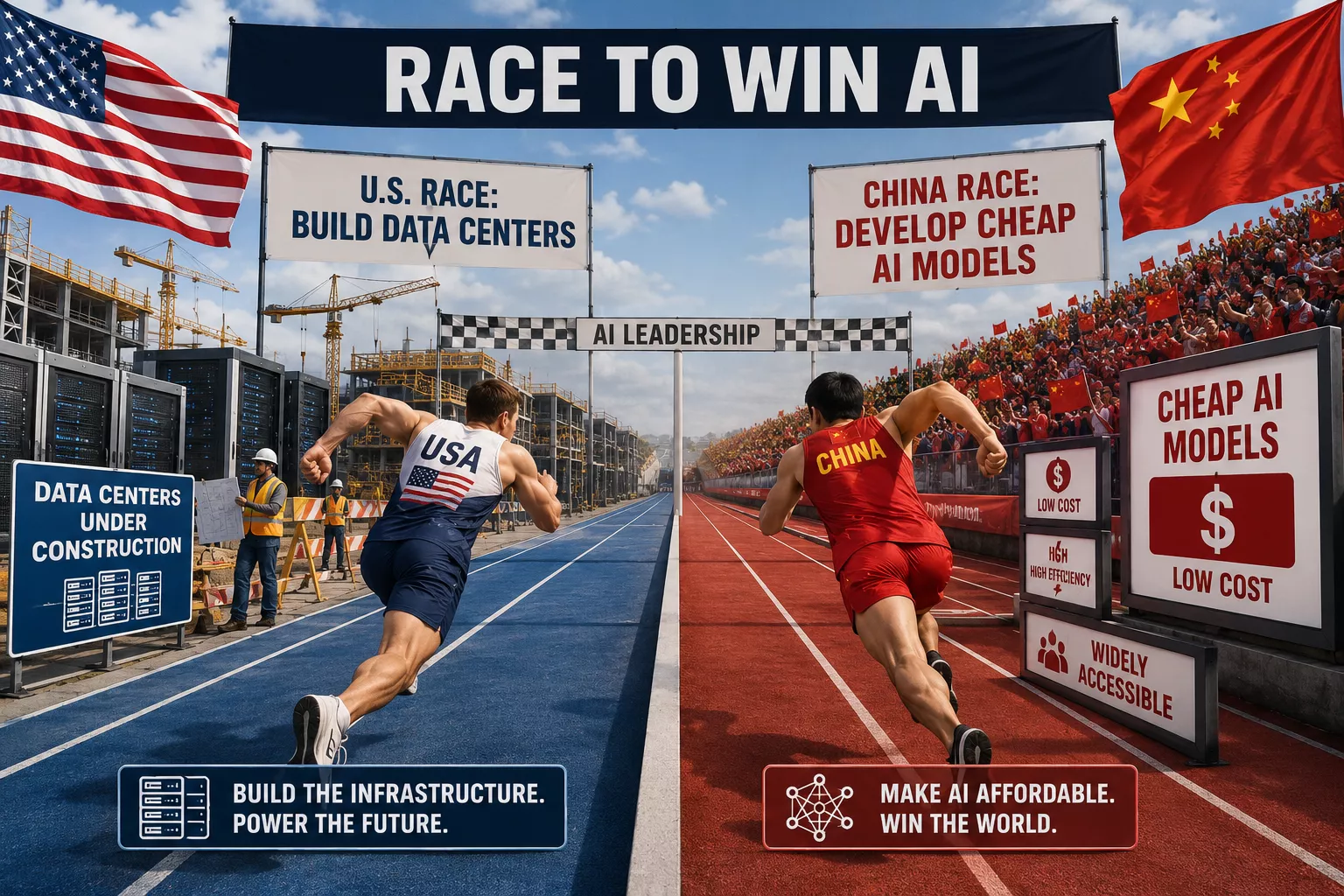
The Race to 'Win' AI
Of the many reasons given to develop AI and AI infrastructure, chief among them has been the need to "beat" China. As has oft been repeated, winning is crucial to ensuring the country's economic security and avoiding the existential threat that will materialize in the event of a Chinese victory. But is someone going to tell China that? Because they don't even seem to be aware that there is a race, let alone a fight for survival.
When we look closer at the reasons for running this race, the argument is essentially two-fold: first, that the AI industry will be an integral part of the American economy; and second, that AI development is necessary to ensure our national security. Both of these claims rest on two key assumptions: that AI's technological capabilities will continue to increase, and that those capabilities can be utilized economically.
But the first assumption can't be known, and it's not at all clear what AI's capabilities are even now. Clearly Big Tech thinks they know, but then why are most of them channeling the bulk of their investment into free-to-use LLMs, or otherwise renting out precious servers in their billion dollar data centers? Shouldn't they stay the course and make a concerted effort to dedicate these resources toward the improvement of their own technologies? And shouldn't they offer to develop products with AI in exchange for some degree of ownership?
As for the second assumption, even if there were a growth in AI's capabilities resulting in a number of breakthrough technologies––and even if these did result in marked improvements in efficiency and output––when it gets down to brass tacks, the only thing that really matters is:
Whether it's profitable.
To date, not a single leader in the AI space has been able to demonstrate that the ROI justifies the billions in CapEx. But much more important than the lack of profit is the fact that there isn't any sign of this improving. Margins appear to be getting worse, actually.
All of this combined with the realization that China isn't developing AI data centers at anywhere near the level seen in the United States makes the stakes of winning this race much less dire, and probably warrants more caution be exercised.
A Race of Our Own: China's Lack of AI Data Centers
It may be surprising to hear that China isn't heavily invested in AI infrastructure but the fact of the matter is, not only are we winning this AI race, China isn't even in the top 10. The idea that China is a peer competitor of ours in the infrastructure space lacks any substantiating evidence.
According to the evidence we do have, the United States has an order of magnitude more data centers of all types, more hyperscalers of all types, and more AI data centers (AIDCs) in terms of quantity, compute, and power capacity.
If we look at data centers of all types, according to US Data Center Market Map and DataCenterMap, the U.S. has between 3,700 and 4,500 operational data centers. One report from Stanford claims the U.S. has more than 5,400 data centers (Figure 1.3.2)
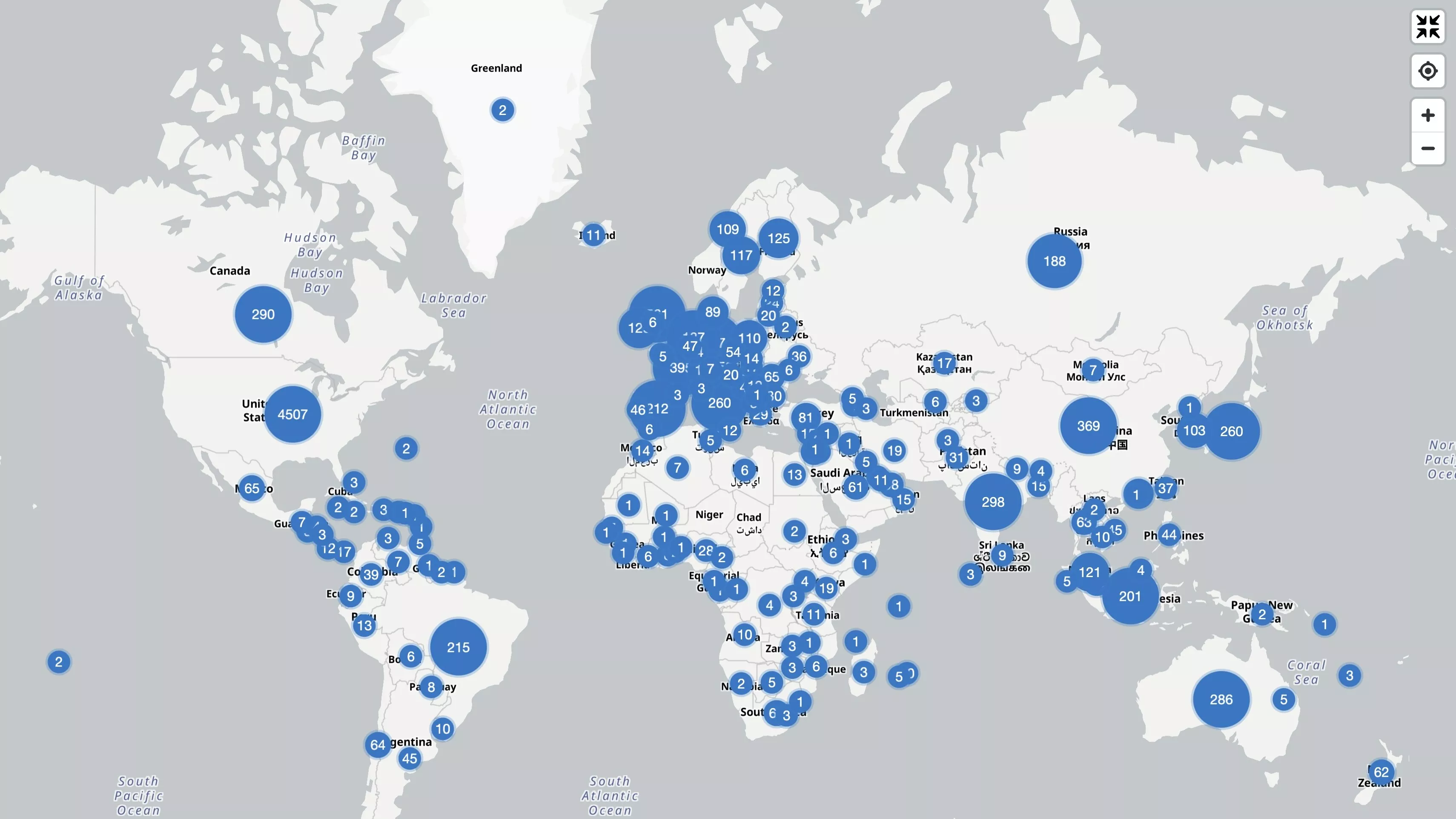 Source: https://www.datacentermap.com/datacenters/
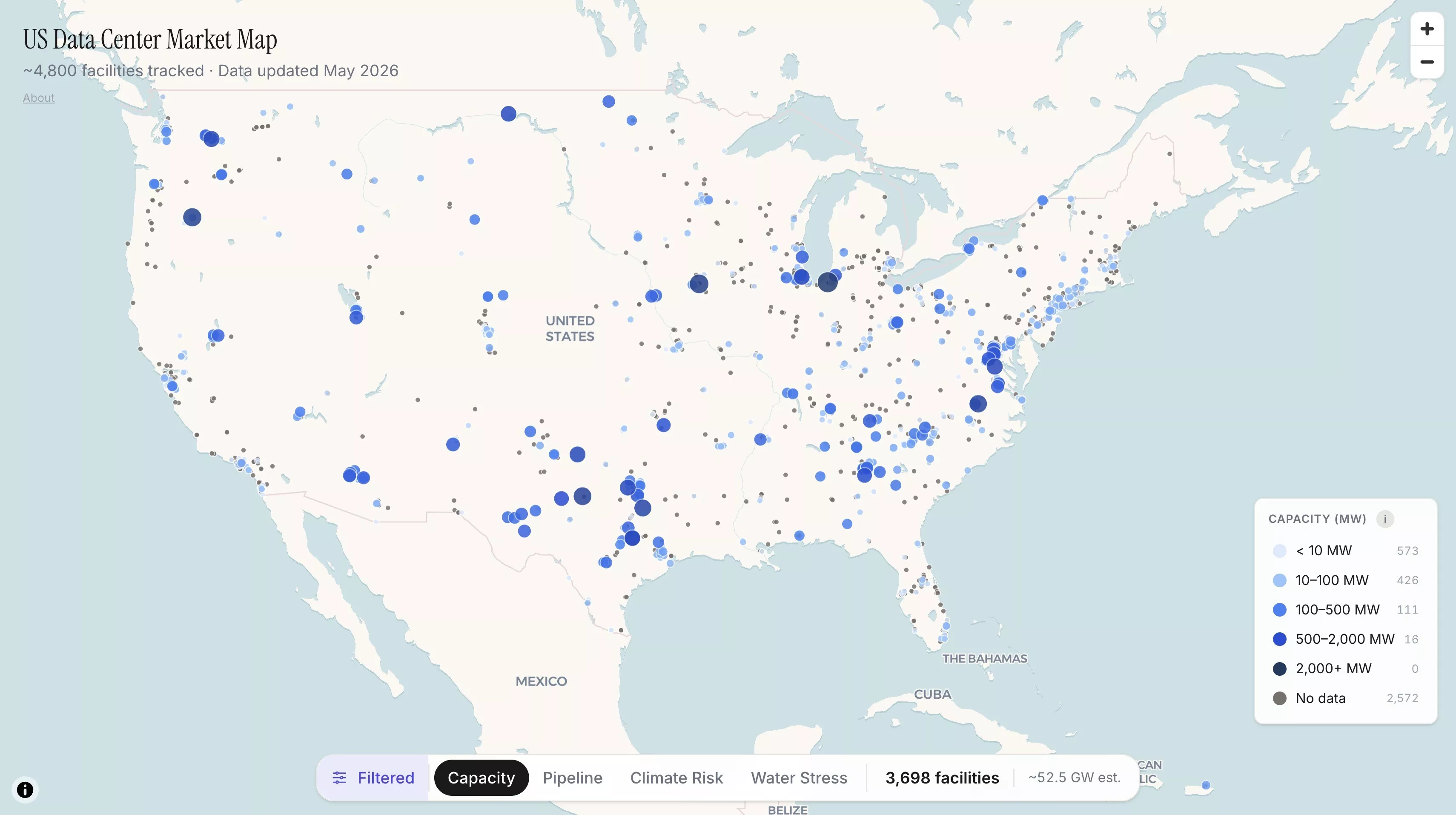 Source: https://dcmap.us/
In contrast to the U.S., China has somewhere between 369 and 449 (p. 33) data centers of all types.
But here's where the real differences become apparent: the U.S. has between 45 and 64 operational AI data centers, while China has somewhere between 3 and 6.
In terms of power capacity, AI Data Center Index puts U.S. capacity for these AIDCs at a staggering 43.6 GW––more than 2.5 times the current generating capacity of Wisconsin––while China's capacity is estimated at a measly 1.1 GW.
The differences are also apparent when we compare the CapEx of U.S. and Chinese hyperscalers––the large data center operators most likely to be building AIDCs for training and inference. According to an article from ZeroHedge, U.S. hyperscaler CapEx has outstripped their Chinese counterparts for four years in a row, with CapEx ranging from 7.5 to 20 times that of China.
In the 2027 out-year, U.S. hyperscalers are estimated to exceed $1 trillion in AI CapEx.
As we will see, despite the U.S. having more and better performing models, the differences in performance aren't very pronounced––especially since the cost savings associated with Chinese models are as substantial as they are.
China: Running A Very Different Race
The reason for the vast differences observed between the U.S. and Chinese approach to AI is because China is forced to take a different approach.
China simply does not have the productive or financial means required to compete in the realm of AI infrastructure. They have the labor and many important resources that the U.S. does not, but advantages in some areas don't automatically result in superior outcomes.
For example, China has made notable improvements in its energy policy by encouraging the use of cheap fossil fuels––the effect of which has been a substantial improvement in the standard of living for the Chinese. But even still, its per capita electricity generation is quite a bit lower than that of the U.S.
So when China has to weigh the costs and benefits of investing in new power generation to service either citizens or industry, you can bet their per capita GDP figure of $13,800 is front and center in their analysis.
When fuel sources for electricity generation are compared, China is clearly expanding its use of solar and other renewable energy sources, but it isn't ideologically committed to their expansion, and the increase in the absolute amount of renewable energy isn't discouraging the use or growth of fossil fuels.
China's embrace of fossil fuels is a clear advantage.
Another area of some advantage for China is manufacturing. However, when it comes to manufacturing data, "assembly" is included in this category. So, when folks in the U.S. lament that "everything is made in China," in reality, much of what we import from China is actually assembled in China––not necessarily manufactured from raw inputs. Apple's iPhone is a great example of this. The packaging used to say "Made in China," but around the time of the release of the iPhone 13, the packaging began to state that it was "Assembled in China." This change was made to reflect China's diminished contribution to the manufacturing process.
What China lacks is the real manufacturing capability that would enable them to produce their own AI hardware to rival that of Nvidia. That's a big reason why the U.S.'s policy of prohibiting Nvidia from selling chips to China was such a big deal––China had no comparable alternative to American chips. It also helps explain why China is so jealous of Taiwan––the world's largest manufacturer of semiconductors.
But perhaps the most important reason China has struggled to compete against the U.S. in the AI infrastructure race is institutional. China is largely a command-and-control economy. The U.S. is a mostly free-market economy. It's kind of ironic, then, that many free-marketers believe a Communist Oligarchy has even a fighting chance against American Capitalism. There are still concerns to be had, of course, but it's important to put them in the proper context.
So all of these factors help explain why the U.S. and China are where they are, but they also explain why China is taking a very different approach to AI, and why they may be winning in an entirely different race.
China's strategy here is to let the U.S. build the physical infrastructure and focus instead on providing the software (the AI models) that infrastructure will use. Importantly, the Chinese have realized that while they might not create models superior to or even on par with America's flagships, they can create models that are "close enough" in performance, and much cheaper in terms of price. Additionally, Chinese AI developers have almost all adopted the open-weight or open-source model for their software. In effect, this "democratizes" the development of their models by allowing anyone to tweak the parameters of the model, and sometimes view and modify the code itself.
As EpochAI shows, this has been incredibly advantageous for Chinese developers whose models are only ever a few months behind OpenAI's latest GPT iterations.
 Source: Epoch AI, click image to view source
When it comes to "Intelligence," the Artificial Analysis Intelligence Index consistently ranks Chinese (mostly open-weight) models among the AI industry's top performers.
Of the 573 models tracked by the Index, 8 of the top 23 models are Chinese (GLM-5.2, Qwen3.7, MiniMax-M3, DeepSeek V4 Pro, Kimi K2.6, MiMo-V2.5-Pro, DeepSeek V4 Flash, and Qwen3.5).
As for the time required to complete tasks, the best Chinese models are worse than the best U.S. models, on average, but still competitive.
In pure cost terms, though, the "Cost per Task" test is dominated by Chinese models. Of the 17 models with a "Cost per Task" less than $1, 7 are Chinese, and 4 of the 5 cheapest models are Chinese too.
However, when AAII benchmarked these models in terms of "Intelligence" and "Cost," a clear pattern emerges that makes Chinese AI models viable alternatives to their American counterparts.
The chart below shows which models provide the best "bang for your buck," and unsurprisingly, only American models occupy the "Most attractive" quadrant.
But the problem for the two American developers in the Goldilocks Zone is that the Chinese competition is only marginally worse in terms of performance, and the other American models are much too expensive to ever capture significant market share.
In short, China may be losing in quality, but its prices are so heavily discounted that it's winning in terms of value creation. And when it comes to "hard-hearted and callous" consumers, value is everything.
When we look at the chart above, of the 8 models with an "Intelligence" score >/= 40 and a "Cost per Task" </= $0.40, 5 are Chinese. While the American models dominate the category of "Intelligence" scores greater than 47.5, the fact that the horizontal axis (the "Cost" axis) is a logarithmic scale means that every additional point of "Intelligence" costs more than the last. That means that the models on the right-hand side will only ever be implemented in very special use cases with high returns. For most enterprise and personal use cases, they will never be worth the expense. Consequently, the cheaper models become much more appealing to this market segment.
The other thing to note is the value added of additional "Intelligence" in the low-cost segment of the market ($0.40 or less). If individuals and enterprises are primarily interested in automating the tedious and time-consuming tasks associated with daily life and operations, this will further bias AI adoption in favor of the cheaper, but less "Intelligent", Chinese models.
For example, notice that switching from Muse to Grok 4.5 increases "Intelligence" by 5.88% and "Cost" by 19.23%, but that switching from Grok 4.5 to the next stepwise improvement––GPT-5.6 Tera––increases "Intelligence" by only 1.85% while increasing "Cost" by a whopping 44.44%. This problem is especially apparent when a DeepSeek V4 Pro user is being asked to increase their expenditures by 550% for just 7 more "Intelligence" points by switching to Muse. Most casual users in the market for AI will have a hard time justifying the adoption of a better U.S. model if their use cases don't extend beyond reading and writing emails.
For these reasons, Chinese developers have a marked advantage with respect to value creation.
The Infrastructure is There, Pivot to Value
U.S. hyperscalers can probably lay off the AIDC CapEx. Chinese competitors have made it clear they're not interested in (and likely not capable of) going toe-to-toe with the U.S. in that regard. What they have made clear is that they're willing to sacrifice performance in exchange for better returns on their products.
Maybe the hyperscalers in the U.S. are correct in their appraisal that AI is on the verge of a breakthrough moment, but unless they can conjure significant demand to close the gap on their balance sheets, they run the risk of not being around for that breakthrough moment.
At this juncture, U.S. hyperscalers are in the not-so-enviable position of hosting their and their competitors' models at significant losses just to slow the bleeding. So if you have to rely on the business of your supposed "enemy" for much-needed revenue, it may be time to pivot from build-baby-build to economically-viable products.
The U.S. has won one race, time to win the other.

Interested in the content of this Article?
Reach out to the MacIver Institute to aquire more information


