
- Podcasts
 Podcasts
 - Videos
 Videos
 - Policy Issues
 Policy Issues
 - About
 About
About


WEC Dismisses Milwaukee Elections Complaint
In a disappointing 5-1 decision issued May 7, 2026, the Wisconsin Elections Commission dismissed a complaint concerning restricted public access at Milwaukee’s Central Count facility during the April 1, 2025, spring general election. Even more troubling, Commission Chair Ann Jacobs and Commissioner Thompson successfully moved to remove the WEC staff’s explicit recommendation that observers receive some level of visual access to key ballot-processing areas. These areas are becoming more and more shielded from public view on election day.
Wisconsin law is clear: “The observation areas shall be so positioned to permit any election observer to readily observe all public aspects of the voting process,” (Wis. Stat. § 7.41(2)). Yet on election day at Milwaukee Central Count, observers have repeatedly reported being unable to see critical steps in the handling and scanning of absentee ballot envelopes.
During the November 2024 general election, election officials erected a large black curtain in the counting area. Observers could see ballots arriving from drop boxes, but once election workers wheeled those ballots behind the curtain for envelope scanning and further processing, they disappeared from view. Observers could not see the ballots arriving through the mail. Officials provided no explanation beyond a vague reference to “health and safety,” despite observers standing in previously accessible areas.
By the April 2025 spring election, the situation had worsened. Officials obstructed windows to the “Secure Ballot Room” and adjacent offices (spaces used for ballot intake, sorting, and scanning). Officials blocked one window with stacked mail bins; officials covered the other with a poster and sprayed it with frosted paint. Observers standing in the public hallway could no longer see into these rooms, even though the doors were occasionally opened, revealing activity inside. Officials similarly painted over the windows in a second office connected to the garage drop-off area, preventing any view of ballots entering through that route.
In the most recent election on April 7, 2026, officials have now completely walled off windows that previously allowed at least some visibility.
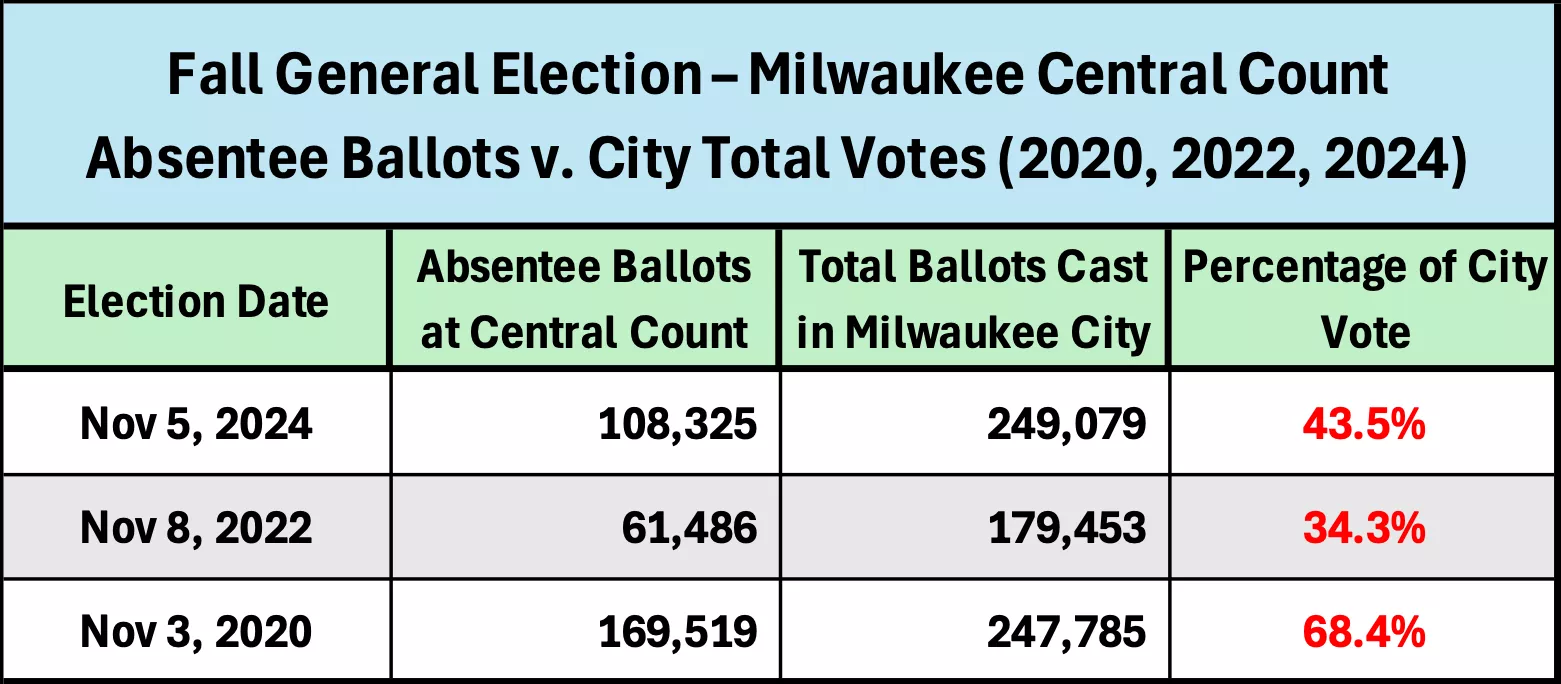
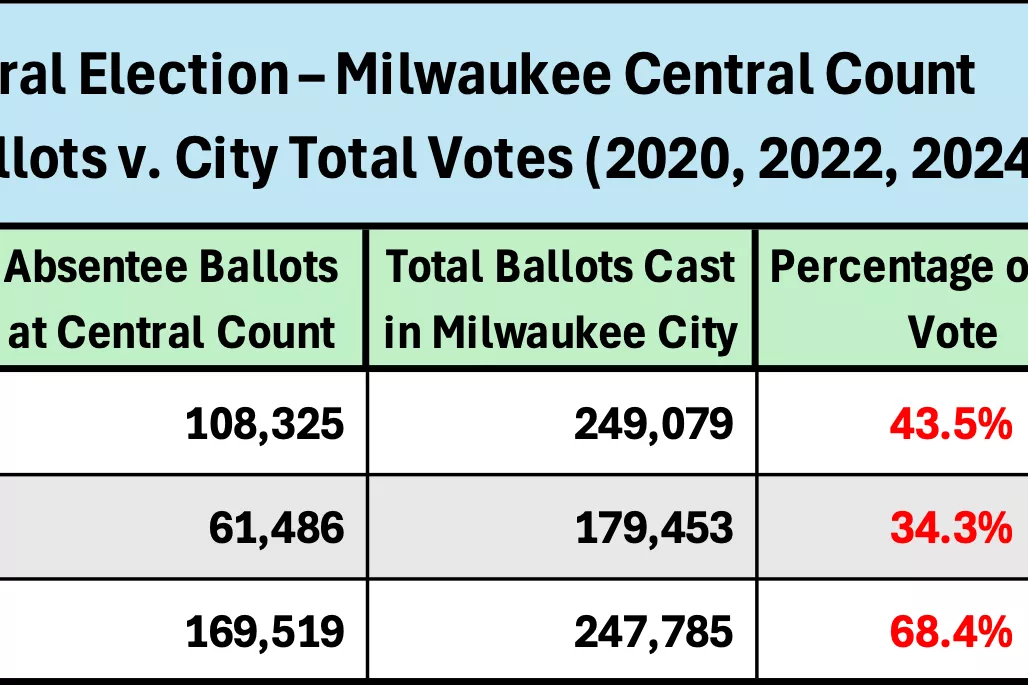
In Wisconsin, elections are frequently decided by margins of 30,000 votes or fewer. Milwaukee Central Count processes a very large volume of absentee ballots, often representing a substantial share of the city’s total vote. When such a significant portion of the statewide vote is handled at this single facility without complete public transparency, it inevitably breeds serious distrust. Even if no wrongdoing occurs, the limited visibility into key ballot-processing steps raises legitimate questions about the integrity of the results and weakens public confidence in Wisconsin’s elections.
Paulina Gutierrez, Milwaukee’s Executive Election Director, justifies restricting observer access to the incoming, scanning, and sorting of absentee ballots by classifying these activities as “administrative” or “ministerial” functions that occur before the official Board of Absentee Ballot Canvassers begins its formal vote counting process. She contends that these preliminary steps are therefore not part of the “public aspects of the voting process” allowing her to block visibility through curtains, painted windows, and physical barriers without violating the observer statute. This misinterpretation enables Milwaukee Central Count to conduct significant ballot handling and processing out of public view on election day and in the weeks leading up to it.
WEC staff, after reviewing the complaint, correctly recognized the problem and included language in their draft decision letter (page 266) urging the Milwaukee Election Commission to restore some level of visual access, for example, through windows, so observers could witness the public aspects of ballot counting. The Commission’s own staff got it right.
Chair Ann Jacobs and Commissioner Thompson disagreed and moved to strike that recommendation entirely. The Commission ultimately voted 5-1 to approve a watered-down final order that dismissed the complaint without requiring or even encouraging greater transparency. Commissioner Bob Spindell was the sole dissenter.
This outcome sends a troubling message. The Wisconsin Elections Commission’s own professional staff recommended modest steps to improve election-day observability into ballot processing to include the intake, scanning of envelopes, sorting into wards, and handling of thousands of absentee ballots. Yet, Chair Ann Jacobs personally led the charge to delete that guidance. Observers are not asking to interfere; they are simply asking to see what the law already requires.
Chair Jacobs, who routinely preaches the importance of “voter confidence” and “election integrity” at nearly every public meeting, had a straightforward opportunity to demonstrate those principles in action but instead chose to keep key areas of Milwaukee Central Count hidden from observers on election day. By actively blocking greater visibility into the counting process, the very leaders who constantly lecture the public about confidence in our elections undermine that confidence far more effectively than any outside critic ever could.
Wisconsin voters deserve better. Election integrity is strengthened, not threatened, when the entire ballot counting process is conducted in full public view.

Interested in the content of this Article?
Reach out to the MacIver Institute to aquire more information


