
- Podcasts
 Podcasts
 - Videos
 Videos
 - Policy Issues
 Policy Issues
 - About
 About
About


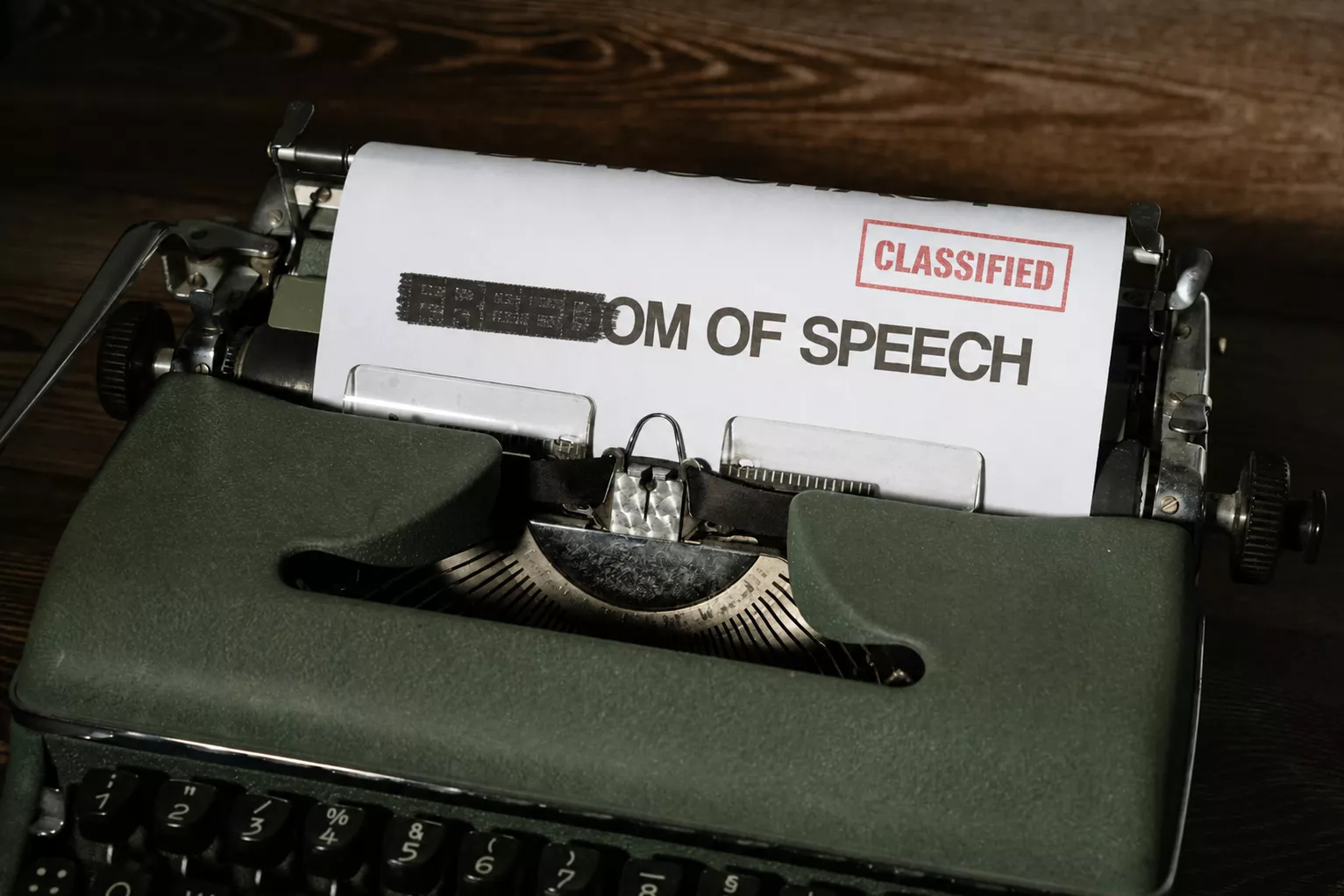
The sanctity of free speech
It has been, by all accounts, a wild week on the free speech front, one of those weeks where the headlines came right at us like a late-night bar brawl.
I’m not really sure who came out on top.
There was yet another assassination attempt on the president—the third in less than two years—with suspicious minds pointing at progressive hate speech as the trigger finger (or Trump’s own hyperbolic speech, depending upon your point of view). There was Wisconsin’s Grim Brewer, Kirk Bangstad, promising free beer if and when one of those attempts actually succeeds.
There was the ex-FBI director, James Comey, indicted over seashells in the sand, and, before we could process that, President Trump and First Lady Melania Trump went after Jimmy Kimmel for reckless insults about Melania’s “expectant widowhood.”
Whew!
But those should have been back stories instead of headlines. Because while the country argued over who said what—and who should be blamed for saying it—the most important free speech story in America barely made the morning scroll. For in late March and early April, albeit almost invisibly, the federal government’s censorship apparatus—built quietly, funded publicly, and aimed inward toward that very public—began to be dismantled.
That was the real story, a real victory for the First Amendment, but, somehow, the corporate media pretended not to notice.
So let’s briefly peek at the headlines and then do a deep dive into the defeat dealt to the tyrants within, otherwise known as the bureaucrats at the helm of a massive government censorship framework. This infrastructure, embedded in the bureaucratic colossus as a whole-of-government project, has, in just a few years, inflicted real pain on our people and our republic, but now, thanks to settlements in two lawsuits, it is being deconstructed.
Let’s start where every conversation about the First Amendment must start: Speech in America must be presumed to be free. Period. In the rarest of cases, provocative speech can become illegal conduct—a direct threat against specific individuals or groups, or purposely promoting or facilitating violence against specific individuals or groups by encouraging or requesting others to engage in such conduct—but even then, such claims must be proven under the strictest scrutiny.
The burden must be on the expurgator to justify the censorship, not on the libertarian to justify his or her free tongue. Otherwise, all political speech will be quickly criminalized, except for the speech that the criminalizers like. As the late Charlie Kirk put it in a 2024 post:
That principle is not some movement slogan. It is the foundation of a free society, and those who trade in the currency of silencing “dangerous” language are only devaluing their own voice in the long run. When the market for totalitarian intolerance finally crashes, they’ll be left with no stock and only a stack of Confederate cash, trying to catch falling knives with their bare hands.
Because once you accept the premise that speech can be punished because it is offensive, or dangerous, or “inciting,” you have already handed power to whoever happens to be deciding what is offensive, dangerous, and inciting. History tells us exactly how that ends.
So, yes, even speech that paints people as evil and Hitlerian must be allowed. One can never use the excuse that incitement to violence is a good reason for censorship. The media incantations about the evil Donald Trump and his administration—in Wisconsin, it was the evil Scott Walker, remember?—do not “cause” or “incite” violence. Believing or calling Trump or anybody Hitler is a political position, as is saying they pose an existential threat to democracy. Many of us said—correctly, by the way—that Biden’s Covid-era suppression of our civil liberties posed an equally existential threat to democracy.
Was the administration right to try to shut us up and cancel us, on the grounds that such positions might incite violence against the president?
Every time there is a political shooting—or an attempted one—the same argument comes roaring back: Whose words caused this, and shouldn’t they be silenced? In a Substack piece this week, “Is Anyone Responsible for the WHCD Shooting Other Than the Shooter Himself?,” independent journalist Glenn Greenwald dismantled that argument with historical and analytical clarity. In the American tradition, he reminded readers, only those who commit violence are responsible for it, not those whose ideas happen to overlap with the perpetrator’s worldview.
As some began to immediately compare the “manifesto” of alleged shooter Cole Tomas Allen to Democratic talking points, Greenwald reminded us that progressives had blamed conservatives for mass shootings because of immigration rhetoric, such as in 2022, when an anti-immigration activist killed 10 black Americans in a market in a predominantly black neighborhood in Buffalo.
“The shooter, 18-year-old Payton Gendron, left a long manifesto identifying those he regarded as heroic and who inspired him (principally other mass shooters who targeted immigrants, Black people, and Muslims), and explained his reasons for deliberately targeting non-white people (focusing on “The Great Replacement Theory”),” Greenwald wrote.
“In its wake, elected liberals and their media allies instantly—meaning: before the bodies were even removed—blamed the massacre on prominent conservatives who were opposed to mass immigration. Because these conservatives expressed views about immigration that were featured as galvanizing motives in the shooter’s manifesto, so this reasoning went, the ‘rhetoric’ of those conservatives ‘inspired’ the shooting, and they thus had blood on their hands.”
Similarly, Greenwald wrote, many prominent Democrats wanted Trump prosecuted for “inciting” violence at the January 6 Capitol riot, and he articulated the dangers of this line of thinking.
“As I often argued back then, such a prosecution of Trump on those grounds would not only violate the First Amendment by holding a citizen liable for constitutionally protected speech, but it would also destroy the vital separation between one’s words and the violent acts of others. And the answer, consistently, must be no.”
In America, you don’t get to punish what the constitution protects. That First Amendment separation between my speech and your conduct is a firewall that protects our speech from becoming a scapegoat to tyranny. Not to mention, to relieve people of personal accountability by turning them into casualties of violent rhetoric is to buy into the worst of progressive mythology. It is a form of woke ideology that relieves a protected class of “victims” from ever having to exercise individual responsibility.
Where Speech Ends and Conduct Begins
That said, there are those rare occasions when speech is not just speech but crosses over into illegal conduct. Admittedly, we have to tread carefully here because, as Charlie Kirk reminded us, the first step is always a big one, and it can quickly lead to a slippery slope. Still, and perhaps this is the only place we can all agree, there are indeed accepted, but extraordinarily narrow, circumstances in which speech crosses the line, such as making direct threats against specific individuals or groups, explicit incitements to imminent violence, and engaging in speech integral to criminal activity.
To be sure, those are categories subject to the strictest scrutiny, and they must remain that way.
It is on those very categories that the Trump administration has now indicted ex-FBI director James Comey again, for Comey’s alignment of seashells in a formation of “86 47.” Even I can figure out that this is a message written about the 47th president. But was it a threat? A joke? A protest? A cryptic political statement?
Whatever it was, the indictment is a prime example of the slippery slope. Even legal scholars like Eugene Volokh, a senior fellow at Stanford’s Hoover Institution, have pointed out the obvious problem. While “47” can reasonably be taken as targeting Trump, “86” itself has multiple meanings, most of them nonviolent. To cite just one of the examples Volokh used, “To ‘eighty-six’ someone is, to quote the Oxford English Dictionary, ‘to eject or debar (a person) from premises; to reject or abandon; (in earliest use) to refuse to serve (a customer).’”
So was Comey advocating murder, or impeachment, or something else entirely? I have no idea, at least not without a reasonable doubt, and I suspect a judge will decide the same thing long before the case ever gets to a jury. It is a frivolous indictment.
Closer to home, though, Bangstad’s case runs closer to the line. Unlike seashells, Bangstad’s comments were not ambiguous. He openly suggested celebrating the president’s death, even offering free beer if it happened: “Well, we almost got #freebeerday,” Bangstad wrote in the widely circulated Facebook post. “Either a brother or sister in the Resistance needs to work on their marksmanship or he faked another assassination to get a positive news cycle. We’ll never know. Regardless, we stand at the ready to pour free beer the day it happens.”
That’s uglier and closer to the edge. The post quickly drew bipartisan condemnation and thrust Bangstad—a longtime progressive activist—into the center of a widening political storm. For starters, the FBI’s Milwaukee field office issued a statement to multiple media outlets, saying it was aware of the posts.
“Hateful rhetoric and speech are despicable,” the FBI said in the statement to the Milwaukee Journal Sentinel. “Threats of violence or terrorism will be investigated by the FBI, and the public is encouraged to report any threats of violence.”
Per standard practice, the FBI did not confirm or deny whether it was specifically investigating Bangstad, though Bangstad claimed this week he was being visited by the FBI and Secret Service. What’s more, in the last few days, Bangstad, perhaps fearing a federal indictment, walked back the comments, sort of.
“I admit that my line about improving marksmanship, intended specifically to be hyperbolic in order to set off the next line that suggested this assassination attempt may have been staged, was probably not as funny as I intended it to be,” Bangstad wrote. “That being said, I won’t apologize for it because not an once [sic] of that line called for violence or called for people to assassinate Donald Trump (I’m not calling him the President on purpose).”
I am not sure that explanation is enough to get Bangstad off the hook. It’s true that the courts have ruled that true threats do not include contexts in which obvious political hyperbole is just that, as Bangstad now depicts his post.
On the other hand, federal statutes define criminal solicitation as “solicitation to commit a crime if, with the purpose of promoting or facilitating its commission, he commands, encourages or requests another person to engage in specific conduct which would constitute such crime…” It seems Bangstad is enthusiastically promoting Trump’s potential death—“we almost got free beer day” and “the Resistance needs to work on their marksmanship,” if the attempt was real—and, even more important, while he may not have called for violence or assassination, he seemed to encourage and incentivize it by offering “free beer” to patrons.
A court might recognize the hyperbole of a direct threat but could public encouragement ever be considered hyperbolic, given the necessity that all the readers of such a post would have to make the same interpretation? Whether that is the case, and whether the offer of free beer is even encouragement in the first place, would be for prosecutors to look at and, potentially, for a jury to decide, but it is close enough to question.
At the very least, it seems to me that if Comey can be indicted for seashells in the sand, Bangstad could be charged for free beer in the bar. If so, it’s a case for a jury of his peers, with strict scrutiny and due process.
All of which brings us to Jimmy Kimmel. When President Trump and the First Lady called for ABC to fire Kimmel after his controversial joke, critics cried censorship.
Critics were wrong. Calling for someone to be fired for not aligning with the community’s and/or the employer’s values is not censorship—it is participation in the marketplace of ideas. And that is exactly what Aspirus Hospital did this week by apparently firing a vice president based out of Wausau after he responded to Bangstad’s post positively, along with a photo of himself in a F-Donald Trump T-shirt and a #freebeerday koozie. Libs of TikTok called him out, and Aspirus booted him out.
Good, because how are conservatives supposed to feel about their health care in a system where the executives endorse the murder of their president?
As for Kimmel, the federal government is not compelling ABC to act, nor has it threatened ABC with penalties or deployed regulatory power to silence him. Even in his earlier suspension after Charlie Kirk’s assassination, when the government considered an investigation into ABC’s broadcast license, neither the president nor the FCC could yank a license or trample on ABC’s or Kimmel’s due-process rights. First, a complaint or violation puts the FCC on notice; the licensee receives formal notice and a deadline to respond, and the licensee can then cure, rebut, or contest the matter. Only if the issue remains unresolved does the FCC initiate a hearing. What’s more, appeals can go to court.
In this instance, Trump and his wife had an opinion. Period.
My, what Big Teeth you have
And yet, none of this—none of the rhetoric, the outrage, or the spectacle—was the real story. By the end of the week, what we had was, as the judge in Fried Green Tomatoes said, “a whole lot of nothing.”
The alleged shooter will be prosecuted; Comey’s indictment will likely be tossed; Bangstad will keep on hating because that is what haters do, though he may or may not be hating from a prison cell; and Kimmel will keep on impersonating a comedian, because, in America, bad comedy is protected, too. Trump will keep on Trumpin’.
But that’s not to say the last month, if not the last week, was substantively uneventful on the front lines of free speech.
Indeed, the biggest threat to free speech has been a massive bureaucratic-censorship complex inside the federal government, and two lawsuits against that machinery have now been settled in a way that will dismantle most of it. While politicians and pundits argued about who could say what, these lawsuits quietly exposed and disposed of something far more dangerous: A coordinated, taxpayer-funded censorship regime operating across federal agencies that was quietly deciding what Americans could say—and who could talk—no matter what happened in public debate.
In one case, brought by the New Civil Liberties Alliance (NCLA) on behalf of The Daily Wire and The Federalist, the State Department entered into a settlement that reads like a deathbed confession. In the lawsuit, NCLA exposed that the Biden government had funded and promoted hundreds of “disinformation” tools; those tools were used to target domestic speech and media outlets; officials coordinated with NGOs, foreign governments, and private companies; and content was flagged, suppressed, demonetized, and downgraded.
“The Department actively encouraged private companies, government bodies here and abroad, and NGOs to use these technologies to target Americans’ speech and media outlets, pushing social media companies to ferret out what it deemed misinformation and disinformation on domestic policy topics like Covid-19 and vaccines,” the NCLA asserted.
Secretary of State Marco Rubio had already announced the closure of the Global Engagement Center (GEC), a centerpiece of the bureaucratic-censorship complex, saying the GEC had been involved in the development and promotion of entities such as NewsGuard and the Global Disinformation Index, which demonetized domestic news organizations by branding them unreliable or risky, among them The Daily Wire and The Federalist, NCLA asserted.
Under the terms of the settlement, the State Department will work to remove specific online material it funded, including “media literacy training” videos produced by Media Literacy Now that denigrated The Daily Wire and The Federalist: “In 2030 and 2035, State will be required to train all its employees on how the First Amendment limits its ability to suppress Americans’ constitutionally protected speech,” NCLA stated.
Caleb Robinson, CEO of The Daily Wire, said the case was especially important in a digital era.
“The U.S. Government has acknowledged its censorship structures under the Biden administration and will now be subject to limitations on similar behavior in the future,” Robinson said. “We’re grateful to NCLA for representing us, and I also appreciate our co-plaintiffs’ efforts in this landmark case.”
The decree also bolsters protections for specific categories of speech discussing Covid-19, including its origin, the safety of vaccines, the usefulness of masking, and the harm caused by school and business shutdowns, as well as speech discussing election integrity, including violations of state election laws, allegations of illegal or fraudulent voting, and critiques on the integrity and security of ballots, polls, and voting machines. Finally, the government agreed to protect categories of speech discussing abortion and issues related to sexuality or transgender ideology.
“Defendants will not use electronic tools or technologies to knowingly or intentionally suppress, censor, demonetize, or downgrade the constitutionally protected speech of Americans or domestic media outlets,” the agreement stated. “Defendants remain free to speak in their capacity as government officials to disagree with, criticize, or encourage self-restraint of speech.”
In the second major case, Missouri v Biden, the government agreed to end government-induced social media censorship. If The Daily Wire case exposed the architecture of the censorship machine, the Missouri v. Biden litigation exposed the operating system. Indeed, discovery in the case revealed what many suspected, but few could prove: a “whole-of-government” effort to pressure social media companies to censor disfavored viewpoints.
That whole-of-government effort included the Centers for Disease Control (CDC), the Surgeon General, the Cybersecurity and Infrastructure Security Agency (CISA), and White House officials, all of whom coordinated to shape what Americans could see and say online. The settlement is nothing short of historic. It prohibits the federal government from pressuring platforms to remove “misinformation,” or threatening regulatory or legal consequences for noncompliance. It also cannot direct or influence content moderation decisions or coerce algorithmic suppressions of speech.
Critically, it underscores this article’s previous assertion of the sanctity of protected speech. Such speech cannot be used to hold citizens liable or to suppress their speech simply because someone labels it as inciting or as dangerously false information.
“In today’s settlement, the Trump administration agrees that government, politicians, media, academics, or anyone else labeling speech ‘misinformation,’ ‘disinformation,’ and ‘malinformation’ does not make it constitutionally unprotected,” NCLA stated. “People are bound to make false statements now and then when they speak their minds, a freedom the First Amendment guarantees. This settlement helps safeguard that marketplace of ideas from the federal government.”
Put in perspective, the machinery the Biden administration built to obliterate the First Amendment, and the fact that the government almost got away with it, should be a lot more terrifying than what Kirk Bangstad or Jimmy Kimmel or James Comey are saying. The two lawsuits exposed the existence of a massive censorship apparatus that used cancellation and omission and outright false data to shape American public opinion, all the while sending the disfavored to digital gulags. The apparatus spread like a steel cobweb around all federal agencies.
The outcomes of these cases are to be praised—they are really something to celebrate, maybe even with free beer—but, at the same time, the greater danger of government censorship, direct or indirect, remains. The recent settlements impose safeguards, but power always looks for a way around them. To cite just one example, as NCLA pointed out, when Congress refused to renew funding for the GEC, the Biden administration simply tried to recycle it within the State Department, renaming it the Counter Foreign Information Manipulation and Interference framework.
That didn’t work, but the bureaucratic state always tries, and then tries again. That is why ongoing vigilance is essential, and why the steady pruning of bureaucratic authority—through tighter missions, regulatory rollback, and fiscal restraint—is the surest way to choke off censorship at its source.
In the end, the answer is what it has always been: a return to individual liberty grounded in responsibility and accountability. When we have free schools in which children are taught the critical thinking skills they need to navigate right from wrong; when strong families thrive and are able to build for their children a foundation of strong moral values, free from government interference; when censorship regimes are dismantled inside government so that propaganda is not an official narrative, the impulse to violence will recede.
The answer to a sick society is to heal it, not kill it. It demands not that we exorcise our constitutional liberties but that we strengthen them.

Interested in the content of this Article?
Reach out to the MacIver Institute to aquire more information


