
- Podcasts
 Podcasts
 - Videos
 Videos
 - Policy Issues
 Policy Issues
 - About
 About
About


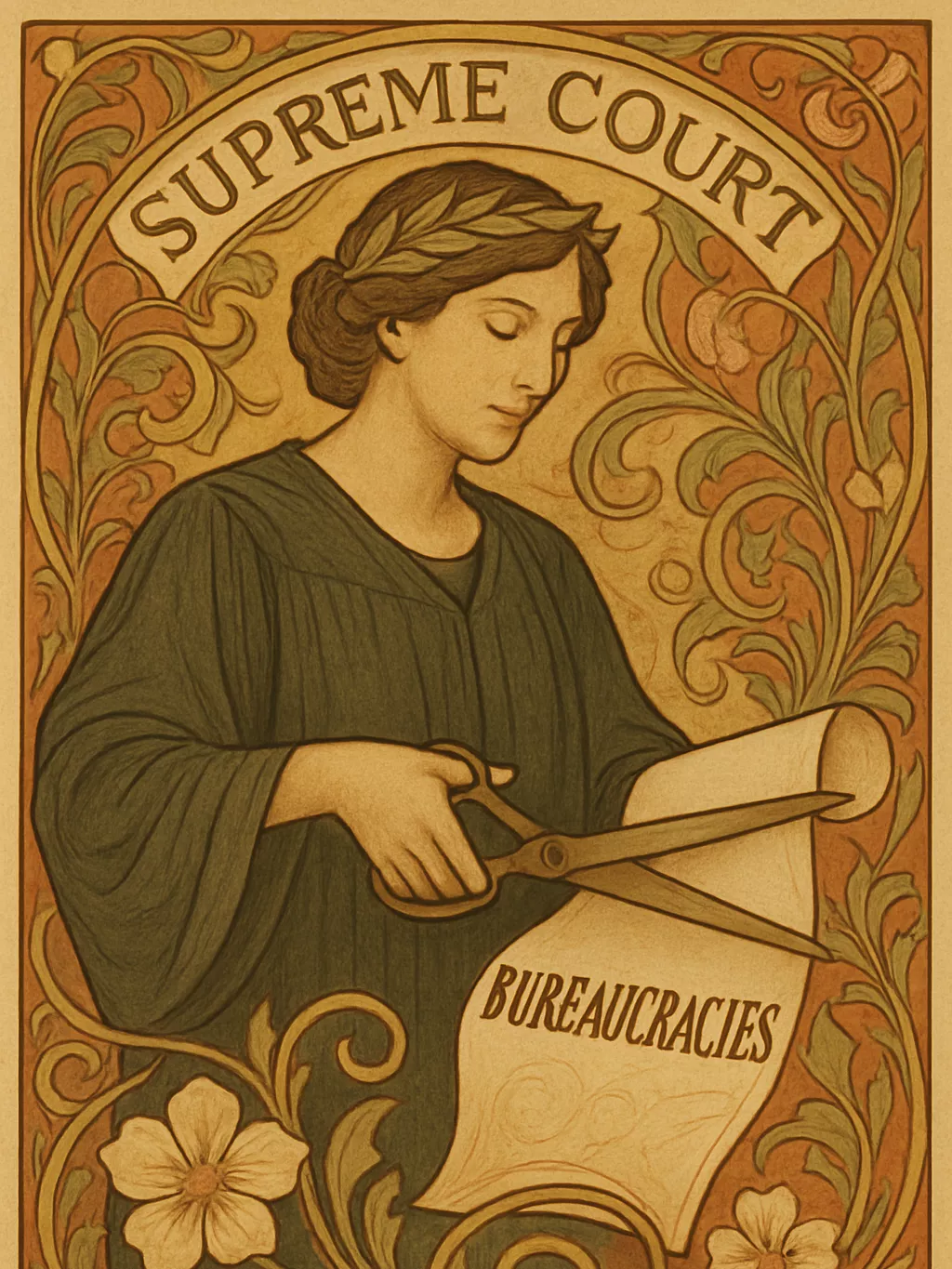
Checking the Unchecked Power of the Unelected
Only since the re-election of Donald Trump have the American people begun to understand just how deep the deep state is.
For a while now we have known there are four branches of government—the biggest and most powerful among them, the sprawling federal bureaucracy, is unconstitutional—but now, thanks to Trump, we’ve been shown the power of a fifth branch, the powerful nonprofit sector, and possibly of a sixth, those independent agencies out of everybody’s reach.
And that’s not even counting rogue federal judges who run interference for the bureaucratic quarterbacks.
We live in an age of quiet tyranny, it has been called, a dull, bureaucratic despotism. A nation where a faceless judge in a backwater district can set policy for the entire nation. A place where so-called “independent” agencies write rules that bind you more tightly than any law passed by Congress.
Trump has pushed back on this, of course, and so has the U.S. Supreme Court, which in a number of decisions has started to hack away the dense bureaucratic overreach that is ensnaring the nation. The Chevron doctrine of due deference was a huge Humpty Dumpty that came crashing down, not to be put back together again, and now in a July decision the court has moved ever closer to obliterating so-called independent agencies.
The question in that decision, Trump v. Boyle, was whether the president could fire three commissioners of the Consumer Product Safety Commission (CPSC), all of whom exercise executive power. The court, by a 6-3 vote, said yes, as it should have. It nodded to a similar case called Wilcox, decided in May, when the justices allowed Trump to remove board members of two other independent agencies, the National Labor Relations Board and the Merits Systems Protection Board.
The latest ruling is a temporary injunction, while the case proceeds. And so the battle continues, as it has for decades while an entire class of so-called “independent agencies” has operated under a peculiar fiction: that they are part of the executive branch but not answerable to the president.
Finally, with the court’s recent decision, we may be watching that fiction finally crash land on a very hard constitutional reality.
Specifically, the Supreme Court, in a brief unsigned order—what’s called a “shadow docket” decision—granted the Trump administration’s request to put on hold a lower court ruling that had reinstated three Democratic commissioners to the CPSC. Trump had fired those officials—Mary Boyle, Alexander Hoehn-Saric, and Richard Trumka—even though a federal statute declares they can only be removed “for neglect of duty or malfeasance in office.”
Supporters of the latest ruling argue that that statute is unconstitutional because its renders the idea of a unitary executive branch null and void. The constitution, they say correctly, vests all executive power in the president.
Others have stated the case more throughly than I can, but the lower court’s determination (and that of other courts) flows from a 1935 case, Humphrey’s Executor v. United States, which held that Congress could create independent, multi-member commissions whose members the president couldn’t fire at will.
The progressive decision was one of many efforts through the years to prevent the “politicization” of agencies, mainly by designing them to be insulated from “special interests,” otherwise known as the people. Instead, Congress could and did structure those agencies to be run by experts who knew exactly what all the correct policy prescriptions were, whether the people wanted those prescriptions or not.
Interestingly, it usually ends up that people don’t want the prescriptions the government bestows upon them. Somehow, the people never know what’s good for them.
Obviously, independent agencies should not have been designed and structured that way. When progressives talk about “politicizing the process” or “undermining independence,” they really mean they want to protect unelected bureaucrats from the political process we call voting for our policymakers. And when they say the Trump administration is undermining independence, they really mean it is undermining the bureaucracy’s absolute authority.
Boyle and Wilcox underscore that the ability to remove bureaucrats in independent agencies who exercise policy-making executive power is crucial to bringing that and other agencies in line with the will of the people, as represented by the policies of an elected president.
One of the most absurd progressive claims is that Trump is increasing executive power at the expense of Congress and establishing an imperial presidency. The truth is, Congress became impotent a long time ago, a lot of its dysfunction caused by its own actions, and what Trump is doing is merely redistributing the existing power of the federal government to where it should be, on the elected side of the equation rather than on the unelected side of the equation.
Or as James Madison put it:
“If the President should possess alone the power of removal from office, those who are employed in the execution of the law will be in their proper situation, and the chain of dependence be preserved; the lowest officers, the middle grade, and the highest, will depend, as they ought, on the President, and the President on the community.”
Without a shadow of a doubt
There are two major issues lurking around in the shadows of the Boyle ruling, and one of them is, no joking, that of the shadow docket.
The term “shadow docket” refers to emergency decisions made by the Supreme Court outside its standard protocols of deliberation, including briefing and oral arguments. They are usually temporary—such as injunctions to stay a law while it is argued on the merits—but they can have major impact. They are often short, unsigned and unexplained.
Justice Elena Kagan, who dissented in Boyle, in part because it was a shadow docket case, has been a consistent critic. Kagan calls the increasing use of shadow rulings dangerous, and she made her opposition clear in her dissent, which was joined by the other two progressives on the court.
“Once again, this court uses its emergency docket to destroy the independence of an independent agency, as established by Congress,” Kagan wrote...
“Two months ago, in Trump v. Wilcox, the majority issued a stay allowing the President to discharge, without any cause, Democratic members of the National Labor Relations Board. Today, the same majority’s stay permits the President to fire, again without cause, the Democratic members of the Consumer Product Safety Commission (CPSC). Congress provided that the CPSC, like the NLRB and MSPB, would operate as ‘a classic independent agency—a multi-member, bipartisan commission’ whose members serve staggered terms and cannot be removed except for good reason. … By allowing the president to remove commissioners for no reason other than their party affiliation, the majority has negated Congress’s choice of agency bipartisanship and independence.”
In so doing, she concluded, the majority had all but overturned Humphrey’s Executor v. United States.
The bottom line for Kagan is that she thinks the ruling was the death knell for agency independence, and she accused the majority of using the shadow docket to sneak in massive structural changes to the government’s natural order of things, all under the cover of darkness.
That description is why it’s called the shadow docket in the first place. Testifying before the Senate Judiciary Committee in 2021, Stephen Vladeck, the Charles Alan Wright Chair in Federal Court’s put it this way:
“[R]ulings on the ‘shadow docket’ typically come after no more than one round of briefing (and sometimes less); are usually accompanied by no reasoning (let alone a majority opinion); invariably provide no identification of how (or how many of) the justices voted; and can be handed down at all times of day—or, as has increasingly become the norm, in the middle of the night. Owing to their unpredictable timing, their lack of transparency, and their usual inscrutability, these rulings come both literally and figuratively in the shadows.”
Make no mistake, large decisions made on the shadow docket can have major impacts, even though they are mostly temporary, at least on major questions. A stay or injunction issued through the shadow docket will likely remain in effect throughout the lower-court process, months and months, until it reaches the Supreme Court, and, when such things as elections are involved, a temporary stay could be decisive to the outcome.
There’s also no doubt about the increasing use of the shadow docket. As Amy Howe of SCOTUS Blog said on PBS Newshour in July, the court has been relying more on the shadow docket not only during the Trump administration but during the Biden administration, too, when it headed to the courts frequently seeking emergency relief or action.
“And just to give you a sense of how often, since January 20, between January 20, when he was inaugurated, and June 30 of this year, the Trump administration came to the Supreme Court on the emergency docket more than twice as many times as the George W. Bush and the Obama administrations came to the Supreme Court in 16 years,” Howe said.
Still, what the corporate media doesn’t get—because they parrot every talking point the progressive left gives them—the real villain isn’t the shadow docket itself but what necessitates its use: a judicial system where lower court judges have increasingly been issuing what are known as universal injunctions. These are court orders that don’t just apply to the parties in a case but nationwide.
The ability for one district judge to effectively legislate national policy inevitably opens the floodgates of appeals for emergency relief. Among other things, the ability to issue universal injunctions incentivizes “venue shopping”—where activists seek out sympathetic judges to impose sweeping national policy via a single ruling. That, in turn, forces the executive branch to run to the Supreme Court begging for emergency relief. And so, we get more shadow docket rulings.
Instead of showcasing the increasing use of the shadow docket, as progressives do, we should highlight the increasing use of the universal injunctions that beget it. According to a May Congressional Research Service report, there were 25 universal injunctions issued during the first 100 days of the second Trump administration. That’s one every four days. By contrast, the CRS identified just four universal injunctions issued during the first 100 days of the Biden administration.
There’s your problem. Rogue district judges are running interference for their bureaucratic and progressive allies to thwart the Trump administration. Again, an unchecked power by unelected bureaucrats.
So if Kagan has a problem with the use of the shadow docket, she needs to look to the lower courts for the fix. End the universal injunctions, make plaintiffs bring cases in their actual jurisdictions, and let the process work as it was designed. That will reduce emergency appeals and put the “emergency” docket back where it belongs—reserved for true emergencies.
Declaration of Independence
As bad as the problem of rogue unelected judges is, it pales next to the threat to liberty posed by independent agencies that write the rules that govern us.
The Consumer Product Safety Commission, the Federal Trade Commission, the Securities and Exchange Commission—each is gifted the power to impose rules with the force of law, to enforce them, and to judge those they say run afoul of them, all in a kangaroo rather than a constitutional court. With that power, they are also awarded immunity from presidential oversight. It’s a recipe for totalitarian abuse.
Again, progressive defenders of this model argue that it insulates agencies from politics. Which it does: It insulates agencies from the people who should be electing the people who govern them. Instead, such agencies are run by lawyers, academics, and career pencil-pushers, none of whom are democratically accountable and many of whom are ideologically compromised.
Often they are just incompetent and wrong.
Even so, the White House’s Office of Management and Budget does not review rules from independent agencies. That means binding regulations are issued without any direct check from the elected executive. It’s bad enough in agencies that aren’t independent. Data from the Pacific Legal Foundation found that 71 percent of Health and Human Services regulations issued over a 17-year period were enacted without sign-off from a presidentially appointed, Senate-confirmed officer.
Think about that. Most of the laws we live by are being written and enacted without any democratic oversight whatsoever, not even cursory review by a democratically accountable officer. We are further removed from the constitution in this country than we have ever been, and if that’s happening in “accountable” agencies, just think what’s going on in unaccountable ones.
Actually, I can tell you what’s going on, and it’s a horror movie. As it turns out, the Consumer Product Safety Commission (CPSC)—the subject of the July ruling that Trump can fire its commissioners—is the poster child for the abuse of power by independent agencies.
Nothing illustrates the danger of unaccountable agency power like like the CPSC case against Leachco Inc., a small, family-run company in Oklahoma that designs baby products.
As the company’s legal representatives (Pacific Legal Foundation) recount, one of its items, the Podster infant lounger, became the target of a sweeping enforcement action by the CPSC after two tragic deaths—both linked not to product defects but to improper use in violation of express safety warnings. Rather than working with the company—or taking the matter to court—the CPSC initiated an internal administrative proceeding to ban the product and impose millions in fines. The commission acted as law enforcement, judge, and jury.
What makes this case even more absurd is the background: Leachco was founded by a nurse who created the first product to protect her own child from injury. Over three decades, the company earned 40 patents, countless customers, and a reputation for safety.
But after the CPSC action, they swooned. Retailers dropped their products. Legal costs skyrocketed. And the founders were forgoing salaries just to keep their employees paid.
It gets even more absurd. On July 3, 2024, in a rare malfunction of bureaucratic conformity, the agency’s own administrative law judge sided with Leachco, concluding that the CPSC failed to prove that the Podster had any defect posing a substantial risk to the public. But that didn’t stop the CPSC’s enforcement lawyers from appealing the ALJ’s ruling to the commission itself—the same body that initially approved the case.
Not to mention, some of the same commissioners Trump just fired. Without that presidential oversight, the CPSC commissioners could continue to mete out unwarranted injury to small businesses and individuals alike, with no one to stop the bureaucratic assaults.
Leachco meanwhile brought a lawsuit in federal court to challenge the constitutionality of the CPSC’s structure and internal legal proceedings. The Supreme Court declined to take up the case in January 2025, but the central question remains: At the very least, why not let the CPSC make its findings and recommendations and, if the company disagrees, let them contest it in a federal constitutional court rather than in a rigged administrative proceeding—in a real Article III court, with a jury of their peers and an independent judge.
The problem is, this is not a one-off. The CPSC might be the poster child for what happens when regulators become unmoored from any check or balance, but in case after case, the most zealous and unfair hounding of citizens emanates from these independent agencies. Not far behind is the Securities and Exchange Commission, where staff have brought unauthorized lawsuits, engaged in illegal collection of data, and participated in the Biden regime’s censorship.
Ultimately, it’s fair to say we have a constitutional problem, but it’s not the one portrayed in the corporate media. It’s not the shadow docket. It’s not the politicization of federal agencies. Rather, it’s rogue judges ruling from their own tenebrious corners; it’s the ideological capture of federal agencies.
And, perhaps worst of all, it’s the existence of independent agencies.
That it is should be a no-brainer. The U.S constitution was written, among many other things, to make government accountable. That’s why Congress is supposed to make the laws. That’s why the executive enforces them. That’s why courts resolve disputes.
The nation’s bureaucratic collectivist enterprise has blurred all three roles, more, has taken on all three functions. Imbued with god-like unaccountability, so-called independent agencies become a new branch of government still—untouchable, Oz-like in their monstrosity, and machine-like in their cold calculations and lack of humanity.
They are all unconstitutional.
The solution is clear: Bring these agencies back under presidential control. Ensure that their regulations go through proper review. Strip them of their ability to self-adjudicate binding decisions. And yes, allow the president to remove officials who wield executive power.
As Trump’s own February 2025 executive order put it: “Officials who wield vast executive power must be supervised and controlled by the people’s elected President.”
In 2025, it’s sad that that is not obvious.
Unless we reestablish democratic accountability, unelected officials will continue to make de facto laws, shielded from both removal and review. That’s not what the Founders intended and it’s not what democracy requires.
It’s time to fix it. Fortunately we have a common cure: Topple the unelected from their thrones. Make government answer to the people through their elected representatives and the elected president.
Pretty obvious, if you ask me.

Interested in the content of this Article?
Reach out to the MacIver Institute to aquire more information


