
- Podcasts
 Podcasts
 - Videos
 Videos
 - Policy Issues
 Policy Issues
 - About
 About
About


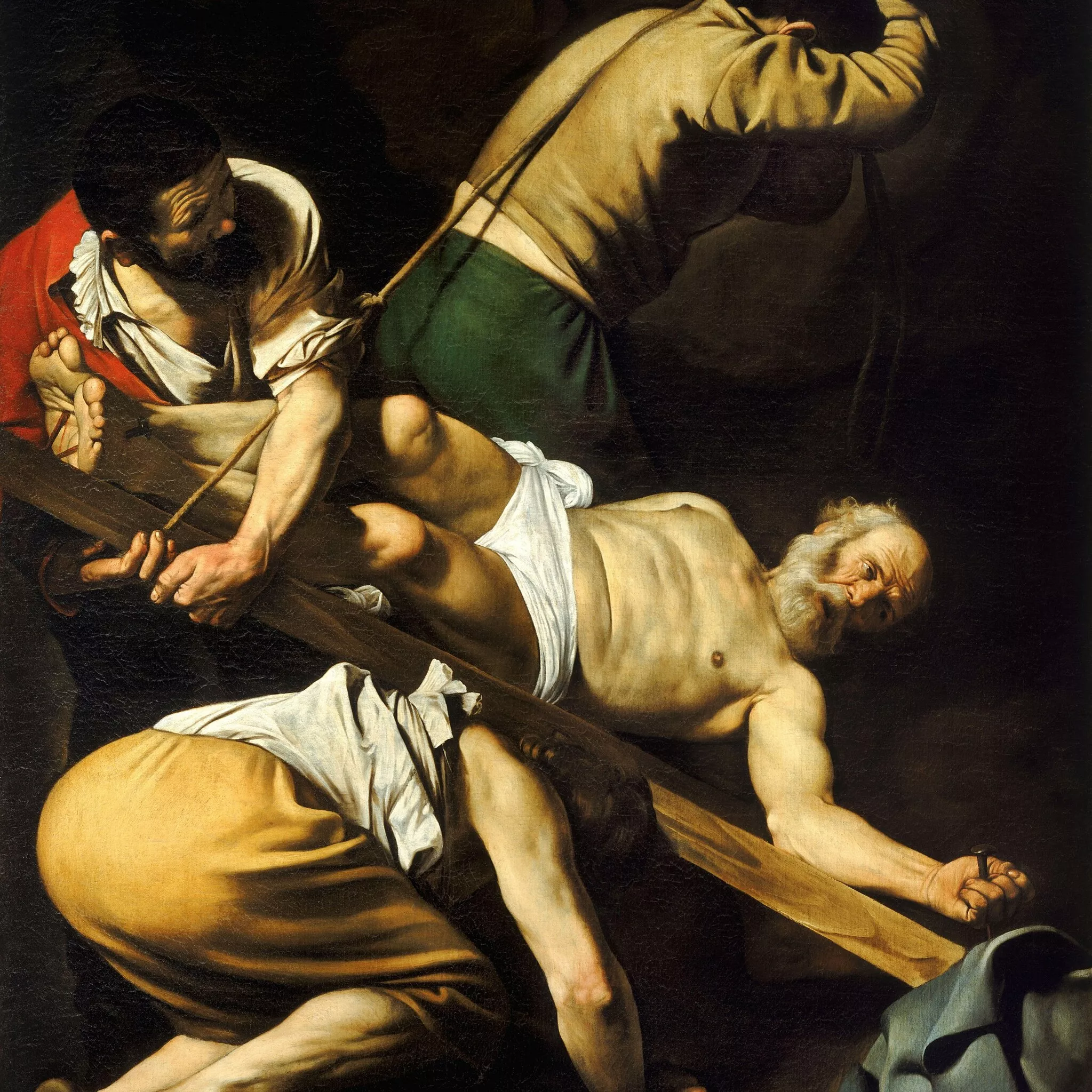 The Crucifixion of Saint Peter by Michelangelo Caravaggio
A Revival of Faith and Hope
This week, I want to pause from the usual dissection of bureaucratic bluster and blunder to reflect upon the assassination of Charlie Kirk and the reverberations that have been occurring globally since that awful moment.
It’s one of those instances where you will always remember where you were when you found out. I was on a back road in northern Wisconsin when I got a call, and, a few minutes later, having pulled to the side in Land O’Lakes, my wife and I heard the news of his tragic passing.
There’s always the hollow feeling in your stomach, and the stabs of pain and breathlessness that such news sends through your system. A bit of surreal fogginess comes with it, the sense that surely this can’t be happening. In this case, too, as several days passed, there was also the sense that something even more significant than one man’s death had occurred, an unexpected turn, not just for his family and his movement but for the country as a whole.
The weeks that have followed have amplified that assessment. The assassination was immediately received and felt as something far more than could be contained within mere political jurisdiction. It was also more than just another act of senseless violence in an already dangerously polarized America.
It ran through and beyond the culture, even beyond specific religions. It ran like a current to the open waters of our very faith. It was a phenomenon of the soul, simply put, a kairos moment that most Americans and millions around the world felt and understood to have come upon us—an appointed time, heavy with sacred weight, when the mundane touches of daily life step back to allow eternity to press closer.
For reasons that no pundit, historian, or politician can fully explain, his death unleashed not only an outpouring of grief and anger but also a revival of hope, resistance, and inspiration that touched the hearts of millions around the world.
Or, to say it another way, there are political movements, spiritual movements, and cultural movements, and this was all that, but it was more. It was a monumental movement of forgiveness, that emotional sustenance that enriches the inner vaults of our humanity but simultaneously bankrupts and empties the accounts of those filled with hate and evil. The energy of it all was amorphous, galloping into churches and schools and workplaces, suddenly free and liberated from normal narrative manacles, and yet it was never out of control.
At Kirk’s memorial, it was best captured not by politicians or activists, but by Erika Kirk herself, who stood before the world and bore witness to mercy. She did not speak of politics or rivals but of revival—of people who had not prayed in years suddenly reading the Bible, of people going to church for the first time in their lives.
Erika Kirk captured this unique moment in our time best of all: “But most of all, God’s mercy and God’s love have been revealed to me these past 10 days. After Charlie’s assassination, we didn’t see violence. We didn’t see rioting. We didn’t see revolution. Instead, we saw what my husband always prayed he would see in this country.”
She spoke about young men, in particular:
“Charlie wanted to help them. He wanted them to have a home with Turning Point USA. When he went onto campus, he was looking to show them a better path—a better life that was right there for the taking. My husband, Charlie, he wanted to save young men just like the one who took his life. That young man. That young man. On the cross, our Savior said: ‘Father, forgive them, for they know not what they do.’ That man—that young man—I forgive him.”
And with those words, a movement that I believe will likely be far more powerful than any of the past century was cemented, the strength and extent of which we have not yet even begun to comprehend. To consider such a movement as merely political is to trivialize it. To see it only as a tragedy is to trivialize the death of the man who built it. History shows that death, when mourned at the altar of sacrifice, can seed movements and great awakenings. It can birth—or at least rebirth—a great nation.
The Kirk assassination belongs in that long line of events that challenge the human spirit.
In an age when a culture of assassination is given the license of legitimacy, and politics runs on the social media narcotic of violence and the celebration of violence, the act of forgiveness stuns like a sudden clap of thunder or the solid strike of lightning against a black sky. It sends the creatures of darkness running for cover. It creates light and space for something altogether new.
Forgiveness is not weakness, Erika Kirk reminded us. It is the deepest power of the Christian faith. And it is not merely personally transformative, but culturally and politically so: It reminds us that communities and nations are populated by living human beings, all of us flawed, all of us vulnerable to occupation by evil, but also resilient and courageous enough to ward it off.
When Erika forgave, she was not letting evil off the hook; she was telling the world that evil must not have the last word, or commit the last act.
This moment may prove to be the seed of such revival, not just for Christians and Christianity, but for those of many faiths who yearn for a day when spiritual values reign supreme once more. Forgiveness may extend mercy to those who commit evil acts, it may call up courage in the most fearful of times, but it can also blow a kiss to a broken heart.
Why the Left’s Violence Fails
And yet, and yet, if Kirk’s martyrdom catalyzed revival rather than riots, part of the explanation for the latter lies in a deeper divide that we cannot forget or ignore: the differing philosophical roots of right and left stake out a line that we cannot allow to be crossed.
Unlike capitalism’s liberal flank, which we used to call the Old Left, and which lived within the confines of markets and individual liberty, tethered to free speech, the anti-capitalist left has no such binding values. History makes clear that the radical left—and I speak here of the anticapitalist left, or progressivism, as it has come to be known—depends upon, and ultimately must depend upon, violence as a necessary political implement.
From Karl Marx’s explicit calls for “despotic inroads on the rights of property, and on the conditions of bourgeois production” to Herbert Marcuse’s doctrine of “repressive tolerance,” progressivism’s intellectual heritage is soaked in the language of forced collectivism; it is stained with a bloodlust for individual enslavement.
Marx may have dreamed of a workers’ paradise, but his program demanded seizure of property, suppression of dissent, and the forcible overthrow of all “existing social conditions.” Marx wrote: “You reproach us with intending to do away with your property. Precisely so: that is just what we intend.”
He advocated not only for the abolition of private property but also for the abolition of all rights of inheritance, the centralization of the media and transport under government authority, the establishment of industrial armies to “mobilize” idle labor, and the confiscation of property from those opposing the revolution, i.e., “rebels.”
With the rise of the totalitarian leftist regime of the Soviet Union, and of its kissing but estranged cousins, the fascists in Italy and the Nazis in Germany, it is a small wonder any left-of-center liberalism survived in the United States. But it survived, and for many years, an Old Left clung to a version of social justice that was morally, if not fiscally, sustainable.
Welfare statism and the growth of bureaucracy ultimately did the Old Left in, and the authoritarian and anti-capitalist New Left guru, Herbert Marcuse, supplanted it. Marcuse sharpened the totalitarian knife in the twentieth century, amputating the left from its civil liberties torso.
In Marcuse, we see clearly the left’s ultimate allegiance to violence—ultimately, one cannot win elections or secure the governing sanction of a people when your agenda consists of taking away their rights of speech and of dissent, and their very property to boot. One cannot win elections when all you promise the people is dictatorship. No one would vote for that, and so in the end, the left must take it, and take it violently when people stand up for their liberties.
Marcuse articulated this vision of leftist violence so well. He insisted that true liberation required silencing the “oppressive” speech of conservatives, churches, and traditional institutions. What he called “repressive tolerance” was in fact an ideological warrant for censorship, coercion, and the eventual suppression of all disliked speech.
I have written before about Marcuse’s ideological manifesto, but it bears repeating now in this age of actionable violence by the left—a skip away, if that, from an outright declaration of war. Liberating tolerance, Marcuse wrote, would mean intolerance against movements from the Right, and toleration of movements from the Left:
“This means that the ways should not be blocked on which a subversive majority could develop, and if they are blocked by organized repression and indoctrination, their reopening may require apparently undemocratic means. They would include the withdrawal of toleration of speech and assembly from groups and movements which promote aggressive policies, armament, chauvinism, discrimination on the grounds of race and religion, or which oppose the extension of public services, social security, medical care, etc.”
But did he preach violence to secure repressive tolerance? Sure he did:
“Even in the advanced centers of civilization, violence actually prevails: it is practiced by the police, in the prisons and mental institutions, in the fight against racial minorities; it is carried, by the defenders of metropolitan freedom, into the backward countries. This violence indeed breeds violence. But to refrain from violence in the face of vastly superior violence is one thing, to renounce a priori violence against violence, on ethical or psychological grounds (because it may antagonize sympathizers) is another. Non-violence is normally not only preached to but exacted from the weak—it is a necessity rather than a virtue, and normally it does not seriously harm the case of the strong.”
In other words, the oppressors rule by the violence of their institutions, and progressive violence to topple it is moral and justifiable:
“In terms of historical function, there is a difference between revolutionary and reactionary violence, between violence practiced by the oppressed and by the oppressors. In terms of ethics, both forms of violence are inhuman and evil—but since when is history made in accordance with ethical standards? To start applying them at the point where the oppressed rebel against the oppressors, the have-nots against the haves is serving the cause of actual violence by weakening the protest against it.”
This line of blood thought is why so many leftist uprisings—from Mao’s Cultural Revolution to the 2020 riots in American streets to Kirk’s assassination—end in mass carnage and death. Violence is not an accident of the radical left; it is the execution of its political playbook.
Thankfully, the aftermath of Charlie Kirk’s assassination lifted up an opposite spirit so much more powerful than any schematic for revolution. Instead of violence, people prayed. Instead of celebrating murder, people forgave and pledged to carry on. The two visions cannot be more starkly contrasted.
History teaches that the deaths of leaders often yield dramatic changes that outlast their lives. Lincoln’s assassination united the Union in grief and motivated selfless devotion to a nation torn. It sent privileged Northern school teachers who had never left their hometowns to the war-devastated South to teach the children of the formerly enslaved. Gandhi’s murder also did not lead to the kind of political strife many expected, as the nation rose to embrace a solemn moral currency.
Charlie Kirk was no ordinary man. He was brilliant, charismatic, and a leader of a movement of millions. However, that is not to say he was as great as Lincoln or Gandhi; in time, history will etch whatever legacy it has for him on the mountainsides of humanity. Whether the impact is large or small, we know the elements of his legacy: Kirk’s life was a daily devotion to free speech, liberty, and the will of God. His death, by the testimony of his widow and the witness of thousands, called forth forgiveness and faith.
It turned grief into revival. It drew lines of contrast between manifestos of hate and the testament of mercy. Whether one admired Kirk or opposed him, his death has become a touchstone, a watershed.
It is an unexpected turn.
Between Loss and Light
As powerful as the pulse of forgiveness is, as transcendent as the historical bridge seems to be, as extraordinary as it feels to be able to suddenly reach beyond politics and culture and sit together in emotional realms populated by very different human cultures, all brought together by the death of one man—as important as all that is to building a long-lasting movement of faith that cannot be toppled by insurgencies of retribution and nihilism, conservatives still cannot afford to ignore the fact that violence against our leaders—and the glorification of their deaths—is a very real thing that must be addressed.
Marcuse’s legacy lingers in academia and bureaucracy alike. AOC and the Democratic Socialists of America routinely slide into moral equivalence when insisting on putting acts of violence into “context.” We still live in an earthly world of violence and treason. Forgiveness may win the war, but immediate skirmishes against violent forces must also be countered.
For that reason, U.S. Rep. Chip Roy (R-Texas) and other lawmakers sent a letter this past week to House speaker Mike Johnson and Judiciary Committee chairman Jim Jordan (R-Ohio) calling for the creation of a select committee on “The money, influence, and power behind the radical left’s assault on America and the rule of law.”
“In the wake of numerous attacks on our way of life, the destruction of the rule of law, and the murder of innocent Americans, prominent and unknown alike, we must take every step to follow the money and uncover the force behind the NGOs, donors, media, public officials, and all entities driving this coordinated attack,” Roy and 22 of his colleagues wrote.
Roy said the patterns were undeniable:
“We are witnessing a sustained breakdown of law and order, fueled not by chance, but by anti-American ideology,” he and the lawmakers wrote. “Of course, we witnessed the 2024 assassination attempt on President Trump as well as the 2017 shooting of Republican lawmakers at baseball practice, but it goes well beyond politicians and to the people themselves.”
Roy and his colleagues observed that the Southern Poverty Law Center (SPLC) had placed targets on Kirk and on the Family Research Council, and both had been victimized in shootings.
“We have seen dangerous networks like Antifa organize, fund, and deploy sophisticated terror campaigns attacking law enforcement and destroying American cities,” they wrote.
“We have seen George Soros, the Wren Collective, and other radical organizations funding and putting in place district attorneys and judges to then coordinate releasing criminals to the streets. The result has been death and injury to thousands of Americans, including the recent horrifying murder of Ukrainian refugee Iryna Zarutska at the hands of a 14-time released criminal and lesser-known attacks like the shooting of San Antonio security guard and former Marine, Jimmy Friesenhahn, leaving him paralyzed.”
Enough is enough, the lawmakers wrote.
“We must follow the money to identify the perpetrators of the coordinated anti-American assaults being carried out against us and take all steps under the law necessary to stop them,” they wrote.
“The best option is a full, stand-alone committee with complete authority to elevate and investigate these matters. … We can no longer pretend to be bound together by shared ideals when a well-funded, vitriolic cadre of our fellow Americans and foreign interests are at war with the very values of faith in God, fidelity to our Constitution, and respect for the principles of liberty and Western Civilization that define us as Americans – including, notably, the free speech practiced and exemplified by Charlie Kirk.”
The letter was a stark reminder of the dual missions ahead.
Conservatives must be the movement that turns the other cheek, for forgiveness and mercy are the true path, but they must also be willing to do what it takes to live long enough to do so.

Interested in the content of this Article?
Reach out to the MacIver Institute to aquire more information


