
- Podcasts
 Podcasts
 - Videos
 Videos
 - Policy Issues
 Policy Issues
 - About
 About
About


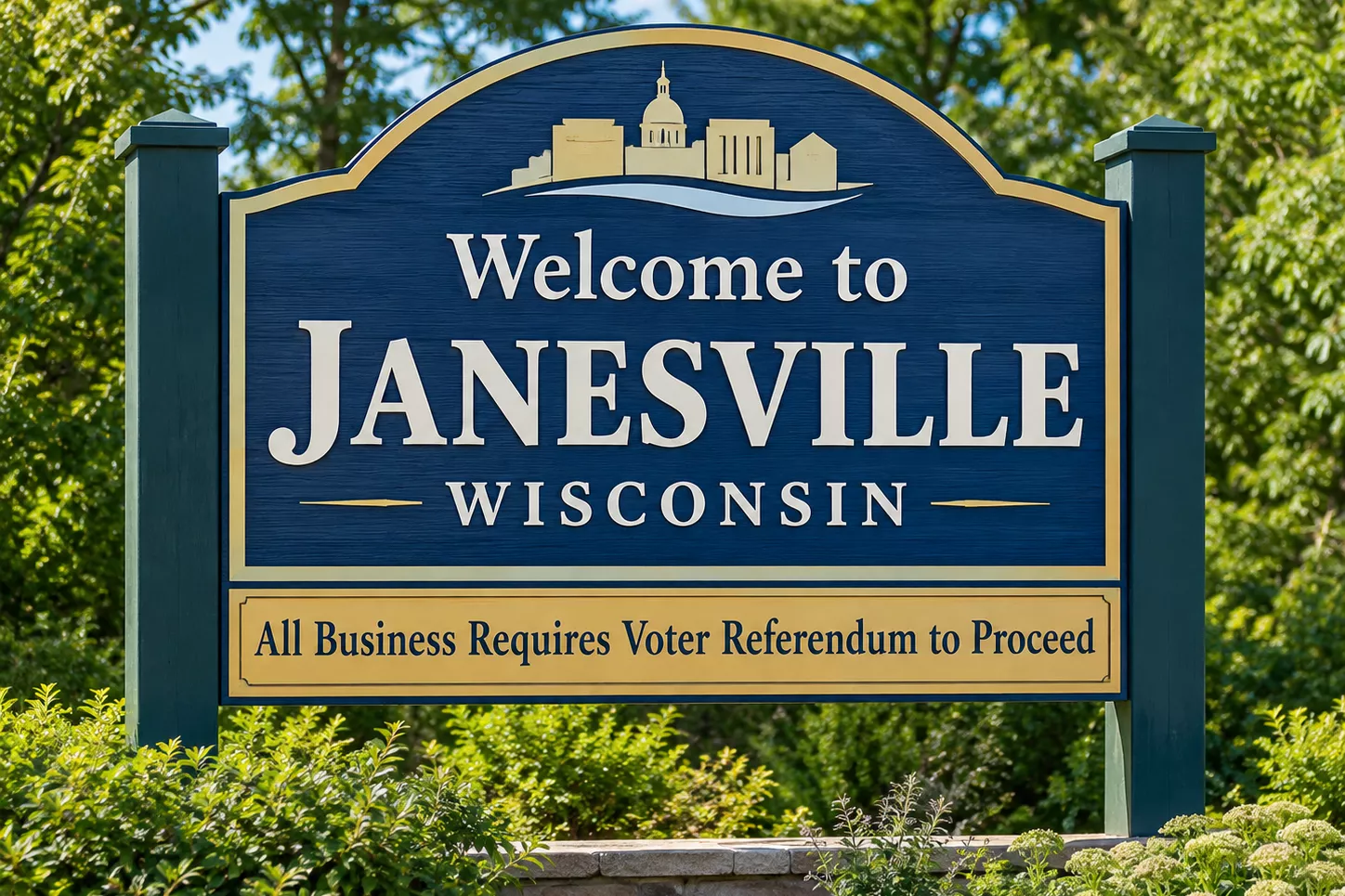
California dreaming in Janesville
Imagine walking into the voting booth to find a binding referendum on whether your community will continue to honor the Fifth Amendment’s protection of private property.
Hard to imagine, I know, unless perhaps you’re in some place such as California. Otherwise, I’ll go out on a limb and say it would move a lot of people to take up civil resistance. The people of a town or city can’t simply pick and choose which constitutional guarantees they keep.
And yet, in an incredibly significant way, that’s just what is going on in Janesville, Wisconsin. Voters aren’t being asked whether to repeal the Fifth Amendment, of course. But they are being asked whether the lawful use of private property can ultimately be conditioned on the approval of a voting majority.
That puts a fundamental guarantee—property rights, the first right, the one that makes all the other rights meaningful—squarely in the crosshairs of a popularity contest.
As if that’s not enough, the potential shutdown of most significant economic development in the state is also being put to a vote in this referendum question, so let’s take a look and see what the fuss is about.
In November, Janesville voters will cast ballots in a referendum stemming from a controversy over a proposed data center on what is now city-owned land. But that fight has produced something potentially far more consequential than the project that triggered it: a proposed permanent change to the rules governing the property’s development.
Specifically, the referendum would require voter approval before the city could lease, sell, approve development of, or enter into a development agreement for its former General Motors (GM) property whenever total project costs exceed $450 million.
Critically, the restriction is not limited to data centers or to its public ownership. It would apply to any qualifying development, even if the property is later privately owned. Local opponents are rightly concerned that would make economic development exceedingly difficult and frustrate the city’s effort to return the former GM property to the tax rolls.
It’s a referendum that business leaders and property rights advocates around the state need to pay close attention to because it could create a strange situation in which government sells property to a private owner while the electorate retains what is effectively a permanent veto over what that owner may subsequently do with it. The danger is that passage could power a runaway train of regulatory takings by popular vote far beyond one stationhead in Janesville.
If that notion succeeds—there are whiffs of the sentiment in the political air already—economic development would screech to a halt, and a fundamental tenet that owners of private property must be able to control its use would go by the wayside.
Environmentalists drool at such a prospect, and maybe that’s why they have have rolled up their sleeves and gone to work to get the Janesville referendum passed. The voters must say no if our representative government and the constitution are to mean anything at all.
Not a data center fight but a liberty right
As the property owner, the city of Janesville clearly has a legitimate say in deciding whether and on what terms to sell it. But the city also wants to return the property to private ownership and the tax rolls. The former GM property includes some 250 acres of vacant, industrial brownfield land, and city officials have viewed it as a major redevelopment opportunity.
So one question is how many regulatory strictures the city can place on such prospective development before it chases away that development, on the one hand, and before it runs afoul of constitutional protections, on the other. After all, a developer must already navigate the rules laid down by elected representatives through the normal regulatory process—zoning, conditional-use requirements, environmental reviews, building permits, and other applicable regulations. Under this proposal, however, project developers could satisfy all those requirements at the GM site and still have to beg voters to like them. This is far different from rigorously enacting a specific development standard in advance, such as a ban on burger chains in a historic district, or on data centers in specified zoning districts. Those rules tell property owners in advance what may or may not be built. This is enabling a raw political plebiscite after all such standards are met.
What starts out as satisfying the rigors of representative government ends up as a survival contest against the tyranny of the majority.
In this case, the city decided a data center might make for a perfect fit for the property. So it sought data-center proposals for approximately 240 acres, with officials identifying among its goals the productive reuse of the brownfield site, the attraction of private investment, job creation, and the expansion of the property-tax base.
Naturally, the data center idea sparked a fight because, well, people are protesting data centers all over the state and nation. A massive pushback ensued, with one part of that fight being a petition drive for the referendum in question, which notched 3,927 valid signatures (just 12 more than needed, for what it’s worth). When the smoke cleared, in June, the Janesville city council voted unanimously to let its non-binding letter of intent expire with Colorado-based developer Viridian Acquisitions, effectively halting an estimated $8 billion, 800-megawatt, 11-building campus.
The thing is, while the specific Viridian proposal is no longer on the table, the referendum is, and voters will digest it one way or another in November.
So what started as a data center fight has become something far different and far more sinister. I’m not sure who crafted the referendum language, but voters should not be fooled about what they are actually voting on. They are being asked to decide no less than whether the reasonable use of private property—reasonable meaning it most assuredly would pass muster with zoning codes, land-use plans, and other municipal and state conditions—depends upon whether a majority of voters happens to like the project.
A widget manufacturer had better hope the voters have a soft spot for widgets instead of those more environmentally sanctioned and government subsidized wadgets produced by a competitor.
There’s another confounding factor in the mix, though it’s actually pretty clear, save for attempts at obfuscation by environmentalists, and that is the distinction between public and private property. Some cite Janesville’s ownership of the parcels to argue that the vote has no impact on private property, but that ignores the facts. To be sure, as long as the city owns the property, voters have a much stronger claim to control how the city uses it. Selling publicly owned land, spending public money, or granting public subsidies are legitimate matters of public concern and participation.
The problem is that the referendum question would require voter approval before the city could not only lease or sell the land but also before approving threshold developments or enter into development agreements—forever. Suppose Janesville sells the land, and a private developer buys it because a contemplated $600 million project would comply with zoning and other permitting standards.
What exactly justifies then requiring that developer to obtain permission from thousands of voters? So the referendum, if successful, would turn a controversy over one particular land use into a permanent rule governing unrelated future land uses on private property. That’s the ruse referendum supporters are using to shut down economic development, period, not just protect communities from data centers.
And for those who would argue that requiring voter approval for such projects is a development standard, I would say, sure it is. It is an unconstitutional development standard.
The bottom line is that property rights are undermined when lawful ownership and use is contingent on the arbitrary political approval of one’s neighbors, based on nothing more than discretionary aesthetic, political, or emotional sensibility. That begins to look less like reasonable land-use regulation and more like the raw material for land confiscation. It’s a de facto regulatory taking, by any other name.
The smoking memo
In February, Janesville’s city attorney and other city officials penned a memo to the city council saying that, had the ordinance originated with city officials, they would have strongly recommended against its adoption, as they also considered it “likely unconstitutional and almost certainly unenforceable.”
“Although the city currently owns the property, the ordinance would apply equally to any future owner,” city attorney Wald Klimczyk and the officials wrote. “As written, it would prevent a future owner from developing, selling, or leasing the site without voter approval if the $450 million threshold is triggered.”
Such a restriction directly conflicts with fundamental property rights long recognized under both state and federal law, they wrote: “The Fifth Amendment to the United States Constitution prohibits the taking of private property without just compensation. This protection extends not only to physical takings but also to regulatory actions that deprive an owner of the economic use or fundamental rights associated with property ownership.”
The consequences would be enormous, Klimczyk and the officials wrote:
“Here, the petitioners’ ordinance would condition an owner’s ability to sell, lease, or develop the property on the outcome of a referendum. This requirement would significantly impair the owner’s ability to market or convey the property freely and, at a minimum, deprive the owner of a core component of the ‘bundle of property rights’ protected against regulatory takings.”
Those officials haven’t been the only ones to raise constitutional questions. Port Washington, for example, is embroiled in two disputes arising from its massive data-center development there. One challenge has already been dismissed; another, aimed directly at a voter-approval requirement for certain future TIF (tax incremental financing) decisions, remains pending.
In the latter, business groups are challenging a voter-approved ordinance that requires a referendum for certain future tax-incremental financing decisions of $10 million or more. Ozaukee County circuit judge Adam Gerol earlier allowed the referendum to proceed without deciding the ordinance’s ultimate legality, and an oral ruling on that challenge is scheduled for Oct. 19.
In a separate lawsuit, Great Lakes Neighbors United challenged the creation of the tax-incremental district supporting infrastructure for the $15 billion Vantage/OpenAI/Oracle data-center campus, but Gerol dismissed that case in September. However, the remaining case underscores what is likely to be an increasingly intense court battle over how far voters may go in inserting direct-approval requirements into development decisions ordinarily made by municipal government.
It’s important to grasp that Wisconsin law does provide for direct legislation, and the Wisconsin Supreme Court has upheld some referendum requirements. Statutorily, direct legislation must be legislative in nature, cannot repeal an existing ordinance, cannot exceed the powers of the municipal governing body itself, and cannot modify statutorily prescribed procedures.
There is some case law out there already. In Heitman, an appeals court knocked down a zoning initiative because it attempted to bypass statutory zoning procedures. In that case, the court of appeals concluded that a proposed ordinance restricting the location of a treatment facility for sexually violent persons was essentially a zoning measure, required by state law to be submitted to the local planning commission. The lesson from Heitman is that direct legislation cannot be used to circumvent land-use procedures the Legislature has statutorily established.
In 2003’s Mount Horeb Community Alert v. Village Board, the court upheld an ordinance requiring referendums for municipal construction projects topping $1 million. But that case involved municipally financed projects, not the development of privately owned property.
Nonetheless, the Mount Horeb decision glimmers with guidance and insight into direct democracy referenda. In that decision, the court, briefly channeling James Madison, cautioned that direct democracy can run headlong into republican governance precisely because representative democracy provides safeguards against majority oppression.
The court reached back to Madison’s observation in Federalist No. 51 to point it out:
“We begin with James Madison’s articulation of the justification for government, the necessity of limitations on governmental power, and the superiority of the republican form of government as a check against faction and the potential excesses of the majority,” the decision states in its preamble to this vintage Madison:
“But what is government itself but the greatest of all reflections on human nature? If men were angels, no government would be necessary. If angels were to govern men, neither external nor internal controls on government would be necessary. In framing a government which is to be administered by men over men, the greatest difficulty lies in this: you must first enable the government to control the governed; and in the next place oblige it to control itself. A dependence on the people is, no doubt, the primary control on the government; but experience has taught mankind the necessity of auxiliary precautions.”
That for sure is one of the great quandaries of establishing government for the free. Government must have enough power to keep all us errant miscreants in line, but it must also be compelled to keep itself in line. Without strict constitutional restraints—without auxiliary precautions—what is a tool for the people to check government power and conduct can be turned against the people as a weapon against their very liberty. As the Mt. Horeb court put it:
“No doubt direct legislation is a potentially powerful limitation on governmental authority, a remedy available to the people when their representative government has become unresponsive or misrepresentative. As a form of pure democracy, however, it also stands in contradiction of the principles of republican government, which is designed to guard against the oppression of the minority by the majority.”
Madison understood how easily things could get out of hand, and so does the state’s direct-legislation law by giving citizens extraordinary power to bypass their representatives while at the same time enacting those auxiliary precautions by limiting its use to those four specific situations.
In this case, the question becomes, are the people voting to override the government on a question of law? In my view, that territory is being seriously breached, as the Janesville city attorney argued. Specifically, the people are exercising a power the city itself has no right to impose—a popularity restriction on otherwise legally developable private property. The government cannot simply turn down a project because it happened not to like it that day, and neither can the people, acting in the stead of government, do so. In the case of direct legislation, the people in referenda have become a superseding government body, an appeals board, bound by the same constitutional constraints.
Finally, with respect to the courts, there is the argument of arbitrariness, specifically the $450 million cap beyond which voters get the final say. Two similar projects could have equal land-use impact assessments, yet a $449 million project would wrap up through the ordinary permitting process while a $451 million project would have to run the gauntlet of an additional popular vote. That’s problematic not because of a threshold per se, but because approval turns not on land-use impact—the ostensible reason for the referendum in the first place—but on the size of the investment.
The economic consequences
The property-rights conundrum soon imposes an economic-development conundrum.
Major developments require huge up-front investments, obviously. Site testing and sampling, engineering, architectural design, environmental assessment, attorney reviews, regulatory approvals—all these and more are required before a shovel ever hits the dirt. If the referendum is successful, companies will factor into their costs the possibility of suddenly facing and losing a voter referendum for reasons completely unrelated to regulatory compliance.
That will make developers run, if not for the hills, at least from Janesville. One ad in the quiver of Janesville referendum opponents speaks directly to the economic consequences for the city. The ad asked voters to consider an analogous situation:
“Imagine you are buying a new house,” the ad urged. “You spend countless hours searching for the right neighborhood and the right house. You pay for an appraisal, an inspection, then go through the financial process. And after all of that time and investment, the neighbors get to vote on whether or not you buy that house. If that were the process, you would not look twice at that neighborhood.”
And that, the ad correctly warned, is what the upcoming vote will decide for the city’s future.
“This referendum isn’t about one project,” the ad states. “It’s about how Janesville competes for future projects so our kids have local opportunities.”
Practically speaking, as referendum opponents have stressed, passage would effectively doom any potential private development of the site and deny the city the opportunity to return it to the tax rolls.
Now I understand many political ads are only as real as the AI who likely made them, but this one has real-world evidence to back it up. For example, DeForest, Wisconsin. Data center opponents there sought a referendum requirement for development of annexed areas larger than 30 acres. The village attorney, Al Reuter, warned that the language could sweep far beyond a data center.
“That means if somebody in TID 7… who wanted to build a convenience store would have to go to referendum, all because it was land in an annexation of more than 30 acres,” Reuter said, as reported by HNG News’s Roberta Baumann.
According to Baumann’s report, Reuter said existing law prevented “land development approvals decided by popular vote,” and he’s right because that would permit voters to bypass statutory land-use procedures.
In this case, the data center developer withdrew the application for a $12 billion campus but reaffirmed its commitment to building data centers in Wisconsin. But again, those questions are limited to data centers. What about Eli Lilly’s $3 billion manufacturing expansion in Kenosha? What about Kikkoman’s $560 million production facility in Jefferson County? What if folks in Jefferson County have an inexplicable hatred of soy sauce?
The point is, data centers are politically unpopular enough to create pressure for extraordinary mechanisms of direct control, but once those mechanisms are written into law, they do not necessarily remain confined to data centers. It might be a factory or a housing development, something as mundane as a convenience store. Or soy sauce.
As some have pointed out, a $450 million project is sizable but not rare even today. Other projects with similar valuations will affect smaller businesses as time goes by. As inflation takes its inevitable toll, the arbitrary number would sweep away small and smaller developers and manufacturers, strangling the broader economy.
If the referendum passes and gains traction—and environmentalists will inevitably take their show on the road—the dominoes could well fall and seriously injure Wisconsin’s prosperity and competitiveness.
The strongest argument for the referendum, I suppose, is some wistful flight of fancy that it would provide a measure of democratic accountability. Mega-projects can alter the physical and cultural character of a place, and, if a community isn’t careful, leave it looking like Carrot Top after plastic surgery. Still, supporters of these referenda argue that elected councils sometimes act too quickly and that citizens should retain direct control over generational decision-making.
That’s so short-sighted for such a long-term proclamation, not to mention completely delusional. Representative government tends to slow things down, not speed them up. Projects are approved only after staff investigation and application vetting, committee deliberation, public hearings, and several layers of approval by elected officials. When it comes to generational decisions, I like the layered look, with a side of public input, over setting policy for a generation on one voting day when emotions are inflamed in the heat of the moment.
The prospect of voters acting on impassioned whims has always been the strongest argument against direct democracy. Besides, that argument is strongest where government is deciding what to do with government property or taxpayer money. Its implications become much more troubling when the principle migrates to private property. It’s there that sensible regulation can stop short of regulatory taking. It’s there that the mob can be stopped at the gate of constitutional property rights.
There must be a boundary between the community’s legitimate authority to establish generally applicable land-use rules and the community’s asserted authority to vote project by project on whether a particular owner may make otherwise lawful use of his or her property.
The Janesville referendum therefore matters far beyond Janesville and far beyond data centers.
In fact, this is serious enough that it is time to think about these referenda as de facto regulatory takings, as the Janesville city attorney hinted at in his memo. A developer who complies with all those requirements and invests substantial sums could argue that a subsequent popular veto—especially when voters approve similarly situated projects—is a compensatory taking.
Once ownership requires not merely compliance with the law but the continuing political approval of one’s neighbors, property rights themselves have become conditional. Meaning, they are no longer rights. And once developers understand that millions of dollars spent satisfying every legal requirement can still end with an election-day veto, economic development becomes conditional, too.
The referendum brouhaha in Janesville exposes an important truth, namely, that beneath the veneer of the issue of the day, the soldiers of totalitarianism are marching still, and the number one front in that war is the relentless assault on private property and the extraordinary means the enemies of liberty will use to eliminate property rights. The nomenclature may vary, but the goal is always the same: Control the property and you control everything and everybody.
And that is why what Janesville decides in November matters far beyond Janesville—it is the preservation of liberty though the preservation of property rights.

Interested in the content of this Article?
Reach out to the MacIver Institute to aquire more information


