
- Podcasts
 Podcasts
 - Videos
 Videos
 - Policy Issues
 Policy Issues
 - About
 About
About


Troupis Team Suspects Judicial Bias
Judicial impropriety undermines the credibility of the courts and risks shaking the public's faith in the justice system. This is especially true in highly political cases.
On Friday, March 7, the MacIver Institute filed an amicus brief supporting former Wisconsin Judge Jim Troupis's petition for review in a high-profile criminal case related to the 2020 presidential election.
Troupis, a former campaign lawyer for President Donald Trump, is facing 11 fraud and forgery counts over the alternate slate of Wisconsin electors who convened in December of 2020.
The criminal complaint against Troupis and his co-defendants, Kenneth Chesebro and Michael Roman, claims that they knowingly convened with the intent and purpose to commit forgery.
Defenders of Jim Troupis deny this and point out that the Trump/Pence legal team gave both the Biden/Kamala legal team as well as the Wisconsin Attorney General advance notice of their intention to convene the alternate electors and no one objected.
The case itself was already controversial, but then potential wrongdoing by the court complicated the matter further.
After Dane County Circuit Court Judge John Hyland issued his August 22 order denying Troupis’s motion to dismiss the charges, Troupis’s legal team questioned whether Hyland had even written the order.
The claim was substantiated by a forensic linguist hired by the Troupis team who concluded that “large parts” of the August 22 order were written by the father of a county clerk who works for Hyland––not Hyland himself.
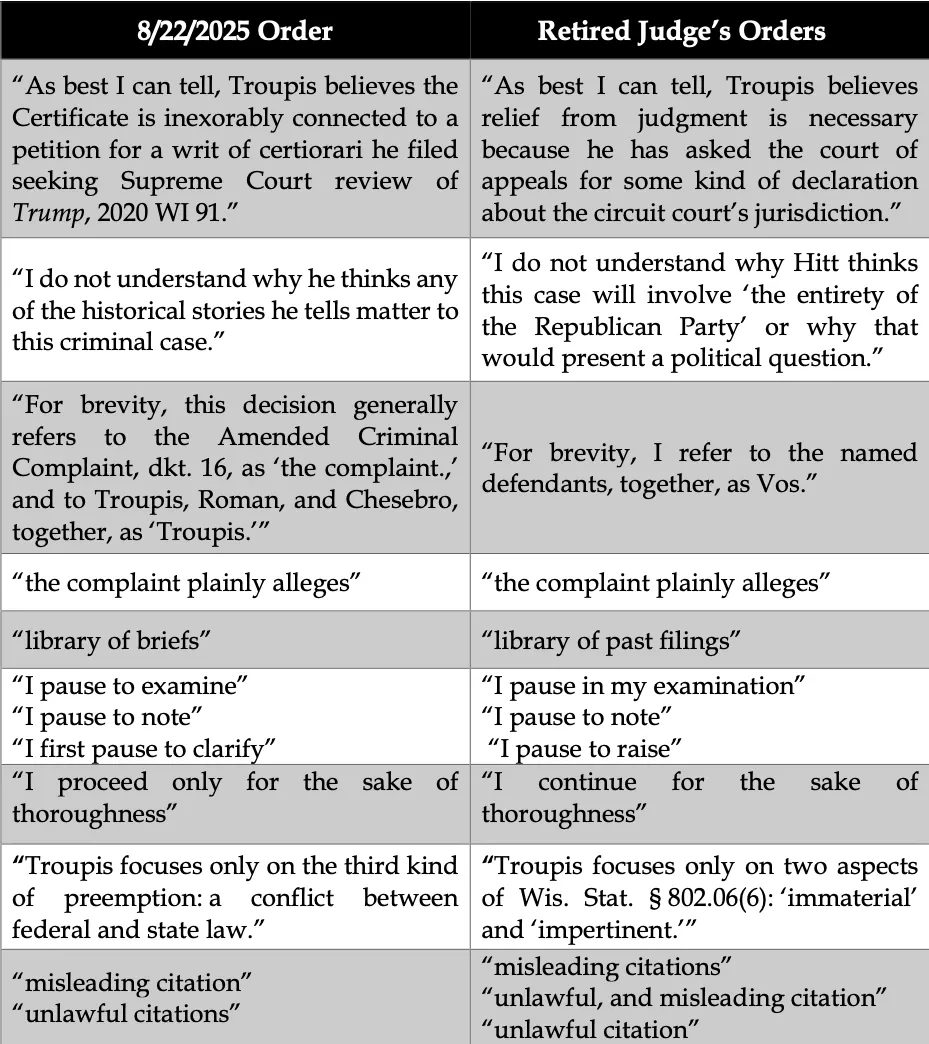
The clerk’s father is retired Dane County Circuit Court Judge Frank Remington who, according to Jim Troupis’s lawyer, “was (to put it mildly) not a fan of my client when they were in practice or when they were colleagues on the bench.”
Both Remington and Judge Hyland denied the allegation. Hyland said that aside from himself and the staff attorney, no one else helped draft or edit the court's decision.
In December of 2025, Wisconsin Senator Ron Johnson wrote a letter to United States Attorney General Pam Bondi requesting that the Justice Department review Jim Troupis’s case to determine if there had been any wrongdoing.
Johnson wrote that the case contains “blatant political bias.”
In February of this year, Troupis’s legal team filed a petition for review with the Wisconsin Supreme Court, containing the linguistic analysis and requesting an evidentiary hearing that Hyland had not previously held.
The petition argues that “failing to hold an evidentiary hearing sent an unmistakable message: the normal rules don’t apply to Troupis’s case.” It cites another court that determined, “without an evidentiary hearing … , we are unable to determine the extent of the … judicial misconduct and, in turn, determine the extent to which the misconduct prejudiced [the criminal defendant].”
The MacIver Institute’s amicus brief filed with the Wisconsin Supreme Court supports a review of the petition filed by Troupis’s legal team, and argues that an evidentiary hearing is more than necessary in this case:
“The MacIver Institute cares deeply about Wisconsin and desires to see strong public support and trust in the administration of our judicial system from all Wisconsinites, regardless of political persuasion.”
The brief goes on to say that this case is a decisive moment in determining whether Wisconsin courts will remain apolitical, impartial institutions of justice, and asks:
“Will the Court and those defending the independence and impartiality of Wisconsin courts be able to point to this case as evidence of a healthy judicial system? Or will this case continue to fan the flames of a growing belief, on both sides of the political divide, that the application of the law is no longer evenhanded and above the political fray?”
It argues that if the allegations aren’t investigated, the public perception that Wisconsin’s justice system is being weaponized against political opponents will be validated.
MacIver’s brief requests two things from the Supreme Court: first, that the Court grant the defendant’s petition for review; and second, that an evidentiary hearing be held to consider linguistic evidence of judicial impropriety.
The brief states: “without an evidentiary hearing, the Defendant must proceed to a criminal trial with credible allegations of serious misconduct against the presiding judge and others in the Dane County court system, untested and unresolved.”
MacIver Institute CEO Annette Olson commented on the matter after the brief was filed:
"Public trust in our justice system is paramount, and Wisconsinites deserve assurance that courts are free from even the perception of impropriety."
Olson explained that "by granting this petition and requiring a transparent hearing, the Supreme Court has a unique opportunity to strengthen the reputation of our state's judiciary and demonstrate its commitment to impartial justice."
Along with their initial petition, Troupis’s legal team filed a recusal motion with the Wisconsin Supreme Court. The motion seeks to disqualify Chief Justice Karofsky and Justice Dallet over comments they made about Troupis both on and off the bench.
During the oral arguments of an earlier 2020 election-related lawsuit in which Troupis represented President Trump, Justice Karofsky criticized Troupis, saying, “what you want is you want us to overturn this election so that your king can stay in power, and that is so un-American,” and said the lawsuit “smacked of racism.”
In the previous lawsuit, Justice Dallet remarked, “the only votes you wanna throw out are the votes in... the two most diverse non-white urban counties...” implying that Troupis had brought a racist lawsuit.
The recusal motion states that “judges must avoid even the appearance of bias” and that the judges’ statements “not only create the appearance of bias but also demonstrate actual bias against Troupis.”
“In other words, the test isn’t about whether the judge thinks he or she is biased. It’s about what a reasonable person would think about the judge’s impartiality.”
The court has not yet indicated whether it will take up the petition.
Troupis’s ongoing legal dispute raises broader questions about how judicial conduct is evaluated in politically charged lawsuits––questions like: Who is allowed to influence a judge’s decision-making process? And when controversial national politics are involved, what standards are courts held to?
The Wisconsin Supreme Court’s decisions will determine not only the trajectory of this case, but how others like it are handled moving forward.
In a system where judges are elected by popular vote, public confidence in fairness and impartiality is essential.

Interested in the content of this Article?
Reach out to the MacIver Institute to aquire more information


