
- Podcasts
 Podcasts
 - Videos
 Videos
 - Policy Issues
 Policy Issues
 - About
 About
About


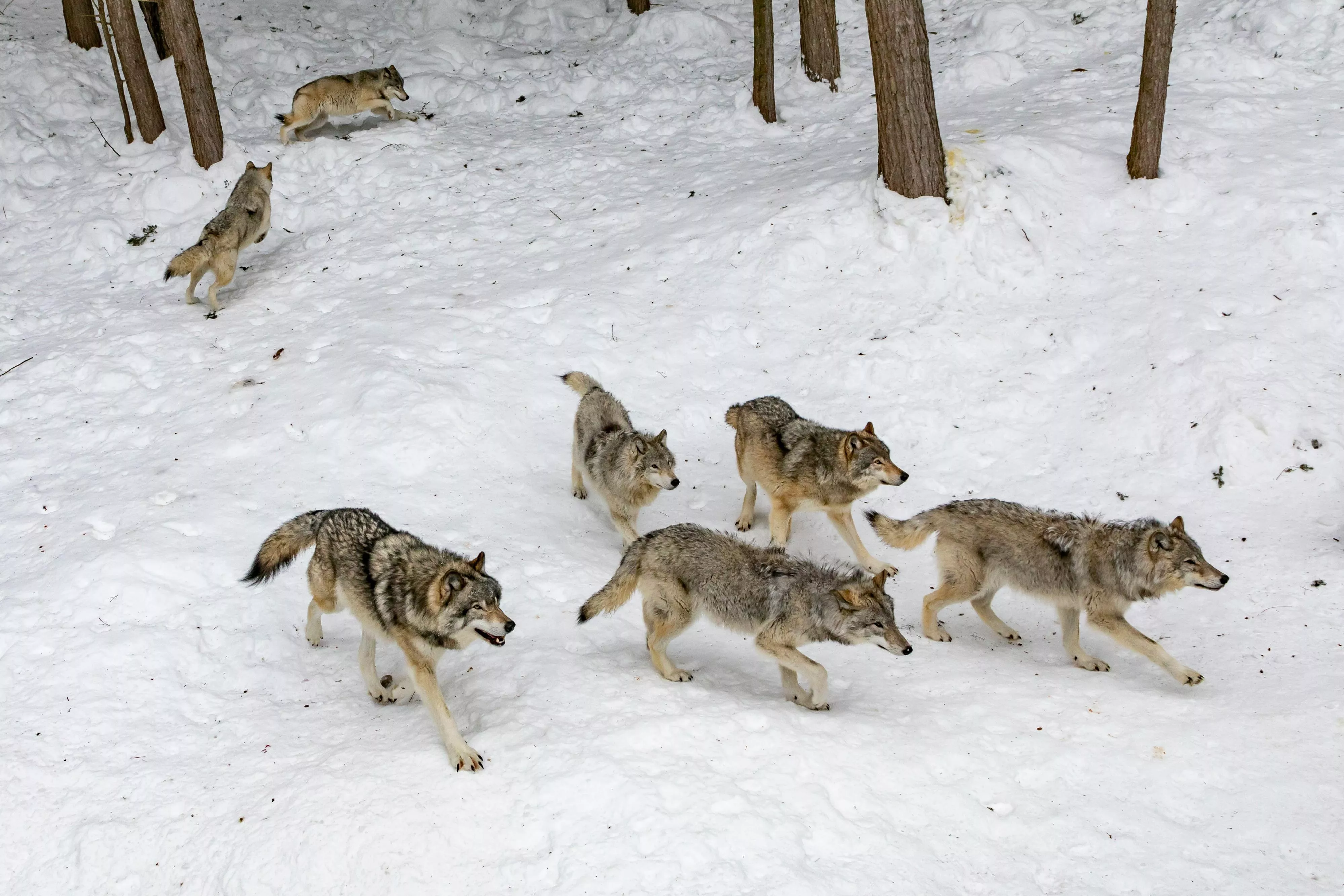
Wisconsin's Wolf Problem
Wisconsin very definitely has a wolf problem. That’s one thing we all know, thanks to crazed environmentalists who prevent the state from responsible wolf management to prevent livestock and pet depredation.
It turns out, though, that the protected canid population isn’t the state’s only wolf problem. The other wolf is the state Department of Natural Resources (DNR) itself. Instead of dealing forthrightly with the issues at hand, including compensation for wolf depredation, the agency is—again—trying to use the problem to reach beyond its jurisdictional boundaries.
No doubt there’s a real issue in the state’s wolf-depredation compensation program. Put simply, a too-large wolf population has led to significant, devastating losses of livestock and pets, and the statutory compensation program—which pays farmers, hunters, and their families for their losses—isn’t keeping up, as even the DNR acknowledges.
So what to do? Well, there are any number of options, but the DNR has settled on the worst among them. It proposes to place the burden on the people who have already suffered the losses, not to mention transfer permanent legislative authority to the state bureaucracy.
Specifically, the agency is developing emergency and permanent rules to establish a process for paying wolf-depredation claims when statutorily identified funding sources are insufficient to cover all claims for the year. The rules would apply both when wolves are listed as threatened or endangered under state or federal law and when they are not.
The agency says the rules may limit the maximum amount a claimant receives, establish priorities among different types of claims, and authorize prorated payments. The Natural Resources Board approved the scope statement on August 13, allowing the DNR to begin drafting the rules.
The problem is, while the statute already authorizes proration when wolves are delisted, there is no express statutory proration authority for the DNR when wolves are on federal or state endangered species lists and baking that provision into the cake of a permanent rule would allow the DNR to bypass the legislature in making that decision, both now and in the future.
The Wisconsin Bear Hunters’ Association stated the problem succinctly.
“The state has a statutory obligation to compensate those who suffer losses from wolf depredation,” Carl Schoettel, the president of the Wisconsin Bear Hunters’ Association, testified.
“If wolf attacks have become frequent enough that available funding can no longer cover valid claims, that is a shortfall for the state to solve—not a burden to be shifted onto the hunters, farmers, and families who have already been harmed. Capping, prioritizing, and prorating payments does nothing to address the underlying cause; it simply forces victims to absorb the cost of the state’s own funding shortfall.”
This is especially relevant given that the wolf is still listed under the Endangered Species Act, and likely will be for some time. Yes, Trump has moved toward delisting with a new executive order, but, even if the administration does delist, if past is prologue, any new rule is likely to face litigation and new injunctions from activist, left-wing judges.
So, however it does it, the state—sitting on a nearly $3 billion surplus—needs to step up and make hunters, farmers, and families whole from their losses. The Bear Hunters’ Association makes a fair point.
But there is an even more fundamental problem. The new rules seek to allow the agency to have permanent authority to decide when to prorate depredation claims, though, by my reading, the Legislature has already decided when the DNR may prorate wolf claims and when it cannot. The DNR simply does not have any legal authority to make that choice.
The statute itself makes clear that the legislature knew how to authorize proration. When wolves are not on either the federal or state endangered-species list, the statute says that, if the applicable appropriation is insufficient to make all payments, DNR “shall make the payments on a prorated basis.” Lawmakers did not imply that authority or leave DNR to infer it. They wrote it expressly into the statute.
Unfortunately for the DNR, lawmakers chose differently when they wrote a separate compensation section for claims made while wolves are listed on state and federal endangered species lists. That subsection states:
“(a) From the sources described …. the department shall pay damage claims for damage caused by wolves during the period when the wolf is listed on the federal endangered list or on the state endangered list; (b) The department shall pay damage claims under par. (a) as soon as practicable after determining that the claim is eligible to be paid; (c) The department shall make the remainder of the payments from [these specific] appropriation accounts …. If the department determines that the amount available under [those accounts] … is insufficient in a given fiscal year to pay the claims under par. (a), the department may request the joint committee on finance to take action….”
That’s pretty specific. The DNR “shall pay damage claims” caused by wolves while they are listed and “shall pay” eligible claims as soon as practicable. If the designated funding sources are insufficient, DNR may request action from the Joint Committee on Finance. It does not contain the proration language found in the other subsection, which indicates that lawmakers were well aware of the proration option and intentionally left it out.
Why would they do so? Because the economic burden caused by federal regulations that tie the hands of both the state and individual victims to mitigate made full compensation a desirable and just policy goal. When delisted, proration could at least be considered as in tandem with state wolf management policy; disconnected completely from any state policy, it leaves state farmers and hunters economically defenseless.
So let’s recap. Delisted wolves: prorate. Listed wolves: Pay the claims and, if necessary, go to JFC.
The bottom line is, lawmakers plainly understood how to authorize reduced payments when funds ran short. Rightly or wrongly, they chose that approach for one category of wolf claims, but established a different funding structure for claims involving protected wolves.
DNR exposes itself
The DNR has a history of unwittingly exposing itself in the naked light of day, and this time is no different. It’s all right there in the DNR’s own scope statement.
The agency’s statement of scope dutifully acknowledges that eligible claims involving protected wolves must be paid from funding sources tied to the endangered-species program and paid as soon as practicable. It also explains that DNR historically paid claims in the order received, but, because available funding is expected to be insufficient in fiscal year 2027, it was instead proposing proration to avoid potentially leaving later claimants with nothing.
In a peculiar sort of way, that’s admirable. The agency was and is facing a legitimate administrative dilemma and was searching for a way out. The agency cannot spend money it does not have, and a first-come, first-served system can indeed produce inequitable results. So when the scope statement reached its required explanation of statutory authority for its proposal, the DNR cited the aforementioned section on paying for claims while the wolf is listed.
There was just one itty-bitty problem: It did not identify any language in that subsection authorizing proration. The agency didn’t because it couldn’t, for such language does not exist. So the agency has a real problem, but the existence of a difficult problem does not magically convey authority to solve it by bureaucratic mantra. This is the reality that the bureaucracy always fails to understand.
To be sure, the Legislature anticipated that the designated accounts would be insufficient. Under §29.888(5)(c), it gave the DNR the ability to request Joint Finance Committee action without having to establish an ordinary emergency finding. That provision gave the agency a route back to the Legislature when funds ran short.
The DNR says it did just that back in April without any success. According to Wisconsin Public Radio, the DNR’s Eric Lobner said the agency had not yet submitted a request for the current fiscal year because it wanted greater budget clarity.
It’s also important to note that the statute does not require the DNR to make such a request. But again, an unsuccessful request, or a decision not to make one, does not necessarily confer a separate power to reduce otherwise eligible claims. The Legislature could on its own decide to provide additional funding, amend the compensation statute, or authorize proration. The failure to do any of those things to resolve a compensation shortfall does not automatically transfer those decisions to the DNR.
Why JFC did not act on the April request is unclear to me. It’s also unclear to me why Gov. Tony Evers and his heavily tilted Democratic agency have pursued only one path to solve the shortfall, that of punishing those the program was designed to help, as Schoettel wrote in his testimony.
What is clear to me is that this issue reaches once again where only Evers and other Democrats want to go—into the black hole of ever-expanding bureaucratic power. For while the emergency rule addresses the immediate shortage, the permanent rule would establish an ongoing administrative mechanism for future funding shortfalls. The scope statement presents as both emergency and permanent rules, and DNR says compensation costs are occurring at an “unsustainable rate,” with funding anticipated to be insufficient in FY2027 “and beyond.”
Ah, “and beyond.” So this is not simply a temporary stopgap but a standing process for future years in which the agency could limit payments, prioritize claims, or prorate them whenever available funding is expected to fall short, in the DNR’s estimation. In other words, it would manufacture the pro-rating authority that is so glaringly absent in the current statutory language.
Under the contemplated permanent rule, while the fund may or may not ever run dry, a shortage could instead become an administrative calculation: determine how much money is available, establish a formula, and reduce payments to fit it. That does not formally strip JFC of authority, but it potentially gives DNR a permanent alternative to returning to the Legislature, where the word ‘no’ could be uttered, along with the most terrifying words of all to a bureaucrat: “accountability” and “oversight.”
In discussion of both immediate funding and long-term authority, the people should not be forgotten. The victims of depredation should be made whole by the state—the DNR, the governor, and the legislature need to act—but we must make sure we do not set up victims to be victimized again through the installation of a permanent bureaucratic compensation formula that will evade oversight and endow bureaucrats with the ability to make funding decisions.
All of which brings us back to the bear hunters, who put that matter in human terms.
“Our Association has particular concerns as bear hunters whose dogs are routinely at risk in wolf territory,” Schoettel testified.
“These dogs are not disposable property they are family, and owners invest countless hours and real money training them to hunt. When a dog is lost to a wolf attack, the loss is personal, and replacing that dog is expensive and time-consuming. It takes years of training for a dog to be ready for the field, and that time needs to be considered. Compensation for that loss should be guaranteed in full, not subject to the department’s discretion or contingent on whether the state happened to budget enough that year. A rule that allows the state to pay claimants only a fraction of what they are owed abandons the very people the compensation program was created to protect.”
The state has made a policy choice to compensate losses for depredation. That choice has been codified by the people’s elected representatives. The state should therefore honor the will of the people. The executive branch must not be able to unilaterally redefine the state’s obligation when the Legislature has not authorized it to do so, not when wolves are on protected lists and not when they are delisted.
The people must control because only the people will ever make the people whole. If Wisconsin wants to change its wolf-compensation law, there is a branch of government empowered to do that. It is called the Legislature.

Interested in the content of this Article?
Reach out to the MacIver Institute to aquire more information


