
- Podcasts
 Podcasts
 - Videos
 Videos
 - Policy Issues
 Policy Issues
 - About
 About
About


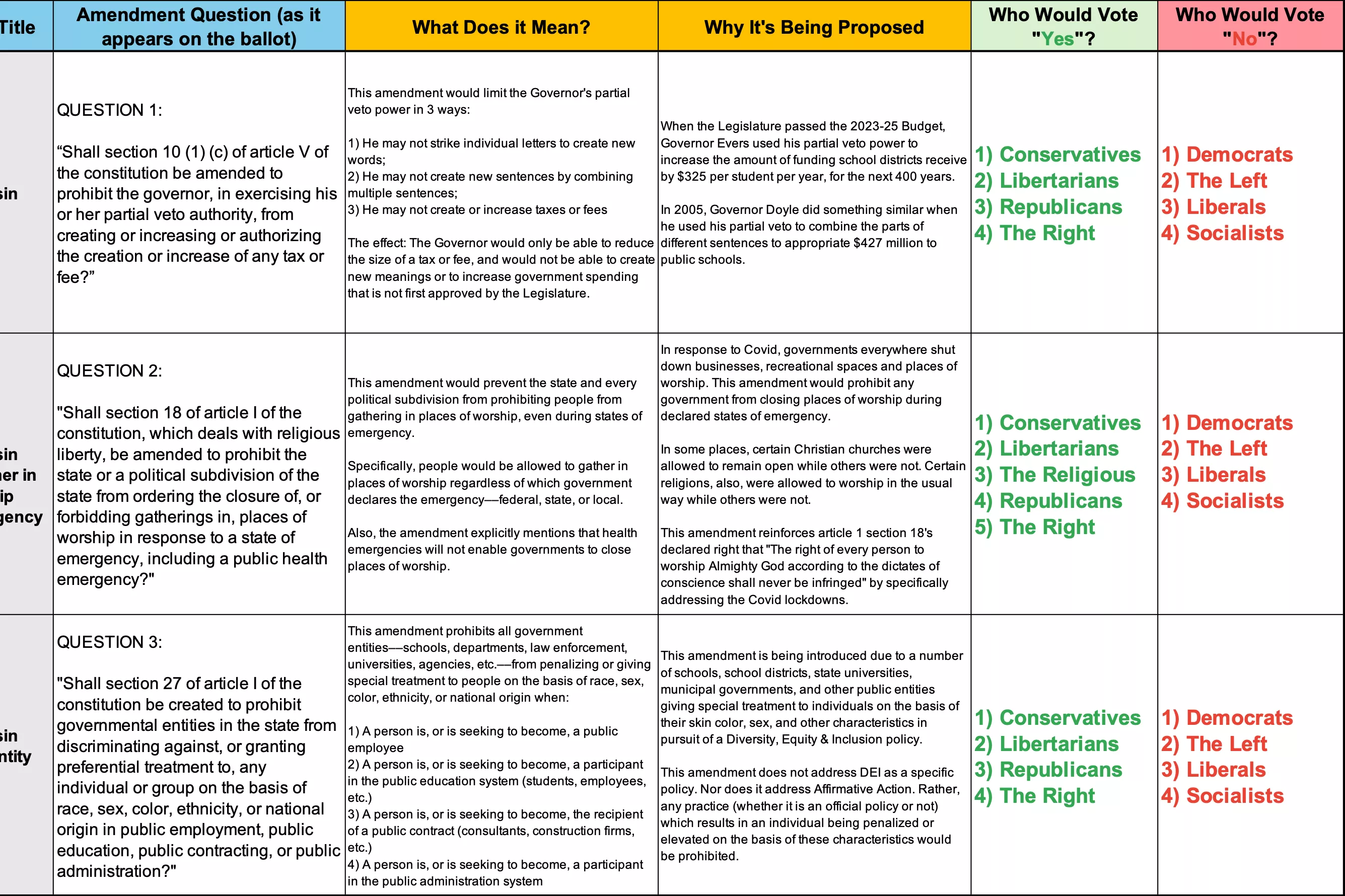
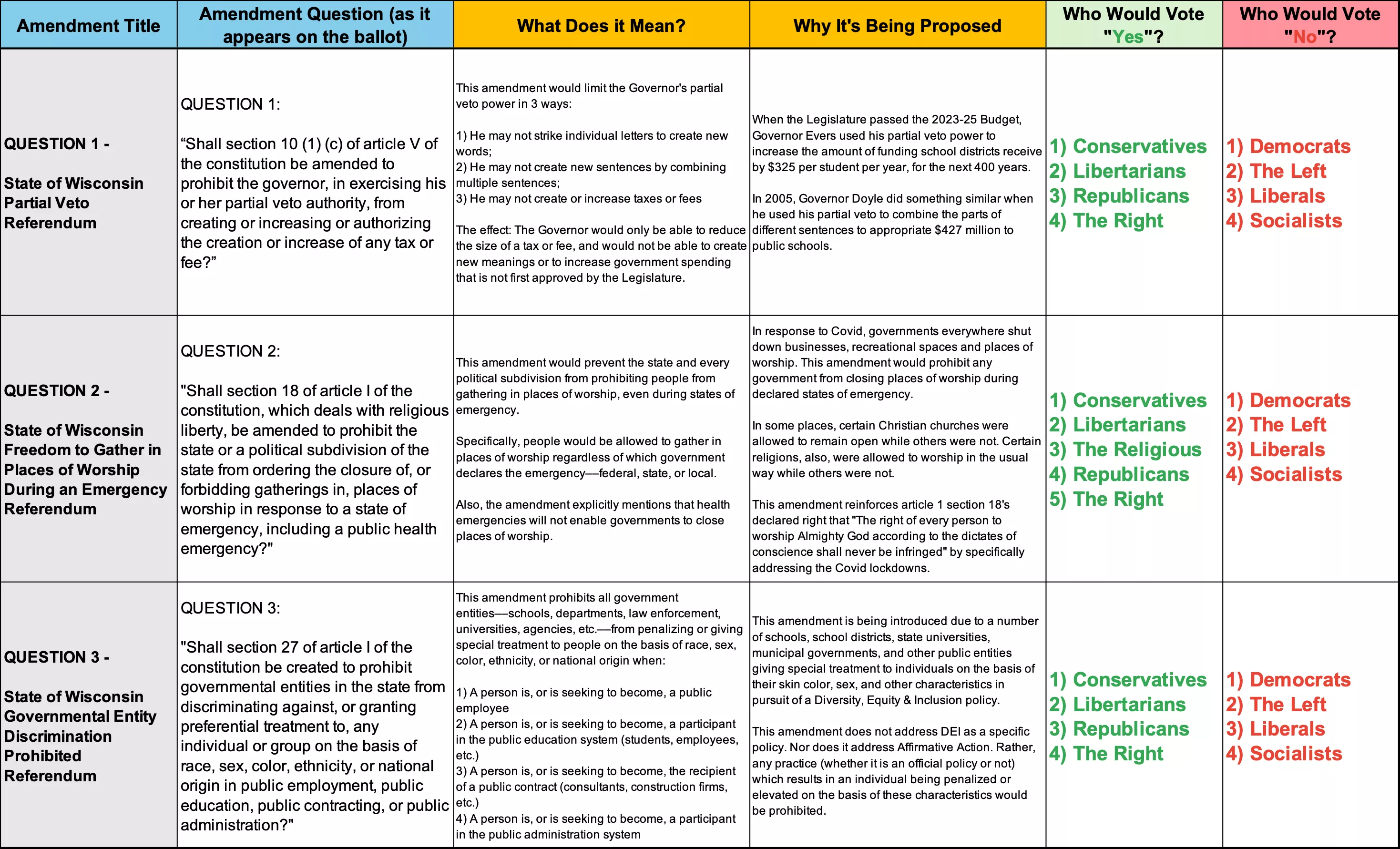 To view a larger version of this image, right click the image and then click "open image in new tab".
On the Ballot This November
On November 3rd there will be three constitutional amendments put to Wisconsin citizens for a vote. The amendments are posed as "questions" and will appear on the very last page of the ballot. Any question that receives a majority of "Yes" votes will be ratified and added to the Wisconsin Constitution. Any question that receives a majority of "No" votes will fail and not be added to the Wisconsin Constitution.
Many voters often find the phrasing of these questions confusing, so for clarity's sake, I will list each proposed amendment below with an explanation of what it would do, why it is being proposed, and how the political Left and Right are likely to vote on each.
If you would like to read these questions yourself and see everything that will be on your specific voter ballot this November, click HERE to visit the What's On My Ballot webpage by myvote.wi.gov. Simply enter your address and then click "Search" to see which offices you will be voting for. The amendment questions are at the very end.
Amendment #1
Title: State of Wisconsin Partial Veto Referendum
Question:
“Shall section 10 (1) (c) of article V of the constitution be amended to prohibit the governor, in exercising his or her partial veto authority, from creating or increasing or authorizing the creation or increase of any tax or fee?”
The Exact Text of the Amendment:
Section 10 (1) (c) of article V of the constitution is amended to read:
[Article V] Section 10 (1) (c) In approving an appropriation bill in part, the governor may not create a new word by rejecting individual letters in the words of the enrolled bill, and may not create a new sentence by combining parts of 2 or more sentences of the enrolled bill, and may not create or increase or authorize the creation or increase of any tax or fee.
Amendment #2
Title: State of Wisconsin Freedom to Gather in Places of Worship During an Emergency Referendum
Question:
"Shall section 18 of article I of the constitution, which deals with religious liberty, be amended to prohibit the state or a political subdivision of the state from ordering the closure of, or forbidding gatherings in, places of worship in response to a state of emergency, including a public health emergency?"
The Exact Text of the Amendment:
Section 18 of article I of the constitution is amended to read:
[Article I] Section 18. The right of every person to worship Almighty God according to the dictates of conscience shall never be infringed; nor shall any person be compelled to attend, erect or support any place of worship, or to maintain any ministry, without consent; nor shall any control of, or interference with, the rights of conscience be permitted, or any preference be given by law to any religious establishments or modes of worship; nor shall any money be drawn from the treasury for the benefit of religious societies, or religious or theological seminaries; nor shall the state or a political subdivision of the state order the closure of or forbid gatherings in places of worship in response to a state of emergency at the national, state, or local level, including an emergency related to public health.
Amendment #3
Title: State of Wisconsin Governmental Entity Discrimination Prohibited Referendum
Question:
"Shall section 27 of article I of the constitution be created to prohibit governmental entities in the state from discriminating against, or granting preferential treatment to, any individual or group on the basis of race, sex, color, ethnicity, or national origin in public employment, public education, public contracting, or public administration?"
The Exact Text of the Amendment:
Section 27 of article I of the constitution is created to read:
[Article I] Section 27 (1) In this section, “governmental entity” means the state, its political subdivisions including municipalities, the University of Wisconsin System, the Technical College System, any public college or university, any public school district, and any office, department, independent agency, board, commission, authority, institution, association, society, or other body in state or local government created or authorized to be created by the constitution or any law, including the legislature and the courts.
(2) A governmental entity may not discriminate against, or grant preferential treatment to, any individual or group on the basis of race, sex, color, ethnicity, or national origin in public employment, public education, public contracting, or public administration.
(3) This section does not prohibit action that must be taken to establish or maintain eligibility for any federal program, if ineligibility would result in a loss of federal funds to the governmental entity.
(4) Nothing in this section prohibits bona fide qualifications based on sex that are reasonably necessary to the normal operation of public employment, public education, public contracting, or public administration.
(5) If any part or parts of this section are found to be in conflict with the United States Constitution or federal law, the section shall be implemented to the maximum extent that the United States Constitution and federal law permit. Any provision of this section held invalid shall be severable from the remaining portions of this section.

Interested in the content of this Article?
Reach out to the MacIver Institute to aquire more information


