
- Podcasts
 Podcasts
 - Videos
 Videos
 - Policy Issues
 Policy Issues
 - About
 About
About


Introduction
The Milwaukee School Board approved the $1.6 billion budget for the 2026-2027 school year in an 8-1 vote on Thursday, May 28. The budget, which was originally presented to the board and the public in early May, is the latest development in the rollercoaster that is Milwaukee Public Schools' (MPS) finances.
As the state's largest school district, with a budget that far exceeds any other district in Wisconsin, MPS's leadership and finances deserve the attention of both lawmakers and taxpayers. While the new budget seeks to address past overspending while adding new positions, outside observers such as the Wisconsin Policy Forum have warned about the district's financial future.
How MPS Got Here
MPS's financial path has been particularly bumpy since former Superintendent Keith Posely resigned in 2024 when the district lost millions in state funding after failing to submit financial reports on time. The district also faced the loss of federal funding following investigations in 2024 that uncovered inadequate supervision and abuse within MPS programs.
Brenda Cassellius stepped into the role in March 2025. The former Boston Public Schools superintendent joined MPS at a challenging time, and, frankly, she walked into a perfect storm of problems. Aside from state and federal funding jeopardization, the district continues to face numerous other challenges. Issues such as poor academic performance, declining enrollment, rising truancy, the discovery of lead paint, and deteriorating school facilities have raised serious concerns about the district's future.
On top of all of that, in June 2025, a $46 million budget deficit was discovered in the MPS main fund as the chart from WPF below shows (p. 13).
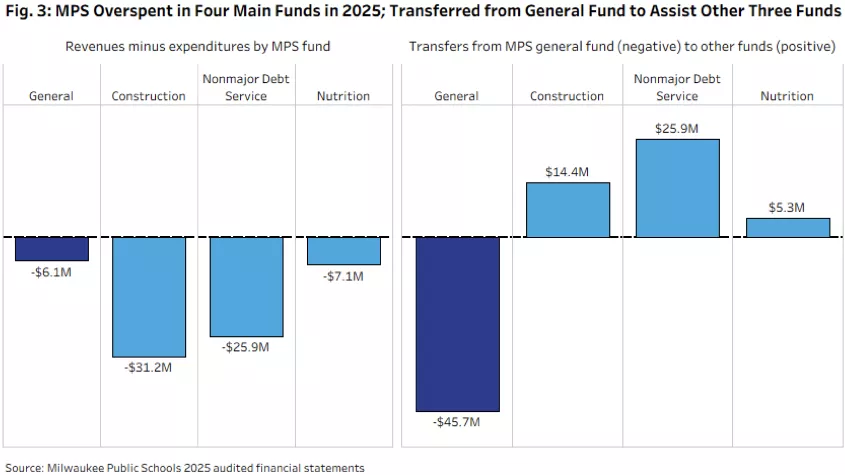 Source: Wisconsin Policy Forum "Budget Brief: 2027 Proposed Budget Milwaukee Public Schools" (p. 13). Click image for link to source.
For comparison, Hustisford School District and other Wisconsin schools whose referendums failed to pass in April of this year are considering dissolving or shutting down school buildings due to budget deficits of just $1 million to $2 million. Cassellius has said that the deficit was created due to three unfinished audits, as the district wasn't aware of where it was beginning financially.
In an effort to balance the district's budget earlier this year, Cassellius eliminated 264 positions across MPS, with many of the cuts falling on administrative roles, particularly assistant principals. In an interview with TMJ4, however, she said those cuts only made up for about $30 million of the roughly $46 million deficit.
Despite the earlier cuts, the new 2026-27 budget proposal that Cassellius presented to the Milwaukee Board of Education in early May provides for the addition of a significant number of new positions.
The New Budget
The new MPS budget includes the addition of hundreds of full-time equivalent (FTE) positions in MPS, though outside observers such as the Wisconsin Policy Forum question whether the district can afford it. According to their analysis, new staff salaries, coupled with needed infrastructure investments and declining enrollment-driven revenue, threaten to strain future budgets as soon as 2028.
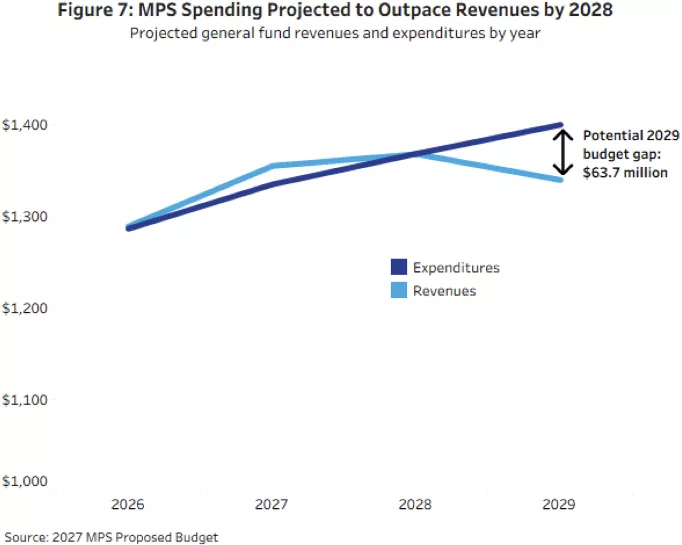 Source: Wisconsin Policy Forum "Budget Brief: 2027 Proposed Budget Milwaukee Public Schools" (p. 21). Click image for link to source.
“The trouble would arise in later years, when revenues are projected to struggle to keep up with the overall proposed 8.2% salary and wage increase caused both by the new FTEs and by raises implemented across the board,” the report states.
This is particularly noteworthy given that MPS continues to seek additional funding from state lawmakers. If spending continues to increase while revenues continue to decline, Milwaukee residents may soon find themselves facing another request to raise property taxes through a referendum. Much of that revenue pressure comes from an ongoing problem for MPS: declining enrollment.
The Enrollment Problem
While the newly approved budget may help stabilize MPS's finances in the short term, declining enrollment continues to loom over the district's future.
According to the Wisconsin Policy Forum's analysis of the 2026-27 budget proposal, MPS projects that total September enrollment will fall by 4,204 students, or 6.5%, dropping from 64,594 students to 60,390 students. Most of that decline is due to the departure of nine schools from MPS governance, which accounts for a loss of 3,756 students. Despite the departures, traditional MPS schools are expected to lose an additional 448 students.
This trend isn't new––enrollment has been on the decline for years. If the projections turn out to be accurate, in 2027 MPS enrollment will have fallen by nearly 16% since 2021. Since funding is tied to student enrollment, fewer students means less revenue for the district. If MPS doesn't adjust for the change in demand, its revenue will decrease while fixed costs remain the same. Whether or not schools are running at full capacity or with classrooms half-empty, buildings still need to be heated and maintained, buses still need to run, and staff still need to be paid.
According to a City Forward Collective policy brief, as of February 2026, MPS is operating 25 school buildings that it doesn't need. “Every dollar spent maintaining underutilized infrastructure is a dollar not invested in academic programs, teacher development, or student support services,” the brief states.
Despite those findings, Cassellius has said she won't recommend the closing of schools for the 2026-27 school year. For now, MPS appears to be kicking the can down the road. Although declining enrollment is not a problem that can be solved through budgeting alone, unless the district finds a way to attract more students or reduce excess capacity, the loss of students will further strain its finances.
Conclusion
If MPS is serious about getting its finances under control, it will have to do much more than ask for more money. As enrollment continues to decline, MPS should close or consolidate underutilized school buildings rather than continuing to maintain schools it doesn’t need. The district should also build on the administrative downsizing already implemented by the new superintendent and reduce unnecessary programming that doesn’t improve student outcomes.
Ultimately approving a new budget doesn't change the underlying problems facing MPS. The district is serving fewer students while continuing to add positions despite warnings about its long-term financial outlook. The purpose of MPS is to educate kids, and before asking taxpayers for more money, district leaders should be able to show how that money will improve student outcomes. MPS is already asking state lawmakers for additional funding, and if current trends continue, it wouldn't be surprising to see the district return to voters for another referendum in the years ahead. The 2026-27 budget has been approved, but the questions surrounding MPS's future have yet to be answered.

Interested in the content of this Article?
Reach out to the MacIver Institute to aquire more information


