
- Podcasts
 Podcasts
 - Videos
 Videos
 - Policy Issues
 Policy Issues
 - About
 About
About


No One Uses Central Count
When the Legislature authorized Central Count in the 2005 election reforms, the goal was practical: ease the growing strain of absentee ballots in larger cities, reduce congestion at polling places, and allow specialized equipment and teams for high-volume processing. It was an optional tool, never a mandate. Today only about 43 of Wisconsin’s roughly 1,850 municipalities use it.
Two decades later, that tool has become one of the most visible sources of delay, expense, and eroded confidence in Wisconsin elections. By concentrating tens of thousands of absentee ballots into a single facility (most notably Milwaukee’s Central Count) the process creates a high-stakes bottleneck. Recent cycles have produced repeated tabulator failures: memory sticks containing only audit logs instead of results (delaying roughly 28,000 ballots in the August 2026 primary), improperly sealed machines that forced the re-running of more than 30,000 ballots in 2024, and mis-transported data drives. Each incident triggers late-night recovery, police escorts, and public suspicion that distributed ward-level counting largely avoids.
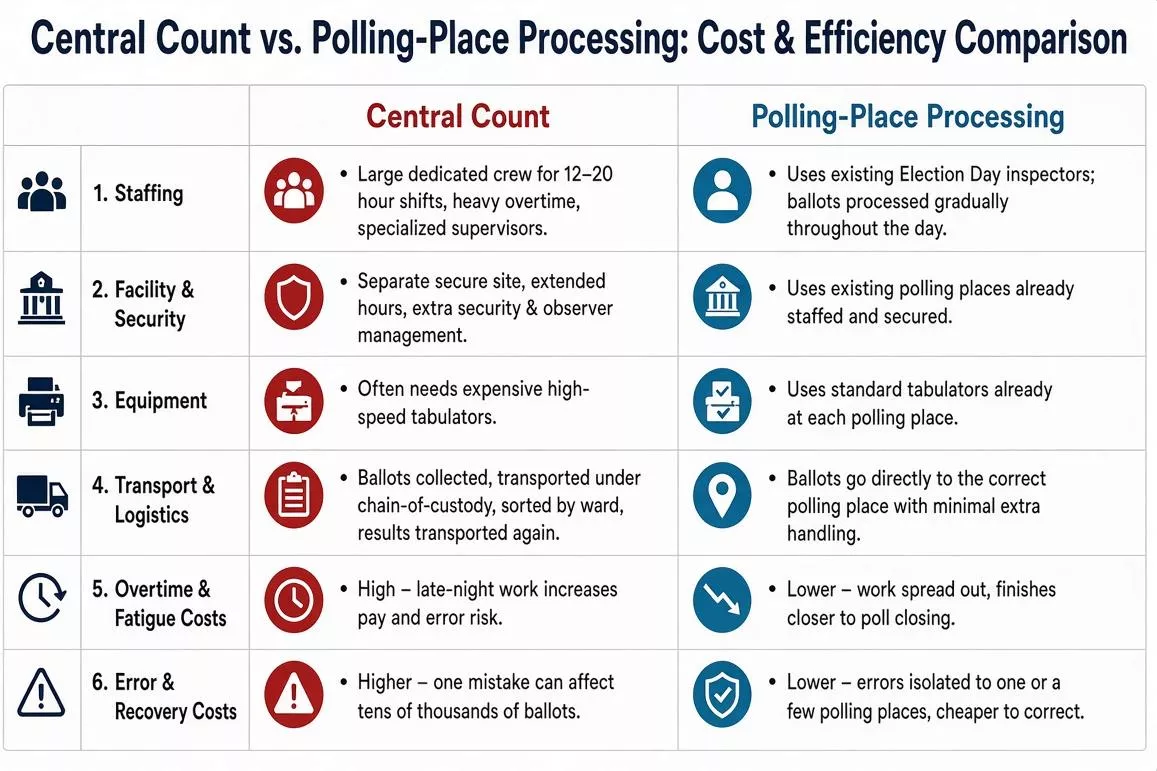
The side-by-side comparison below illustrates why. On nearly every measure: staffing demands, facility and security needs, equipment costs, transport logistics, overtime, and the consequences of error, Central Count imposes heavier burdens and greater risk than simply sending absentee ballots to the neighborhood polling places where they belong. The graphic makes the contrast plain: one system concentrates work, cost, and potential failure into a single high-pressure operation; the other spreads the load across existing staff and locations already open on Election Day.
The costs compound the problem. A reasonable estimate for all 43 Central Count operations in a major election cycle ranges from $1.5 million to $3.5 million, with Milwaukee accounting for the large majority. That city routinely deploys hundreds of temporary workers for 12-to-20-hour shifts, plus high-speed tabulators, secure transport, extended facility time, and post-election redaction of the unique poll list numbers that state law requires workers to write on every ballot. Smaller Central Count sites still incur extra staffing, security, and equipment costs that scale poorly. Spreading the same ballots across neighborhood polling places would use inspectors already on site, allow continuous processing throughout the day, slash overtime, and eliminate single points of failure.
Central Count also undermines ballot secrecy and uniformity. Writing each voter’s poll list number on the back of the ballot creates a traceable link between voter and vote, an unnecessary risk that generates costly redaction work when open records requests arrive. And because only larger municipalities can opt in, voters in different communities face different counting procedures, raising equal protection concerns under both the Fourteenth Amendment and Wisconsin’s constitutional requirement for uniform elections.
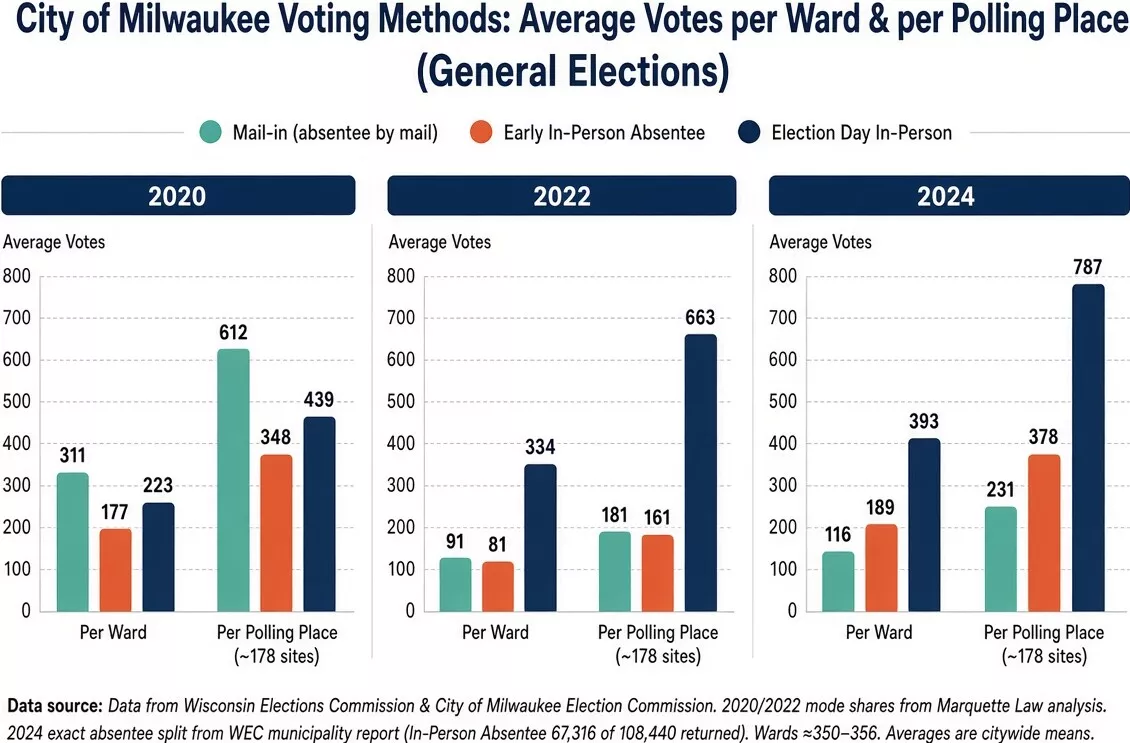
Mail-in ballots in Milwaukee can and should be processed at the ward or polling place because the volume is already small enough to handle locally. In 2024 the city counted only about 41,000 mail ballots citywide. Spread across roughly 178 Election Day polling sites, which is about 230 envelopes per location, fewer than the number of in-person voters many of those same sites already process in a few hours. A pair of poll workers checking signatures, opening envelopes, and running ballots through a scanner can finish that stack in a single shift without special equipment or a downtown warehouse. Other Wisconsin cities routinely process comparable or larger numbers of absentees at the polls; Milwaukee’s choice of Central Count is an operational preference, not a response to an unmanageable workload. Putting those 230 mail ballots at each site would let results come in ward by ward as they do everywhere else, instead of holding more than 100,000 absentees for one late-night dump.
The contrast is clear. Most Wisconsin municipalities already tabulate absentees at the voter’s own polling place. Ballots stay with their ward, volumes remain manageable, processing happens gradually as time allows, and any problem is contained. Central Count does the opposite: it concentrates risk, inflates costs, exhausts workers, delays results, and invites distrust. What began as an efficiency measure has become a recurring failure that Wisconsin voters no longer need to tolerate.

Interested in the content of this Article?
Reach out to the MacIver Institute to aquire more information


