
- Podcasts
 Podcasts
 - Videos
 Videos
 - Policy Issues
 Policy Issues
 - About
 About
About


The Risk to Wisconsin Elections
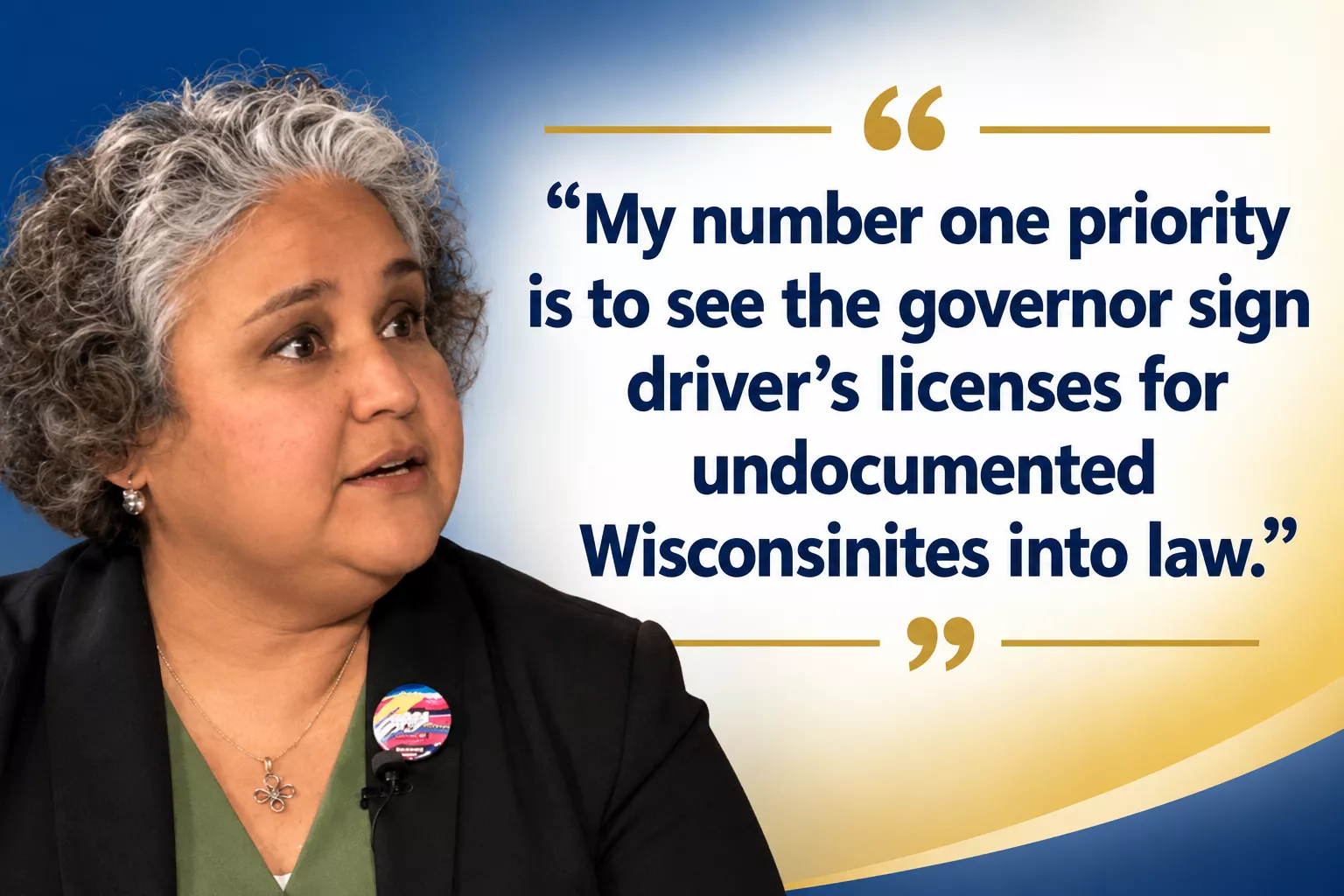
Democratic candidate for Wisconsin Secretary of State JoCasta Zamarripa recently stated
that her top priority is for the next governor to sign legislation granting driver’s licenses to “undocumented Wisconsinites,” expressing confidence that Milwaukee County Executive David Crowley would do so if elected.
This proposal, long advocated by Zamarripa during her time in the state Assembly, would reverse Wisconsin’s current requirement that applicants prove lawful presence in the United States. Wisconsin does not currently issue standard driver’s licenses or state IDs to people without legal immigration status.
Voters Already Decided This Question
In November 2024, Wisconsin voters overwhelmingly approved a constitutional amendment declaring that only a United States citizen who is 18 or older may vote in Wisconsin elections. The amendment passed with roughly 70 percent support statewide and won every county. It changed the prior language (“every citizen”) to the clearer and more restrictive “only a United States citizen.”
The amendment was a direct response to concerns about non-citizen voting. It is now part of the Wisconsin Constitution. Yet the administrative systems that enforce it remain weak. Issuing driver’s licenses to people who are not lawfully present would create new government-issued photo IDs that can be used for voter registration and voting, while the state still lacks systematic checks to prevent non-citizens from using them.
How Wisconsin Registers Voters Today
To register in Wisconsin, an applicant must affirm that he or she is a U.S. citizen. Official guidance from the Wisconsin Elections Commission states that this is done under penalty of perjury, and a false claim can be prosecuted as a felony. The same guidance explicitly notes that “Wisconsin and federal law do not provide for any process to systematically verify citizenship beyond the attestation during registration.”
There is no routine cross-check of the voter rolls against federal or state citizenship databases for every registrant. The Department of Transportation holds citizenship or legal-presence data for people who already have licenses, but the Elections Commission has historically resisted using that information for systematic citizenship verification. A Waukesha County judge has ordered the Commission to develop a plan to identify non-citizens on the rolls, but implementation remains contested and incomplete.
Online registration is particularly streamlined when an applicant supplies a Wisconsin driver’s license or state ID number that matches DMV records. The system confirms name, date of birth, and address against the DMV file; it does not independently confirm citizenship status beyond the applicant’s checkbox.
Why Expanding Licenses Creates a Voting Vulnerability
If Wisconsin begins issuing driver’s licenses to people who are not lawfully present, those individuals will possess a government-issued photo ID that is accepted for voting. Combined with the existing self-attestation system, the practical barriers to registering and casting a ballot shrink dramatically, even though the state constitution now explicitly limits voting to U.S. citizens.
Other states, such as New Jersey, that issue licenses or driving privilege cards to non-citizens have faced documented cases in which those credentials were later used in attempts to register or vote. Wisconsin’s current safeguards rest almost entirely on the honesty of the registrant and the deterrent effect of potential prosecution after the fact. That is a weak foundation when the same government is simultaneously creating official identification documents for people ineligible to vote under the state constitution.
Additional System Weaknesses
Several structural features compound the risk:
The Policy Choice
Issuing driver’s licenses to people who are unlawfully present is a policy decision with dangerous trade-offs in public safety, insurance markets, and law enforcement. Those trade-offs can be debated on their own terms. What should not be ignored is the interaction with Wisconsin’s election system and the recent constitutional amendment.
Wisconsin voters already decided, by a wide margin in every county, that only U.S. citizens should cast ballots. Expanding driver’s licenses to non-citizens without corresponding upgrades to citizenship verification at registration would make that constitutional decision harder to enforce. The gap between what the constitution now says and what the administrative system can actually check is the core vulnerability. Closing it requires either maintaining the legal-presence requirement for licenses or building real, systematic citizenship verification into voter registration, neither of which is currently fully in place.
WEC’s statement accurately reflects current practice and the absence of a detailed statutory blueprint for systematic verification. It is less accurate as an absolute claim that the law “does not provide for any process.” A court has already found that state law creates a duty to verify citizenship, DOT data exists that could be used for that purpose, and federal tools are available once privacy barriers are addressed. The claim is best understood as WEC’s longstanding policy position that self-attestation is legally sufficient and that systematic checks are neither required nor authorized without further legislation.
To register in Wisconsin, an applicant must check a box affirming U.S. citizenship and sign a certification that all statements on the form are true. The printed voter registration form (EL-131) warns that providing false information “may be subject to fine or imprisonment under State and Federal laws” and states that “Falsification of information on this form is punishable under Wisconsin law as a Class I felony.” The Wisconsin Elections Commission describes this citizenship attestation as being made “under penalty of perjury,” though the form itself does not use that exact phrase. The same official guidance notes that “Wisconsin and federal law do not provide for any process to systematically verify citizenship beyond the attestation during registration.”
There is no routine cross-check of the voter rolls against federal or state citizenship databases for every registrant.
Wisconsin voters already settled the citizenship question when they passed the “Only a United States Citizen” amendment by a wide margin in every county. JoCasta Zamarripa’s stated top priority, securing driver’s licenses for people who are not lawfully present, would hand non-citizens the very government-issued photo ID most commonly used to register and vote, while the state’s verification system still rests almost entirely on an unchecked self-attestation box. That combination does not strengthen public safety; it widens a known gap between the constitutional rule that only US citizens may vote and the administrative reality that currently fails to enforce it.

Interested in the content of this Article?
Reach out to the MacIver Institute to aquire more information


