
- Podcasts
 Podcasts
 - Videos
 Videos
 - Policy Issues
 Policy Issues
 - About
 About
About


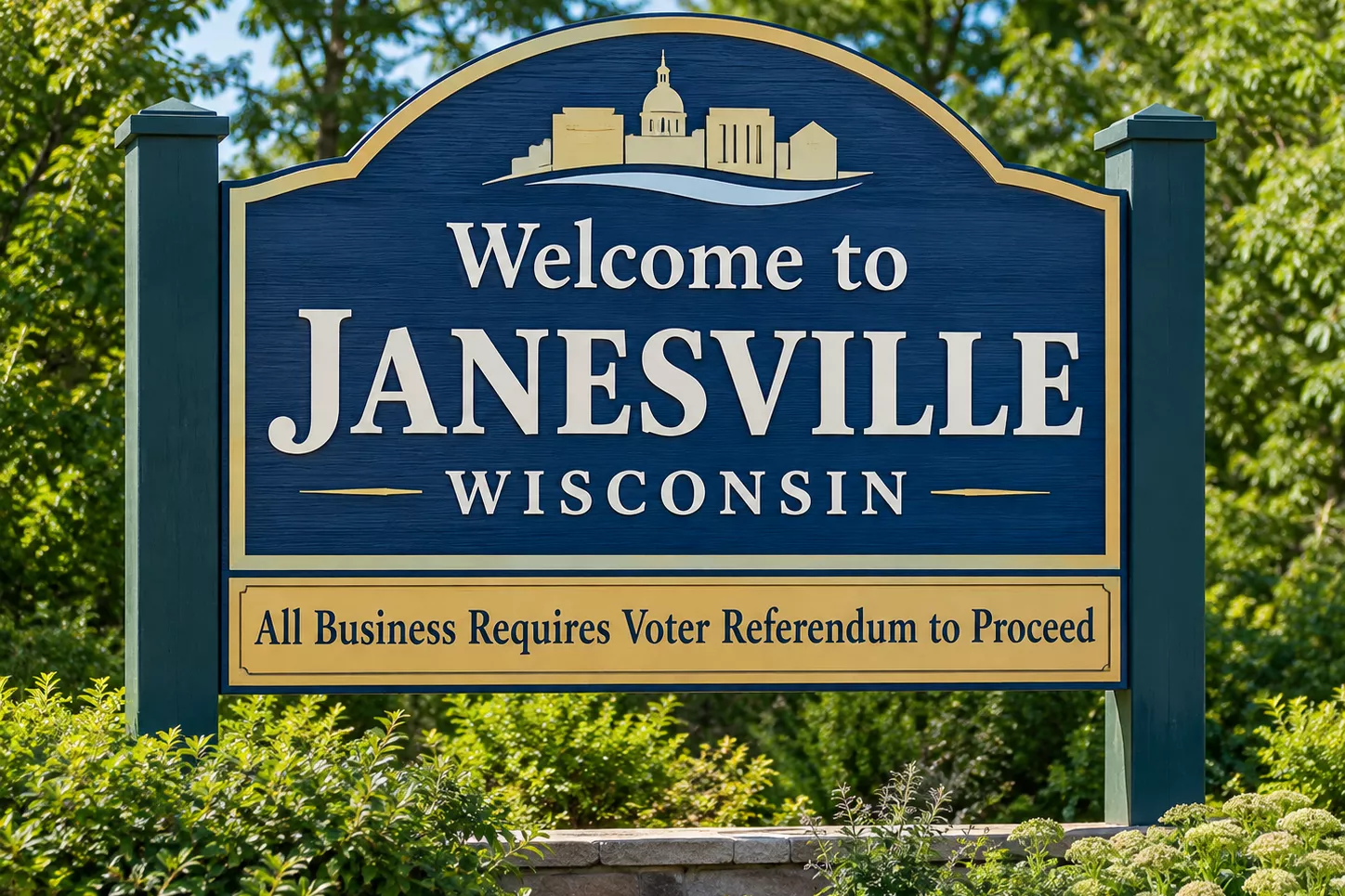
Janesville's Risky Ordinance
Janesville voters are considering an ordinance requiring voter approval for development exceeding $450 million on the city-owned, undeveloped former GM/JATCO property, and critics warn that, if it passes, it could be a death knell for Janesville’s economic growth and prosperity.
That’s true enough, but there is another specter hanging over the city. A voter referendum denying an otherwise lawful development could be challenged in court as a regulatory taking, and taxpayers could be on the hook for compensation.
Previously, I argued here that property rights should not become a popularity contest, using Janesville’s development referendum as an example. But the controversy raises a second property-rights question that has nothing to do with whether voters, elected officials, or government regulators impose the restriction.
The question is, sooner or later, who becomes responsible for paying the costs of public regulation? The answer is clear enough: When the public exercises its power over someone else’s property for a purported public benefit, the public shouldn’t be able to bill the owner. The public itself has to pay the tab.
The starting point is, of course, the Fifth Amendment, which declares that private property shall not “be taken for public use, without just compensation.” Most people understand that, in its traditional sense, if government wants your property for a highway, a courthouse, or other public purpose, the government takes the property and pays you.
But government can also take your property without taking title to a single square foot. Regulations can prevent development and restrict or eliminate particular uses. Zoning can sequester land with its invisible fences; historic preservation ordinances can transform properties into veritable museum pieces; health and sanitation and public nuisance ordinances can further erode land-use choices.
Most of these escape constitutional scrutiny but not always. Sometimes the restrictions go so far as to constitute constitutional takings requiring compensation. The issue becomes how much a government can take from the value or use of your property before the constitution considers anything to have been “taken,” and that’s the question that is being overlooked in Janesville.
There’s another twist in these popular referenda to proclaim what someone can reasonably do with their property—or not do, as the case may be. In such cases, the public has effectively become another regulatory body, voting yay or nay on projects just as elected officials do on zoning permits in committees. But when that popular approval is demanded for properties that have met all other legal tests—including public hearings—it wanders toward the territory of compensatory takings, especially given that the criteria are malleable and whimsical and fickle. What’s voted down today might have been be approved tomorrow.
The problem that supporters of the Janesville referendum have is that case law gives us an inkling that courts could conceivably find a taking lurking in a municipal rejection of an otherwise legal development, especially when it is delivered in a referendum.
Let’s make no mistake about several distinctions. This is quite unlike a moratorium on a particular kind of project such as a data center, though even moratoria are statutorily limited.
And it is not like a ban on specific types of projects for justifiable regulatory reasons. By contrast, the Janesville referendum assumes that all preordained conditions for development have been satisfied and that public participation has occurred through statutorily required public hearings, or at least that the developers can reasonably be expected to clear those hurdles. This referendum gives the electorate a kick at the can no matter all that.
It’s problematic, to say the least, and I’m not the only one who has recognized it. In February, Janesville’s city attorney and other city officials penned a memo to the city council saying that, had the ordinance originated with city officials, they would have strongly recommended against its adoption, as they also considered it “likely unconstitutional and almost certainly unenforceable,” in part because of concerns about regulatory takings.
“Although the city currently owns the property, the ordinance would apply equally to any future owner,” city attorney Wald Klimczyk and the officials wrote. “As written, it would prevent a future owner from developing, selling, or leasing the site without voter approval if the $450 million threshold is triggered.”
Such a restriction directly conflicts with fundamental property rights long recognized under both state and federal law, they wrote: “The Fifth Amendment to the United States Constitution prohibits the taking of private property without just compensation. This protection extends not only to physical takings but also to regulatory actions that deprive an owner of the economic use or fundamental rights associated with property ownership.”
The consequences would be enormous, Klimczyk and the officials wrote:
“Here, the petitioners’ ordinance would condition an owner’s ability to sell, lease, or develop the property on the outcome of a referendum. This requirement would significantly impair the owner’s ability to market or convey the property freely and, at a minimum, deprive the owner of a core component of the ‘bundle of property rights’ protected against regulatory takings.”
Interestingly, public reporting on the city officials’ memo has focused on development uncertainty and enforceability, and other officials and council members have discussed its potential chilling effect on future development. Those are proper concerns, to be sure.
But for the most part, public accounts have not similarly raised another potential outcome: namely, that voters, in rendering a future regulatory judgment that intrudes upon already established administrative decision-making by elected representatives, could impose a sizable compensation liability on taxpayers.
All aboard
Others will argue that there is no compensatory danger because the property owners would still possess other reasonable uses of the property. That’s true as far as it goes, but it doesn’t get us too far into the railroad station. We have to punch the ticket of a little case law to get us there.
The starting point is the Supreme Court’s 1978 decision in Penn Central Transportation Co. v. New York City. The dispute that produced it—over an office tower that Penn Central wanted to build above Grand Central Terminal—poses the precise question Janesville and its voters are facing: If the public wants a restriction because the public benefits from it, at what point should the public have to pay the private owner who bears its cost?
In the Penn Central case, Penn Central Transportation Co. owned Grand Central Terminal, but it also owned something extraordinarily valuable above it: airspace. So Penn Central proposed constructing an office tower above the terminal.
Whoa, not so fast! said New York City’s Landmarks Preservation Commission. It rejected the plans because Grand Central had been designated a historic landmark. From the city’s perspective, the regulation preserved one of New York’s great architectural treasures. From Penn Central’s perspective, New York was preventing it from exploiting valuable development rights attached to property it owned.
And so Penn Central sued.
In the case, Penn Central submitted two designs by architect Marcel Breuer. One contemplated a 55-story office tower above the existing terminal; another proposed a 53-story tower and would have removed portions of the terminal, including its 42nd Street façade. Now here’s where there are shades of Penn Central in Janesville: The proposed office building complied with New York’s applicable zoning and height restrictions.
What stopped PennCentral was the additional requirement for approval from the Landmarks Preservation Commission. OK, perhaps not 50 but definitely some shades of Penn Central because the proposed Janesville development could comply with ordinary land-use rules and still face an additional governmental veto.
In Penn Central, the city argued that it hadn’t taken Grand Central because Penn Central still owned it and benefited from it. Passengers were coming and going, and so were money and profit. The city argued it hadn’t deprived Penn Central of its property rights but had merely regulated what could be done with the property in pursuit of the legitimate public purpose of historic preservation.
Penn Central had a different viewpoint. Under the development agreement, the developer would pay Penn Central $1 million annually during construction and at least $3 million annually afterward for the right to build above Grand Central. Some existing concession revenue would have been lost, but the air rights plainly had substantial economic value.
So Penn Central argued that the city had prohibited it from exercising valuable development rights associated with the property. Those rights had economic value; the government eliminated their use to achieve a public benefit, and so, Penn Central complained, it was being asked to shoulder the entire public burden of the building’s architecture.
That last assertion became central to the case. During oral arguments, Penn Central’s lawyer asserted that the tower wasn’t prohibited because it was unsafe, uneconomic, or contrary to zoning. Rather, the restriction existed to preserve Grand Central for the enjoyment of New Yorkers and visitors, and the public was receiving that preservation benefit while the property owner was being asked to absorb the economic burden.
So guess who lost?
That’s right, Penn Central lost, and so did property rights. But in the end, well, not all was lost.
In fact, something positive came out of it, namely, the Supreme Court said there was no single formula for regulatory takings. Instead, the court found, such takings were “essentially ad hoc” factual inquiries, though it did identify three considerations of particular significance: economic impact on the property owner; interference with distinct investment-backed expectations; and the character of the governmental action.
So the Supreme Court rejected Penn Central’s takings claim, but it did not announce a simple rule for determining whether a regulatory taking had occurred. Quite the opposite. It laid out some litmus-test questions: How severely did the regulation affect the property’s value? How significant was the economic loss when the property was considered as a whole?
And for our purposes here, just how much were the investment-backed expectations being diminished? The latter factor is important because, while in Penn Central the court determined that the investment-backed expectation for Penn Central dated back to 1913 and its ongoing use as a railroad terminal—no investors then were contemplating air space for high rises—the court also said there could be instances when economic loss based on the developer’s investment-backed expectations was so severe that, along with other factors, it constituted a compensable taking even though some reasonable use of the property was retained.
The Penn Central court acknowledged this explicitly:
“Pennsylvania Coal Co. v. Mahon is the leading case for the proposition that a state statute that substantially furthers important public policies may so frustrate distinct investment-backed expectations as to amount to a ‘taking.’ There the claimant had sold the surface rights to particular parcels of property but expressly reserved the right to remove the coal thereunder. A Pennsylvania statute, enacted after the transactions, forbade any mining of coal that caused the subsidence of any house, unless the house was the property of the owner of the underlying coal and was more than 150 feet from the improved property of another. Because the statute made it commercially impracticable to mine the coal and thus had nearly the same effect as the destruction of rights the claimant had reserved from the owners of the surface land, the Court held that the statute was invalid as effecting a ‘taking.’”
And Palazzolo v. Rhode Island reiterated the point in 2001:
“Where a regulation places limitations on land that fall short of eliminating all economically beneficial use, a taking nonetheless may have occurred, depending on a complex of factors including the regulation’s economic effect on the landowner, the extent to which the regulation interferes with reasonable investment-backed expectations, and the character of the government action. These inquiries are informed by the purpose of the Takings Clause, which is to prevent the government from ‘forcing some people alone to bear public burdens which, in all fairness and justice, should be borne by the public as a whole.’”
The court added an exclamation point: “In Justice Holmes’ well-known, if less than self-defining, formulation, ‘while property may be regulated to a certain extent, if a regulation goes too far it will be recognized as a taking.’”
The parallel is obvious. In Pennsylvania Coal, the government’s intrusion occurred through statutory enactment after the rights to the coal had been reserved, while in Janesville, the public vote comes after all administrative and zoning conditions have been satisfied, or after developers have moved forward based on designs they know will comply with those administrative requirements. Then they must still face the voters, who can vote to punish the developer and hoist the costs of denying the project on the developer without the public absorbing any of that cost.
The difference is, of course, in Janesville a future developer would know before going in that a referendum will be on the table, whereas in Pennsylvania Coal, the statutory enactment likely could not have been foreseen.
But that doesn’t mean that Janesville is out of the woods just yet. Indeed, in Palazzolo, the court specifically said that a notice of limitation—for example, prior knowledge of existing statutory restrictions or a delimiting referendum—does not foreclose legal action and the finding of a regulatory taking:
“The State may not put so potent a Hobbesian stick into the Lockean bundle. The right to improve property, of course, is subject to the reasonable exercise of state authority, including the enforcement of valid zoning and land-use restrictions. The Takings Clause, however, in certain circumstances allows a landowner to assert that a particular exercise of the State’s regulatory power is so unreasonable or onerous as to compel compensation. Just as a prospective enactment, such as a new zoning ordinance, can limit the value of land without effecting a taking because it can be understood as reasonable by all concerned, other enactments are unreasonable and do not become less so through passage of time or title.”
In other words, an unreasonable or unconstitutional ordinance or law doesn’t magically become reasonable or constitutional by the mere passage of time.
“Were we to accept the State’s rule, the post-enactment transfer of title would absolve the State of its obligation to defend any action restricting land use, no matter how extreme or unreasonable,” the decision stated. “A state would be allowed, in effect, to put an expiration date on the Takings Clause. This ought not to be the rule. Future generations, too, have a right to challenge unreasonable limitations on the use and value of land.”
By that reasoning, future generations have a right to challenge what they believe is an unreasonable and unconstitutional referendum hurdle to establishing a regulatory taking due to significant economic loss of a realistic, investment-backed expectation.
What government takes—and what it doesn’t
The Supreme Court ultimately rejected Penn Central’s claim because Grand Central could continue to operate as a railroad terminal and generate revenue and in fact that had always been the investment-backed expectation. The company had not established that it could no longer earn a reasonable return, and it retained transferable development rights.
In that case, the court refused to treat the loss of one valuable development opportunity—the air space—as a taking without considering the property as a whole—the terminal and the air space.
Wisconsin’s Supreme Court reached a similar conclusion in Zealy v. City of Waukesha in 1996. Alfred Zealy challenged conservancy zoning that prohibited residential development on 8.2 acres of his 10.4-acre property. He claimed the restricted acreage would be worth approximately $200,000 if residential development were allowed, compared with only $4,000 under the new zoning.
But the court considered the whole kit and caboodle, including land that remained available for residential and business use, and concluded that substantial practical uses remained.
The lesson is that government can substantially reduce property value and come out like a cat with all its skin. However, neither Penn Central nor Zealy concludes that every restriction leaving some economic use intact escapes the Takings Clause. The cat can still be skinned.
And that brings us back to Janesville.
The city’s corporation counsel has already warned that conditioning the sale, lease, or development of the former GM property on voter approval raises constitutional concerns, including regulatory takings claim. That warning does not mean that rejection of every proposed project for that property would constitute a compensable taking.
But it does remind us—and Penn Central is the key—that circumstances matter, particularly the economic impact of the restriction, the character of the governmental action (say, an outcome based on the aesthetic tastes of the electorate), and the owner’s reasonable investment-backed expectations. The bottom line is, a developer’s investment-backed expectations remain a significant part of the constitutional analysis, and that is why Janesville’s corporation counsel’s warning deserves attention beyond the immediate debate over economic development.
The Fifth Amendment does not guarantee property owners their preferred development or require government to compensate them for every loss caused by regulation. But neither does it give government unlimited authority to impose economic burdens on private property without compensation.
Nearly half a century after Penn Central, the question is whether direct democracy’s fiat over an otherwise lawful development project is a constitutional exercise of governmental regulatory power.
The voters in Janesville are voting on that question as much as on anything else.

Interested in the content of this Article?
Reach out to the MacIver Institute to aquire more information


