
- Podcasts
 Podcasts
 - Videos
 Videos
 - Policy Issues
 Policy Issues
 - About
 About
About


A craving for power
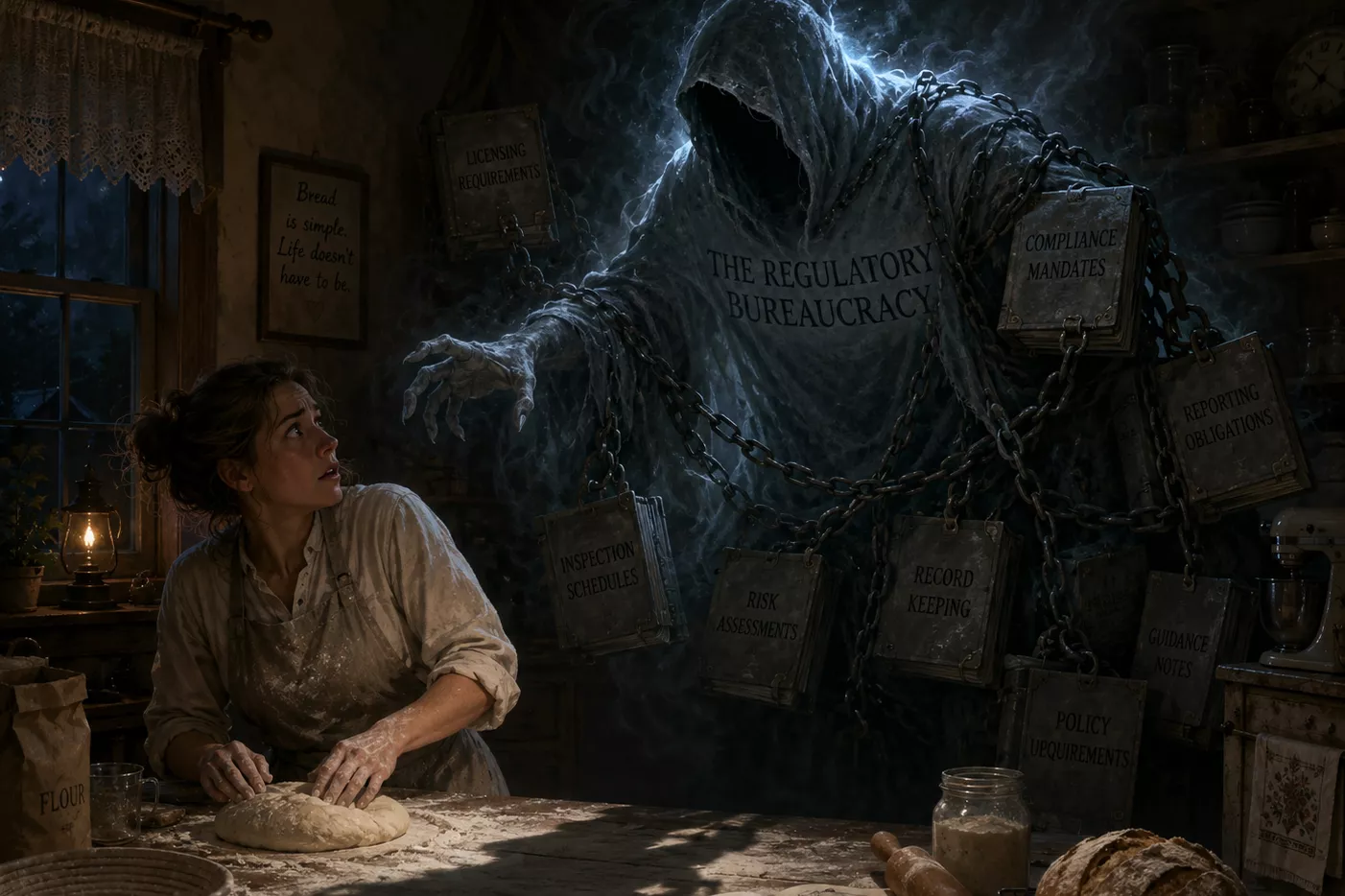
We have all known for a long time that the bureaucratic impulse to seek total control, smash free enterprise, and smother any notion of personal success and satisfaction is pretty much baked into the administrative state’s collective cake.
Turns out, it’s also baked into the cookies.
After battling the cottage food industry for decades and ultimately failing in court a decade ago to stop the direct sale of nonhazardous home-baked goods, Wisconsin’s administrative state has returned to the battlefield with yet another attempt to shut down the entrepreneurial industry.
In so doing, after losing the aforementioned court battle, they have had to concoct a creative recipe. This should have been expected because that’s the thing about bureaucracies, they will do just about anything—anything!—to get their way, often absurdly and just as often leading to burdensome and sometimes tragic consequences.
When a legislature rejects their cravings for power, agencies look for another cafeteria. When a court rules against them, they search for another menu. And when citizens finally win their rights after years of litigation and political battles, agencies often shift the fight from whether those citizens possess the right to how that right is defined.
And that is exactly what is happening once again in Wisconsin’s long-running cottage-food wars.
For years, the Wisconsin Department of Agriculture, Trade and Consumer Protection (DATCP) aggressively defended a regulatory regime that prohibited ordinary Wisconsinites from selling their homemade baked goods unless they complied with commercial licensing requirements and operated from licensed commercial kitchens.
In 2017, home bakers got those restrictions knocked down in court. Lafayette County circuit judge Duane Jorgenson ruled that DATCP could not prohibit the direct sale of homemade, shelf-stable baked goods, and subsequent orders reaffirmed and clarified that decision. The litigation became one of Wisconsin’s most important economic-liberty cases, establishing that citizens could earn an honest living selling nonhazardous baked goods from their own kitchens.
That should have been the end of the story. But now, nearly a decade later, the state has attempted to reshape that triumph into a pyrrhic victory by manufacturing a distinction that the original court rulings never considered important.
And here’s where DATCP got creative: The latest dispute centers on limited liability companies, or LLCs. According to Christopher Ingraham of the Institute for Justice (IJ), which has intervened on behalf of the home bakers, a DATCP regulatory specialist earlier this year informed a Wisconsin resident that the agency’s legal team had concluded that the court rulings (known as the Kivirist exemption after one of the plaintiffs) applied only to individuals and not to LLCs.
“On January 29, 2026, regulatory specialist Daniel Wargolet wrote in an e-mail to a Wisconsinite that DATCP’s ‘legal team... confirm[ed] that the [Kivirist] exemption applies to individuals and not corporations, including an LLC,” Suranjan Sen, an attorney for IJ, wrote in a May 27 letter to Gabe Johnson-Karp, a Wisconsin assistant attorney general. “That means to sell the baked goods out of your home kitchen you could not do it under your LLC but as an individual and take on any risk associated with selling the product individually.”
What’s more, Sen continued, Wargolet sent a follow-up email stating that the apparently new determination was based on the 2017 court decision that allowed the sale of home-baked goods in the first place.
Not even close
However, as Sen explained in his letter, the new interpretation wasn’t even close to the 2017 decision.
“One would expect that, if the court wished to limit its order to natural persons, it would have said so explicitly,” Sen wrote. “Wisconsin law routinely defines ‘person,’ without qualification, to include corporate entities.”
Indeed, state statutes define a ‘person’ as an individual, business corporation, nonprofit or nonstock corporation, partnership, limited partnership, limited liability company, general cooperative association, limited cooperative association, unincorporated association, statutory trust, business trust, common-law business trust, estate, trust, association, joint venture, public corporation, government or governmental subdivision, agency, or instrumentality, or any other legal or commercial entity.
Not only that, Sen wrote, but Jorgenson’s order did not remotely suggest that his ruling was limited to natural persons:
“In fact, its broader application could not be clearer: ‘So long as the food is (1) homemade, (2) shelf stable, and (3) has been baked in an oven, defendants must allow its direct-to-consumer sale,’” he wrote. “That applies to sellers who are natural persons, as well as to sellers who are ‘[b]usiness enterprises seeking to make a profit.’”
Never mind that it wouldn’t make any sense for the court’s order to be limited to natural persons, Sen continued.
“As judge Jorgenson explained in his oral decision granting plaintiffs’ summary judgment, his ruling depended on the safety profile of shelf-stable baked goods, combined with Wisconsin’s exemptions allowing unlicensed sales of similar (or more potentially hazardous) foods by other sellers—including nonprofit corporate entities,” he wrote. “There is no way the safety of any given homemade, shelf-stable baked good depends on whether the seller is selling in her own name or under the aegis of a limited liability company, nor is it rational to deny the latter’s sales while allowing nonprofit corporate entities to conduct unlicensed sales of the same (or potentially hazardous) foods.”
Because there was no basis for DATCP’s position, Sen requested that the agency immediately inform its employees that the 2017 ruling applies to business entities, and he also asked for a clarification on DATCP’s position and “specifically whether Wisconsinites wishing to sell their homemade, shelf-stable baked goods via a business entity can expect to do so without DATCP’s interference.”
As of my writing, IJ had not reported any response to Sen’s letter, perhaps because the state is trying to figure out how to make its absurd position sound logical, a nearly impossible task. Or, as Sen told Ingraham after he sent the letter, “It is absurd to suggest that a loaf of banana bread becomes dangerous the moment its baker files LLC paperwork.”
Never stopped them before
We’ll see how the agency responds; suffice it to say that appeals to rationality have never been particularly persuasive with the administrative state, especially in Wisconsin’s sprawling bureaucracy.
You know, so what that the baker, the kitchen, the ingredients, the oven, the recipe, and the customer are all the same, and no matter that it’s the same loaf of banana bread. Because there’s suddenly paperwork involved—and minimal paperwork at that—a home baker needs to use a commercial kitchen and obtain a license.
It is important to understand how the bureaucracy is shifting the terrain here. The entire mission of all these regulations is supposedly food safety, but suddenly DATCP is making it about legal form. The original lawsuit asked whether shelf-stable baked goods posed sufficient public-health risks to justify government prohibition. The state’s new interpretation asks whether the baker filed organizational documents with the Department of Financial Institutions.
Those are entirely different questions, but they do expose the true bureaucratic priority: not public safety but compliance with the government.
And here’s another crucial point about the DTACP’s new position—it tries to gaslight home bakers by directly contradicting Jorgensen on the question of business entities, brazenly saying Jorgensen’s decision says exactly the opposite of what it actually says. Here is the precise wording of that 2017 decision, after the state had requested limited reconsideration. Jorgenson denied it and said the ruling applied to all home bakers similarly situated, not just those who brought the lawsuit:
“It is clear from this Court’s decision that home bakers who seek to sell their baked goods directly to consumers and whose kitchens are in a sanitary condition are similarly situated to the three Plaintiffs in this action. Which in summary they are similarly situated to Plaintiffs in that they are:
1) Business enterprises seeking to make a profit (emphasis added);
2) food processors as defined by [state law]; they are doing food processing outside of a commercially licensed kitchen or seeking to do so; they are processing foods that are shelf-stable, non-hazardous, or not ‘potentially hazardous’; they seek to sell their foods directly to consumers; those baked goods like plaintiffs, are home baked goods, or baked in the producer’s home; the kitchens used by these home bakers are clean and sanitary, and are therefore subject to reasonable inspection for cleanliness and sanitation.”
So, besides the fact that a ‘person’ under Wisconsin law can be a business entity, specifically including LLCs, the judge underscored that his ruling applies to home-based business enterprises seeking to make a profit.
That was in fact central to the case and it is a marvel of dastardliness that, nearly a decade later, DATCP would attempt to override the plain language of the judge.
I have often wondered how long it takes bureaucrats who have nothing better to do than to make life miserable for average citizens to come up with some of these brainstorms. Now we know. So, for those who wonder what bureaucrats who are protected by antiquated civil service laws do when those who don’t agree with their agendas take power, here’s your answer: They sit in their cubicles and dream up outlandish regulatory schemes to transfer authority to the cubicles and to distribute pain to farms, Main Streets, and home kitchens.
There is a cruel irony in all this, too. The home baker, whom the state once considered to be too much of a business to use a home oven and sell direct without a license, has now suddenly become too much of a business as an LLC to qualify for its own exemption, even though nothing about the bakers’ activities has changed. The bureaucracy couldn’t take away the right, so they redefined it.
The bureaucracy is determined to get you coming or going. The state-run cookie monster is determined to devour your home-based cookie business, one way or another.
Lured into a trap
Here’s another cruel irony. After Jorgenson ruled that home-baked nonhazardous goods could be sold directly from baker to customer and explicitly included those doing so as business enterprises seeking to make a profit, the cottage food industry and many business experts advised home bakers to at least consider registering as LLCs to protect themselves and their businesses from liability.
Here’s what is on the FAQ page of the Wisconsin Cottage Food website:
“Do I need insurance? How do I structure my business? Do I need to be an LLC? When do I pay taxes? Answer: All great and important questions! Thanks to the Judge’s 2017 ruling recognizing your constitutional right to earn an honest livelihood, you have the opportunity to go from a hobbyist that gives away your baked treats to a legal food entrepreneur, running your own business out of your home kitchen.”
With that, the association cautions that there is a responsibility to research and make the right decisions to keep the business thriving as a legal, legitimate food entrepreneur.
In other words, the Wisconsin Cottage Food’s own educational materials encourage entrepreneurs to think like business owners. The association directs bakers to Wisconsin Small Business Development Centers and local chambers of commerce for assistance. The message is clear: Act professionally, operate legally, build a legitimate enterprise, and protect your assets. All that flows from the judge’s 2017 decision.
Only now is the state saying that if you do all those things, it just might punish you.
The transfer of power
What has obviously changed are the goalposts, and that is why this controversy matters far beyond cookies and banana bread. What is unfolding is a pattern that Wisconsin citizens have seen before—an agency loses a policy battle and then attempts to recover some of the lost ground through interpretation. Or it simply changes the rules mid-game to deprive individuals and businesses of their hard-won rights.
For example, that is exactly the tension swirling around the 50-year-old state Spills Law. For decades, businesses operated under the assumption that they were only liable for cleaning up spills of explicitly classified hazardous substances that had undergone a formal rulemaking process, only to have the DNR broadly apply rules without going through any transparent process.
In Wisconsin Manufacturers & Commerce v. DNR, regulated entities argued that the Department of Natural Resources had effectively expanded obligations relating to PFAS contamination through agency interpretation rather than through the traditional rulemaking process many believed Act 21 required. Businesses that thought they understood their obligations suddenly found themselves facing reporting, remediation, and liability requirements based on an evolving interpretation of existing statutory authority.
Supporters of the DNR argued that the agency was merely enforcing existing law.
There are other parallels on the PFAS front, including the treatment of exemptions. In the PFAS context, the DNR at one point proposed treating commercial and industrial/manufacturing facilities differently from those run by municipalities facing similar contamination issues. In other words, the state proposed distinguishing between municipalities and businesses engaged in the same activities, and the same principle is at issue in the cottage-food dispute: whether government may distinguish between bakers operating without an LLC and those operating with one when the underlying activity—selling homemade baked goods—is otherwise identical.
The same complaint lies at the heart of the Sierra Club guidance-document litigation currently before the Wisconsin Supreme Court. There, rather than transform agency groupthink into de facto statutory definitions or imagined case law, the state seeks to transform guidance documents and interpretive methodologies into technical standards presented as fact.
In all these cases, state agencies are imposing their own internal thinking into binding law, despite the lack of legislative authorization and, with the bakers, in direct contradiction of the court. They highlight that the most important policy decisions are not being made through legislation but through interpretation.
But the home-baking case illustrates another equally important point—that administrative interpretation delivered as the law of the land is percolating throughout all levels of society. It doesn’t only impact that nameless, faceless big corporation; it affects moms and pops in their kitchens, trying to bake and sell homemade goods in their towns and neighborhoods. It doesn’t merely attach to economic outcomes at the corporate level but at the entrepreneurial scale.
It doesn’t just hit you in the pocketbook; it smacks you in the gut.
Over the years, Wisconsin citizens have watched the same governing pattern reproduce in vastly different policy areas. It’s happened to residential property owners, manufacturers, farmers, and small-business owners alike. A legislature grants a right or a court recognizes one, but the celebration has barely begun before the state strikes back.
Another example was Wisconsin’s long-running disputes over boathouses.
For years, the DNR banned boathouse owners from using their rooftops as decks. Eventually, lawmakers successfully pursued legislation specifically allowing boathouse roofs to be used as decks under certain conditions. Yet even after the legislature settled the question, the DNR opined that, while one could have a rooftop deck, that didn’t mean they could have outside stairs—accessory structures—to access those decks.
The agency backed down after public outcry, but the modus operandi was the same. It was an absurdism comparable to the home-baking measures and all too familiar to those who have run into the bureaucratic buzzsaw. On the one hand, the legislature says boathouse owners could use their roofs as decks; on the other, the agency says, ‘yes, but only under our interpretation of what that means.’ Or the court decides that home bakers can sell their baked products directly to customers without having to be commercially licensed or using a commercial kitchen, and the state says, ‘yes, but only under our definition of what a home baker is.’
The Legislature or the court grants a right, and then the agency interprets the right so narrowly that much of the practical benefit disappears. When that happens, bureaucratic retrenchment has won the day. The battlefields move from prohibition to definition.
In the end, this may be the administrative state’s oldest trick of all. The administrative state, and the administrative state alone, increasingly defines our freedoms and decides how we exercise those freedoms, usurping the roles of the legislature, the courts, and even elected executives.
Under such a regime, freedom itself has been defined out of existence. At that point, the state doesn’t just have its hand in the cookie jar. The Cookie Monster has devoured every single cookie.

Interested in the content of this Article?
Reach out to the MacIver Institute to aquire more information


