
- Podcasts
 Podcasts
 - Videos
 Videos
 - Policy Issues
 Policy Issues
 - About
 About
About


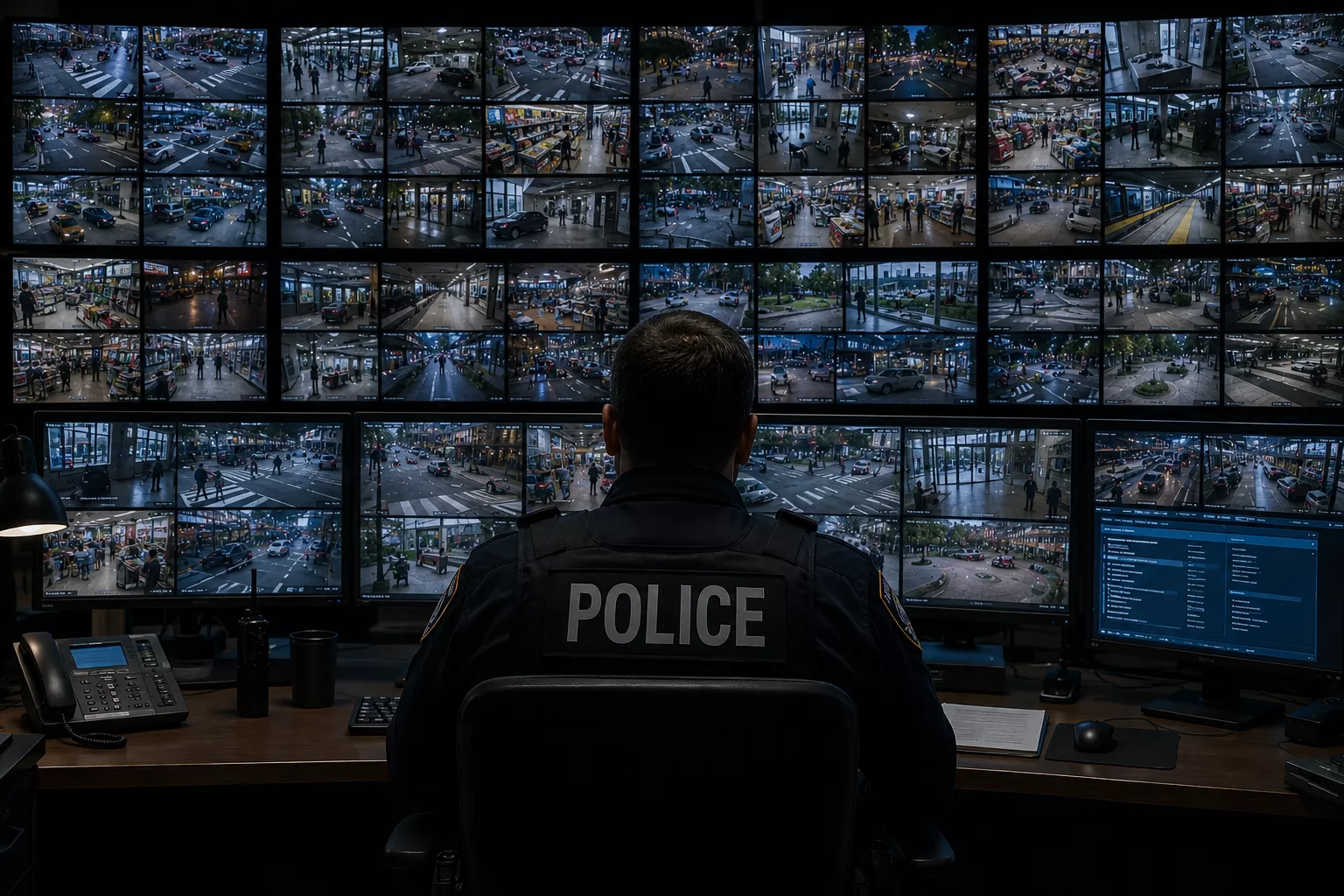
Can you spell surveillance?
If you’re just asked on the street, surveillance can be a hard word to spell. Most people spit out the 12 letters they’ve been taught and go about their business. They might be right or wrong, but nobody really cares.
Unlike the word, surveillance itself is not hard at all. Governments at all levels erect a massive apparatus of cameras to follow everyone coast-to-coast, not merely in real time but prospectively; that is, they can use the cameras to reconstruct your movements and predict where you will go next. Until recently, most people just shrugged and went about their business. Nobody really cared.
Unfortunately, it turns out that, while the intelligence behind these surveillance systems is artificial, the police state controlling them is not. The surveillance state is being built one camera at a time, even as the camera manufacturer used by most governments, Flock Safety, keeps assuring everyone that there are guardrails in place to protect our privacy.
Never mind their need to keep enacting “reforms” to prevent the latest outrageous breaches of privacy and other civil liberties from ever, ever happening again.
It’s probably a good time to observe that, while Flock is the dominant player—its 82 percent market share is the reason its name is used generically—it is not alone. Automated license-plate readers (ALPR) are also supplied by companies such as Motorola Solutions/Vigilant, Genetec, Rekor, Leonardo/ELSAG, Axon and others.
Of course, ALPR defenders acknowledge the creepy stories of abuse. To hear them tell it, though, they are merely outliers. In this viewpoint, everybody hears about all the bad and stupid things some individual police officers do when they abuse the system—there’s always one in every crowd!—but hardly anyone talks about all the good crime fighting it helps law enforcement achieve.
And achieve results for law enforcement the cameras do, but, if stories of abuse are outliers, they are whopper outliers. Just recently, as Reason reported, police jailed a Florida woman for two weeks, seized her car, and charged her with eight felonies after she was wrongly identified through ALPR camera surveillance. In Florida, as the Institute for Justice reports, a Monroe County sheriff’s deputy allegedly used an ALPR system to track and pull over a woman he met while providing security on a TV set.
Here’s maybe the champion of Flock abuse. In Colleton County, South Carolina, a sheriff’s lieutenant was terminated last week after an internal audit showed that he accessed the Flock system for unauthorized searches more than 2,700 times in a single year. He surveilled his family. He surveilled his friends and associates. He surveilled his neighbors.
Heck, in an apt example of the deep state taking itself to its own absurd conclusion, the deputy even surveilled himself!
Wisconsin is not immune. By now everyone has heard about the Milwaukee police officer who used the Flock database 179 times to track his ex-girlfriend and her partner. Hey, it’s not 2,700 times, but that probably won’t make the ex-girlfriend feel any better. In Kenosha County, a now former sheriff’s deputy was criminally charged after allegedly running a coworker’s/then-girlfriend’s license plate 16 or 17 times, and, in Menasha, an officer was sentenced to jail for allegedly using the network to surveil his ex-girlfriend.
Yes, there’s a strong theme of girlfriends and ex-girlfriends here, but stay with me, this is not the point. Anyway, Flock has announced a series of reforms it says will help curb police misuse of the systems. The changes reduce recommended default data retention from 30 days to seven, require case codes for searches, implement proactive lockouts when activity matches criteria for abnormal behavior, and let agencies restrict outside searches.
Institute for Justice senior attorney Robert Frommer calls all that window dressing.
“Flock suggests that police departments limit their retention periods to 7 days, while admitting that decision is still entirely up to the police departments themselves,” Frommer said. “The company also suggests that police departments conduct their own audits, but as we’ve seen in our lawsuit against the city of Norfolk, Virginia, there can be no effective review of audit records when the people tasked with auditing are understaffed. The police cannot police themselves.”
IJ attorney Michael Soyfer also pointed out that one word you don’t see in Flock’s proposed reforms is ‘warrant’: “Until police are required to get a warrant based on probable cause to search ALPR databases, these half measures will do nothing to protect innocent people from warrantless mass surveillance.”
All true enough, but even that misses the point. And that point is not about warrants and guardrails any more than it is about girlfriends. The Flock systems need to be dismantled the same way they were built—one camera at a time—and as quickly as possible. Here’s the point, finally:
If all the Flock guardrails were literally accompanied by a stairway to Heaven that defeated all misuse, the cameras would remain an existential danger to our liberty and would end up defeating it if allowed to stay intact.
Ain’t no telling where that barrel’s been
With all due respect to a perfectly good proverb, this controversy isn’t about a few bad apples, or even a whole barrel of them. In this case it is the other way around, that is to say, it is the barrel spoiling the apples. It is the barrel—the surveillance system—that is the poison. After all, are we really going to blame wayward cops for engaging a system whose very design enables the kind of mass surveillance the Fourth Amendment was intended to prevent?
Think about it. Communities across America are constructing an interconnected infrastructure capable of tracking automobiles over enormous distances and reconstructing movement patterns over long periods of time. I can’t think of a collectivist dystopia more worthy of Ayn Rand, in which responsibility for the surveillance apparatus is conveniently shifted onto the individual users who abuse it. But beware. Today’s misuse of the system by a few bad apples is an apt predictor of what the government will do pervasively tomorrow under the banner of public safety.
It’s the capability—the apparatus—that counts.
A police department with twelve cameras is one thing. A nationwide, interoperable network capable of recording the location of automobiles as they pass thousands upon thousands of fixed points is something qualitatively different. According to recent reporting, Flock now has more than 120,000 cameras in more than 6,000 communities, generating about 20 billion plate scans a month.
Twenty billion scans a month! And the schmuck who ran 2,700 scans gets busted. Not that cops who do this shouldn’t be busted, but it’s like comparing murder to speeding.
A Wisconsin Examiner review last year found that at least 221 Wisconsin law enforcement agencies used Flock from January 1 to May 31 of 2025. It is a massive apparatus, both nationwide and in Wisconsin, so imagine what the government could potentially do with it. Look at the damage the Biden administration caused with its sprawling, quasi-formal public-private censorship system during Covid, then multiply it exponentially in a formalized system of surveillance. You’ll be seeing Boris Karloff, and it won’t be in a movie.
Again, we’re not just looking at a camera taking a car’s photo to see if it ran the red light. We’re creating the technical capability for retrospective movement surveillance, coast-to-coast, which is law-enforcement parlance for the ability to reconstruct, track, and analyze the historical routes of individuals or vehicles backward through time. Retrospective movement surveillance can reveal a movement pattern and feed it to a voraciously hungry network.
What’s more, Flock is relentlessly bucking up the network’s technological prowess. Consider the company’s superhero OS Investigate system, whose X-Ray vision makes capturing a particular plate at a particular camera location seem charmingly Fred Flintstone-ish. According to a WIRED investigation published on August 19, the system can combine the camera network with police files, public business data, court records and more to map movements and identify associations—and terrifyingly—find their “associates.” Here’s how Wired put it:
“Drawing on a network of cameras that logs the movements of drivers in more than 6,000 communities, the tool can pick out potential witnesses by how often their cars pass through a neighborhood, or surface a driver’s ‘associates’ from the cameras they pass together. Because the system also reaches police case files, 911 dispatch logs, and commercial identity records, those plates can be turned into names, home addresses, and relatives. It can search for people in an area drawn on a map based on nothing more than a physical description.”
Even license plates are no longer needed—just a good photo of a passing car. Once upon a time a famous book offered struggling writers a dream too good to be true: “No plot? No problem!” Now Flock makes an equivalent offer to law enforcement: No license plate? No name? No crime? No problem! They supply a place, a stretch of time, and a pattern of behavior, and the system is designed to hand back the people who fit, WIRED stated.
One example cited by WIRED took a single plate and asked the system to plot the journeys of that car and its “top three associates”:
“It counts how often other plates appear at the same cameras within a two-minute window of the target by default, and reports back any car that shows up next to it three or more times within a ‘confidence threshold’ defaulting to 0.75. An officer supplies one vehicle and the software finds up to 20.”
And here’s another big problem. The civil-liberties question isn’t just what today’s camera records, or how it is mapped, or how associations are profiled, or how long the data is retained. Once a foundation of surveillance is laid, new analytical capabilities can be layered almost effortlessly on top of the existing infrastructure.
There’s no question such capabilities assist law enforcement. ALPRs help recover stolen vehicles and identify vehicles linked to serious crimes. They are valuable resources in kidnapping and child abduction cases. But there’s also no question they would assist bad actors who might control the system. Remember, China has low crime, too.
The bottom line is, police work should never be reduced to reliance on technology. Indeed, reliance is born the day that the tools the authorities use step beyond the severe limits placed on all police conduct. Warrants, probable cause, separation of powers, and the Fourth Amendment exist for a reason, namely, free societies place structural limits on governmental power, or they are no longer free. Any tool that possesses the organic potential to destroy constitutional guarantees is not a tool; it’s a monster.
One of those structural limits must be the lack of formalized governmental apparatuses custom-made for unconstitutional conduct, whether or not the technology exists. Just as the Trump administration dismantled Biden’s censorship regime known as the Counter Foreign Information Manipulation and Interference (R/FIMI) unit, which itself had previously been renamed from the Global Engagement Center (GEC), so too must formalized surveillance systems be demolished.
The harms
Often, we hear otherwise reasonable people say, “I don’t care if the government surveils me, I’m not doing anything wrong.” Maybe not, but over time a psychological toll is taken, as we have witnessed in totalitarian country after totalitarian country.
In 2013, Dr. Neil Richards, writing in Harvard Law Review on “The Danger of Surveillance,” outlined some of the harms of global surveillance, not least the kidnapping of precious liberties before people can even realize it.
“The important point is that our society lacks an understanding of why (and when) government surveillance is harmful,” Richards wrote. “Existing attempts to identify the dangers of surveillance are often unconvincing, and they generally fail to speak in terms that are likely to influence the law.”
Protection of these individual rights and social practices allows individuals to develop both intellectual diversity and eccentric individuality, Richards wrote:
“They reflect the conviction that big ideas like truth, value, and culture should be generated from the bottom up rather than from the top down. It rests on the idea that free minds are the foundation of a free society, and that surveillance of the activities of belief formation and idea generation can affect those activities profoundly and for the worse.”
When we are watched while engaging in intellectual activities, broadly defined—thinking, reading, web-surfing, or private communication—we are deterred from engaging in thoughts or deeds that others might find deviant, Richards wrote.
There is the brutal police state, in other words, but there is also the debilitating self-censorship that comes with mass surveillance.
“My argument is not that intellectual surveillance should never be possible, but that when the state seeks to learn what people are reading, thinking, and saying privately, such scrutiny is a serious threat to civil liberties,” he wrote.
The same goes for the government knowing where you are going and figuring out where you have been and with whom. People might opine that no one should be afraid if they are not doing anything wrong, but it’s what the people in power consider “wrong” that makes all the difference.
The trigger could be something as simple as going to church or attending a meeting of gun rights advocates. And if people do not think that’s possible, remember that the Biden administration wanted to punish dissenting parents speaking at school board meetings. More, administration allies had called them domestic terrorists. Such people and administrations could have a field day with mass surveillance, along the way no doubt uncovering a “vast right-wing conspiracy” of dissenters, their associates, and addresses.
The court on observation and aggregation
The U.S. Supreme Court hasn’t ruled that Flock or ALPR networks violate the Fourth Amendment or any other constitutional requirements. But two earlier Supreme Court cases provide a useful backstory for understanding why networked surveillance can be constitutionally different from isolated observation, and how a future court might rule.
In United States v. Jones, police attached a GPS device to Antoine Jones’s vehicle and tracked his movements for 28 days. The majority ruling focused mostly on the physical trespass needed to attach the tracker. That is sort of irrelevant for ALPRs, but much more interesting opining came in several concurring opinions, especially that of justice Samuel Alito.
In his opinion, Alito fingered not the trespass issue so much as the notion of long-term tracking itself. Justices Ruth Bader Ginsburg, Stephen Breyer, and Elena Kagan joined the opinion.
“The Court’s reasoning largely disregards what is really important (the use of a GPS for the purpose of long-term tracking) and instead attaches great significance to something that most would view as relatively minor (attaching to the bottom of a car a small, light object that does not interfere in any way with the car’s operation),” Alito wrote....
“Attaching such an object is generally regarded as so trivial that it does not provide a basis for recovery under modern tort law. But under the Court’s reasoning, this conduct may violate the Fourth Amendment. By contrast, if long-term monitoring can be accomplished without committing a technical trespass—suppose, for example, that the Federal Government required or persuaded auto manufacturers to include a GPS tracking device in every car—the Court’s theory would provide no protection.”
The court’s approach leads to incongruous results, Alito wrote:
“If the police attach a GPS device to a car and use the device to follow the car for even a brief time, under the Court’s theory, the Fourth Amendment applies.
But if the police follow the same car for a much longer period using unmarked cars and aerial assistance, this tracking is not subject to any Fourth Amendment constraints. Under this approach, short-term monitoring of a person’s movements on public streets accords with expectations of privacy that our society has recognized as reasonable.”
But the use of longer-term GPS monitoring in investigations of most offenses impinges on expectations of privacy, Alito asserted:
“For such offenses, society’s expectation has been that law enforcement agents and others would not—and indeed, in the main, simply could not—secretly monitor and catalogue every single movement of an individual’s car for a very long period.
In this case, for four weeks, law enforcement agents tracked every movement that respondent made in the vehicle he was driving. We need not identify with precision the point at which the tracking of this vehicle became a search, for the line was surely crossed before the 4-week mark. Other cases may present more difficult questions.”
The retroactive reconstruction of vehicular movements would seem to cause the same breach—the secret monitoring and cataloguing of every single movement of an individual’s car for a very long period. In Jones, Alito would have held that prolonged GPS monitoring violated Jones’s reasonable expectation of privacy, and Justice Sonia Sotomayor separately agreed that longer-term GPS monitoring ordinarily impinged on expectations of privacy.
Sotomayor even saw where technology was heading. She specifically worried about surveillance technologies that could generate comprehensive records of people’s movements without the physical intrusion on which judge Antonin Scalia’s majority opinion depended.
A later case is even more relevant. In Carpenter v. United States, police obtained 12,898 historical cell-site location points covering 127 days of Timothy Carpenter’s movements—about 101 location points per day—all without a probable-cause warrant. The Supreme Court held that obtaining that historical location information was in fact a Fourth Amendment search.
As Jones before it, Carpenter did not touch upon the ALPR question. Chief Justice John Roberts went out of his way to describe the ruling as narrow, but its reasoning nonetheless points directly toward the question Alito was asking even then: when does the aggregation of individually lawful observations become impermissible surveillance?
“A person does not surrender all Fourth Amendment protection by venturing into the public sphere,” Roberts wrote for the Carpenter court. “To the contrary, ‘what [one] seeks to preserve as private, even in an area accessible to the public, may be constitutionally protected.’”
The decision cited a classic offering on privacy:
“As Justice Brandeis explained in his famous dissent, the Court is obligated—as ‘[s]ubtler and more far-reaching means of invading privacy have become available to the Government’—to ensure that the ‘progress of science’ does not erode Fourth Amendment protections. Here the progress of science has afforded law enforcement a powerful new tool to carry out its important responsibilities. At the same time, this tool risks government encroachment of the sort the Framers, ‘after consulting the lessons of history,’ drafted the Fourth Amendment to prevent.”
This is precisely the issue. With Flock surveillance, scientific progress has once again afforded law enforcement a powerful new tool. The technology may exist for widespread use beyond more limited possibilities. But the Fourth Amendment, if it is not to be eroded, demands that we prevent its construction, or demand its deconstruction, as the case may be.
It demands that we once again consult the lessons of history.
Community resistance
As more people become aware of the implications, resistance to ALPRs increasingly extends beyond complaints about particular abuses. More than 80 cities have terminated or declined to renew Flock contracts, and, in Connecticut, communities have even imposed moratoriums while lawmakers and local officials debate the implications of nationwide data sharing.
Even vandalism of the cameras—while illegal and hardly evidence by itself of widespread public opposition—suggests that perceptions about ALPR technology are swiftly changing. People who would scarcely notice an ordinary traffic camera appear to understand that these cameras are different because they talk with each other, and, when they do, they are talking about you.
There’s something else local citizens are coming to understand—taxpayers are helping finance their own surveillance. The problem with any deep-state project is that oftentimes it appears to have sprung from the grassroots, from within local communities, when it has not. Many communities have come on board not because they thought it was so compelling that they needed to fund it themselves but because they were offered state and federal incentives by deep-state bureaucracies and their tentacled nonprofits. That’s how we got military-grade equipment—tanks and other weaponry—flowing to local law enforcement over the past 20 years. And that’s how ALPRs have arrived on the scene.
To cite just one example, though a massive one, federal Covid-19 relief funds have helped finance Flock deployments. Menomonie used $57,900 in ARPA funds for six cameras and related costs, and the police department pitched it by saying it could not purchase the cameras without ARPA funding. Wisconsin’s Law Enforcement Agency grant program—which itself was financed with federal ARPA money—helped pay for Flock deployments in communities such as Glendale, Whitewater, Oshkosh, and Brown County.
That same program distributed $19 million to local and tribal law-enforcement agencies, all from the state’s federal American Rescue Plan Act allocation. Madison’s resolution describing its own LEA award spells it out: the money came from “the state’s American Rescue Plan Act funds.”
The script is a familiar one in county after county. In Oshkosh, in 2023, an ARPA-funded LEA grant paid for the initial purchases. Just two years later, the grant money was exhausted, and then the city operating budget paid $81,750 annually under a subsequent agreement. In 2026, police sought a $163,500 two-year renewal, again from the operating budget. The council ultimately approved a renewal, only to rescind it less than 24 hours later after the police chief said Flock had misrepresented the system’s ability to create heat maps of vehicle movements.
Flock has also been lobbying in Wisconsin for legislation to create a state grant program specifically for purchasing the systems. That could turn Wisconsin from relying on miscellaneous grants to finance the systems into having a dedicated, taxpayer-funded ALPR grant program.
Private money has flooded the system, too. Axon provided the Dane County’s sheriff department with a $68,750 grant used for ALPR equipment (though the county board has voted to pull public funds for the systems). Walmart contributed toward Greendale’s system. Woodmans paid for three Sun Prairie cameras. Other departments have raised private money locally.
The funding pyramid helps explain how surveillance infrastructure proliferates. Federal grants, state-administered grants, private donations—all can reduce or eliminate the initial political and financial cost of, and resistance to, entering the network.
Of course, governments and communities do not just sit down one day and say to each other, ‘Hey, why don’t we build a massive surveillance infrastructure to spy on everybody. What could go wrong?’ Nope, they build it camera by camera, grant by grant, department by department, and eventually discover that all those individual decisions have created something far larger than they could ever have imagined.
If none of this convinces you, here’s a quick exercise. Imagine that every Flock employee and every police officer behaves like angels from now on and never break the rules. The infrastructure is still there, but it is gathering cobwebs in the corner. Then imagine different officials running the show—the worst, most horrifying politicians you can think of (we all know who they are). Think back to Biden and his censorship regime. Now imagine what those cameras could mean for you and your family when the tyrants dust the cobwebs off and update the technology.
Guardrails are policy, and policy tends to become like a set of good intentions once bureaucracy gets involved. Infrastructure, though, is capability. It judges not good intentions.
Let’s don’t, either. A free society should be extraordinarily reluctant to construct the infrastructure of a surveillance state merely because its present operators promise not to use it the wrong way.
And that leads us back to the real way surveillance is spelled: t-o-t-a-l-i-t-a-r-i-a-n
Same number of letters, a distinction without a difference.

Interested in the content of this Article?
Reach out to the MacIver Institute to aquire more information


