
- Podcasts
 Podcasts
 - Videos
 Videos
 - Policy Issues
 Policy Issues
 - About
 About
About


The BECI 765 kV Transmission Line
Last Friday gubernatorial candidate Tom Tiffany and three state legislators spoke at an event in the Wisconsin Dells hosted by No 765 Line, a nonprofit group whose mission is to equip "Wisconsin communities to take part in the energy decisions being made about their land, their rates, and their future."
The topic of discussion was MISO's BECI transmission line––a 190-mile long 765 kV power line that was one of two competitively-bid Wisconsin projects awarded earlier this year by MISO. The speakers were unanimous in their opposition to the project, stating that it was unnecessary and would have a negative impact on Wisconsin and citizens' way of life.
The BECI line has been controversial for several reasons, but mainly because:
Because the developer of BECI (Transource/MSG) is a new entrant to Wisconsin it does not have any existing "utility corridors" or "rights-of-way" through which it could build this line. That means that the planned route will require taking property from those whose land falls within a certain distance from the line (90 ft on both sides, p. 10 ¶4).
Wisconsin Property Map has found that roughly 5,000 parcels fall within 400 feet of the route's study segments––the array of potential routes. Depending on the final route, this means that hundreds––but likely not much more than 2,000––parcels of property will be forced to relinquish de facto ownership of their land. This Wisconsin Property Map shows all the parcels which may be affected by the line.
Whatever the route, the total acreage required for the BECI line's rights-of-way is 21.8 acres per mile, or 4,145 acres for a 190-mile route.
During Friday's event and elsewhere, some have said that a ROFR law for Wisconsin's incumbent transmission utilities would have prevented a situation such as this. This is false.
As was explained ad nauseam over the past two years, all a ROFR law would accomplish is the end of the competitive bidding process for projects like BECI and WISE, and the automatic selection of whoever the relevant incumbent transmission utility is––in this case, ATC. It's true that if a ROFR law were passed today, MISO would be within its rights to cancel the BECI and WISE projects (as was done in Texas) because the selected developers have not broken ground or received approval from the PSC.
However, this would do nothing to prevent MISO from simply proposing these projects again, and the high-cost nature of anti-competitive monopoly would make BECI, WISE, and every future project that much more burdensome to Wisconsin ratepayers.
In response, ROFR proponents have said that the rights-of-way (ROW) impact would be lower because incumbent transmission utilities have lots of established utility corridors to utilize. In other words, they would simply build the 765 kV line along their existing routes. But at best, this can't be known by anyone, and at worst, it's completely false.
As I reported in January, we know from the context of the BECI Selection Report that ATC is 'Developer C.' Again, Transource proposed a 180 feet ROW, but ATC proposed a 200 foot ROW (p. 10 ¶4). Furthermore, ATC was actually tied for having the most impacts on Protected Areas––seven in total (p. 21 ¶4)––and there is not even any mention in the Selection Report of ATC offering to co-locate the BECI line with its existing lines.
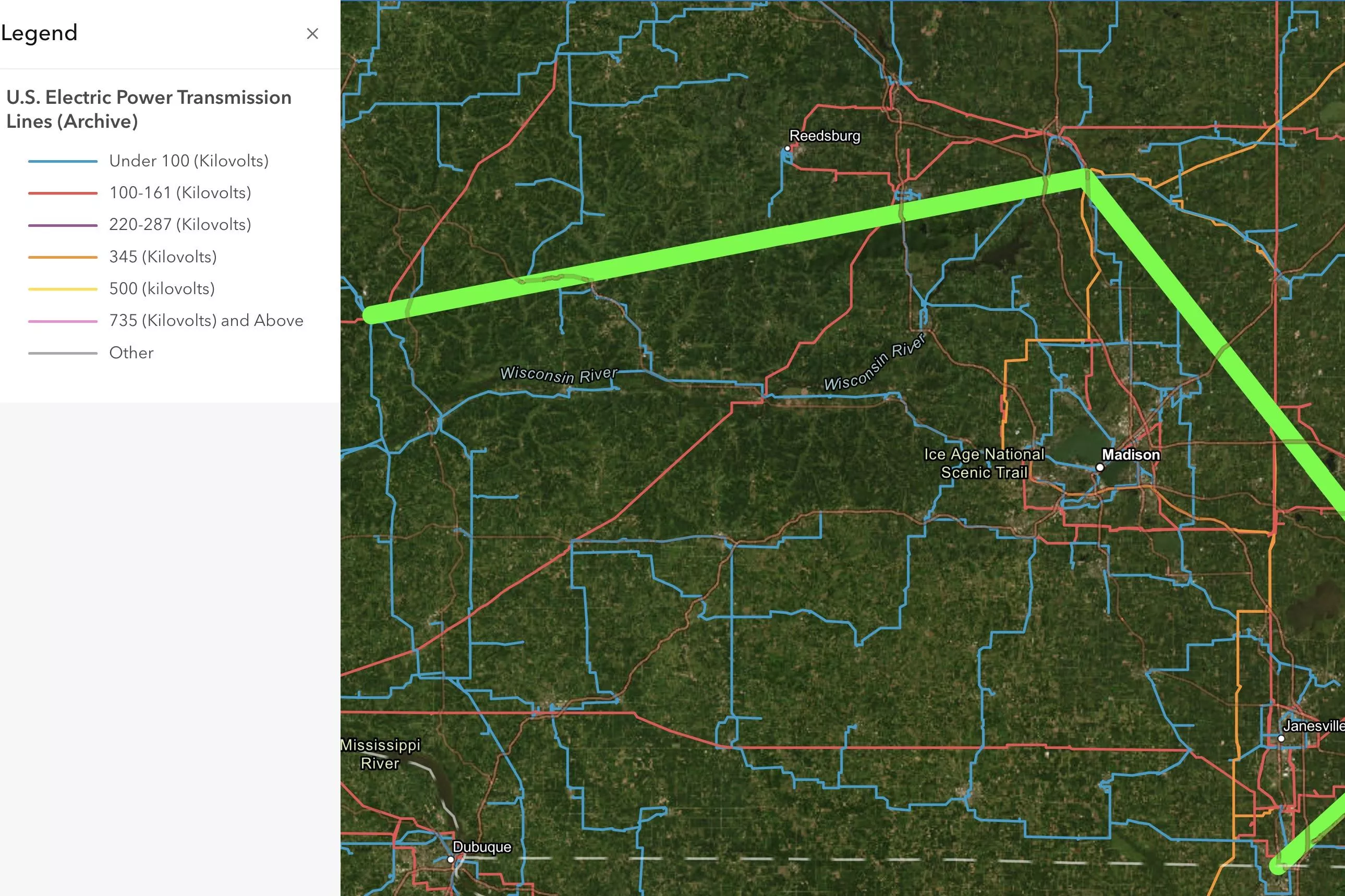
The map below makes this incredibly apparent when you compare existing transmission lines in WI (as of 2024) with the general route of the BECI line as proposed by MISO.
You can visit two different interactive transmission maps HERE and HERE.
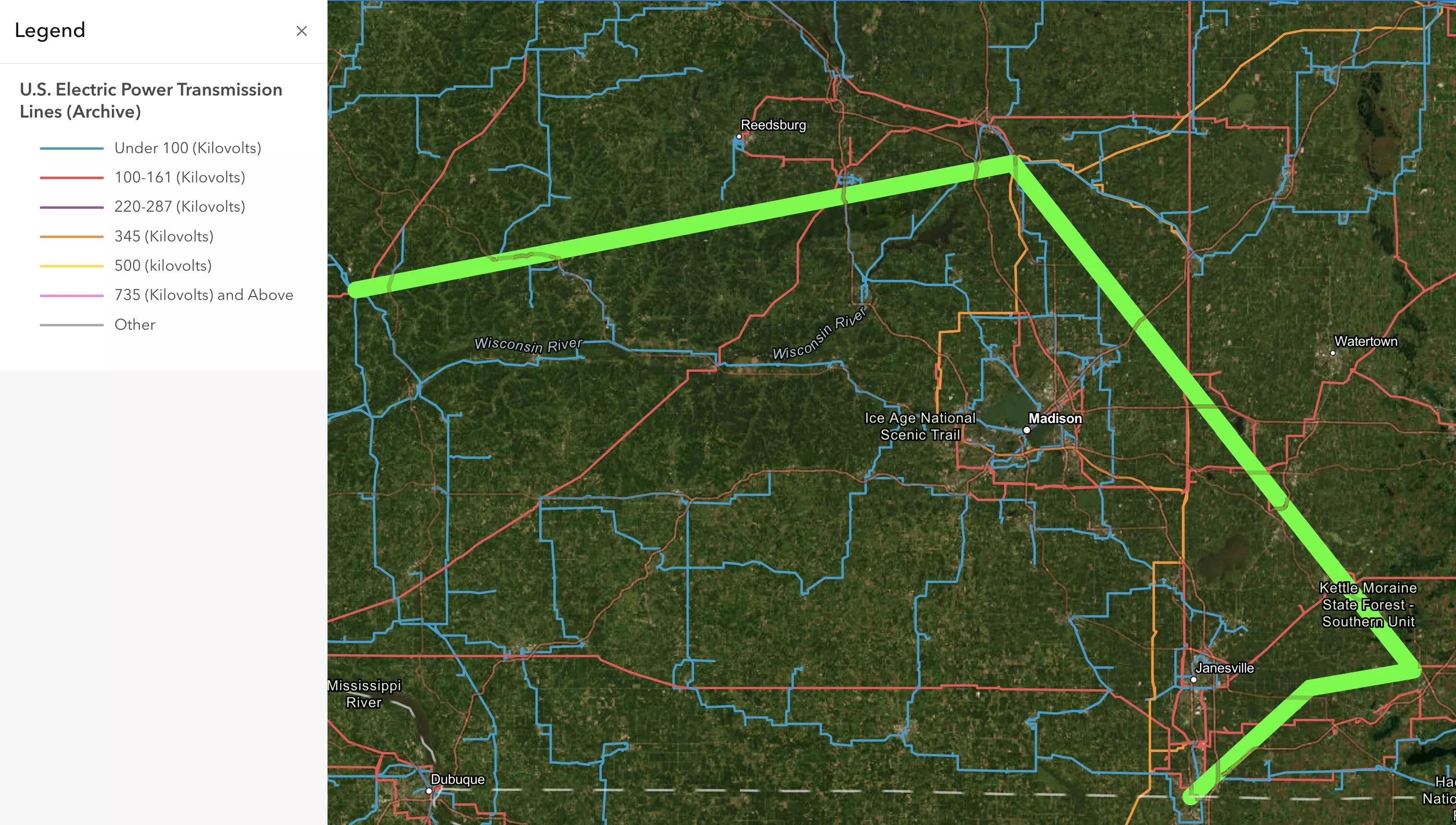 BECI Line = Neon Green
As the map shows, co-locating the BECI line with existing utility corridors would have been impossible for huge portions of the line because corridors simply do not exist there. A much more indirect route would have had to be taken which means there could have been an even greater impact on private property and the environment.
But, because we do not have access to ATC's proposal, we cannot know the extent to which their line would have been co-located with existing lines apart from the suggestion that it was so insubstantial MISO did not feel the need to mention it in its Report. This also suggests that co-locating the BECI power line would have been cost-prohibitive anyway. If it were economical to repurpose existing lines to accommodate a 765 kV line, ATC would have included this in its proposal to remain competitive. Assuming they did do this, they lost to Transource anyway.
What we do know, however, is that in the absence of competition incumbents like ATC have even less incentive to choose cost-efficient, low-impact routes. Assuming for a moment that co-location is cheaper in this case, a ROFR law would simply afford incumbents the latitude to never propose a co-located line.
Why?
Because utilities are guaranteed a percentage rate of return on their total build cost such that they would much rather earn 5% on $1 billion than 5% on $999 million. Repurposing an existing line for co-location would also mean disrupting service to ratepayers, thus decreasing the utility's revenues. So if we had a ROFR law, why would a utility ever opt to receive less revenue from ratepayers on less and cheaper infrastructure when they could simply leave their existing lines alone, build a new power line, and charge customers for both?
WI Laws Governing Transmission Line Development
The No 765 Line group correctly pointed out a number of laws pertaining to the development of transmission lines in Wisconsin, but there are a few others governing this sort of development as well.
First, as the group pointed out, WI §1.12(6) outlines the state's energy policy regarding how utility corridors are to be chosen:
(6) Siting of electric transmission facilities. In the siting of new electric transmission facilities, including high-voltage transmission lines, as defined in s. 196.491 (1) (f), it is the policy of this state that, to the greatest extent feasible that is consistent with economic and engineering considerations, reliability of the electric system, and protection of the environment, the following corridors should be utilized in the following order of priority:
(a) Existing utility corridors.
(b) Highway and railroad corridors.
(c) Recreational trails, to the extent that the facilities may be constructed below ground and that the facilities do not significantly impact environmentally sensitive areas.
(d) New corridors.
Next is WI §196.491 "Strategic energy assessment; electric generating facilities and transmission lines; natural gas lines" sections (1) and (3) which specifically list the criteria that must be met for the PSC to approve high-voltage transmission lines like BECI:
(1) Definitions. In this section:
-(e) “Facility” means a large electric generating facility or a high-voltage transmission line.
-(f) Except as provided in subs. (2) (b) 8. and (3) (d) 3m., “high-voltage transmission line” means a conductor of electric energy exceeding one mile in length designed for operation at a nominal voltage of 100 kilovolts or more…
(3) Certificate of public convenience and necessity.
-(a)1: Except as provided in sub. (3b), no person may commence the construction of a facility unless the person has applied for and received a certificate of public convenience and necessity under this subsection.
-(d): Except as provided under par. (e), the commission shall approve an application filed under par. (a) 1. for a certificate of public convenience and necessity only if the commission determines all of the following:
---3. The design and location or route is in the public interest considering alternative sources of supply, alternative locations or routes, individual hardships, engineering, economic, safety, reliability and environmental factors…
---3r. For a high-voltage transmission line that is proposed to increase the transmission import capability into this state, existing rights-of-way are used to the extent practicable and the routing and design of the high-voltage transmission line minimizes environmental impacts in a manner that is consistent with achieving reasonable electric rates.
---3t. For a high-voltage transmission line that is designed for operation at a nominal voltage of 345 kilovolts or more, the high-voltage transmission line provides usage, service or increased regional reliability benefits to the wholesale and retail customers or members in this state and the benefits of the high-voltage transmission line are reasonable in relation to the cost of the high-voltage transmission line.
The most important part of this statute for the BECI project is (3)(d)3t.
As WI statute 196.491(3)(d)3t specifies, the PSC may only approve a high-voltage transmission line (like BECI) if it:
“provides usage, service or increased regional reliability benefits to the wholesale and retail customers or members in this state and the benefits of the high-voltage transmission line are reasonable in relation to the cost…”
The key word here is "and."
Given that MISO’s Independent Market Monitor––Potomac Economics/Dr. David Patton––has found that MISO’s benefit-cost ratio for their Tranche 2.1 transmission portfolio is negative, there is a chance these high-voltage power lines are rejected. In other words, the IMM found that the benefit-cost ratio is only $0.40 - $0.70 of benefit for every $1.00 in cost, meaning the entire tranche of projects is uneconomical. BECI, WISE and every other MISO project slated for Wisconsin may fail to meet this statutory requirement, and could be rejected as a result.
The BECI and WISE projects planned by MISO still require the approval of Wisconsin’s utility regulator in order to go forward. For those affected by the proposed transmission routes this is a silver lining, but it’s complicated by the fact that the WI PSC approves virtually all transmission project applications.
Because the BECI line is the first of its kind in this state, and because the owner of the line is a new entrant to the Wisconsin utility market, there are no existing rights-of-way which Transource can utilize. This means roughly 5,000 parcels are in the sights of the BECI line which could be subject to easement.
When land usage and cost factors are considered, I speculate that rather than the BECI line having a 99% chance of approval by the WI PSC, its chance of being approved is somewhere between 80 and 90%. The deciding factor in the PSC's decision of whether to approve the BECI line will rest on the quality of the cost-benefit analyses provided by the applicant and intervenors. The applicant will have to work to discredit the IMM's benefit-cost analysis, but also explain why MISO saw fit to select the IMM in the first place; how ERCOT, New York and New England all managed to make the same mistake in retaining Potomac but employ them nevertheless; why FERC rejected MISO's petition to limit the IMM's planning oversight if their analysis is unreliable; and why five utility commissions in the MISO region have requested that FERC undo MISO's multi-value project portfolio.

Interested in the content of this Article?
Reach out to the MacIver Institute to aquire more information


