
- Podcasts
 Podcasts
 - Videos
 Videos
 - Policy Issues
 Policy Issues
 - About
 About
About


Restoring Trust in Our Elections
In an era where trust in democratic institutions is paramount, election integrity stands as the bedrock of a fair and representative government. With the 2026 midterm elections on the horizon, concerns over bloated voter rolls, including the potential for illegal immigrants to cast ballots, have intensified. According to a recent Gallup Poll, 83% of those Americans surveyed endorse early voting voter identification.
 Source: https://news.gallup.com/poll/652523/americans-endorse-early-voting-voter-verification.aspx
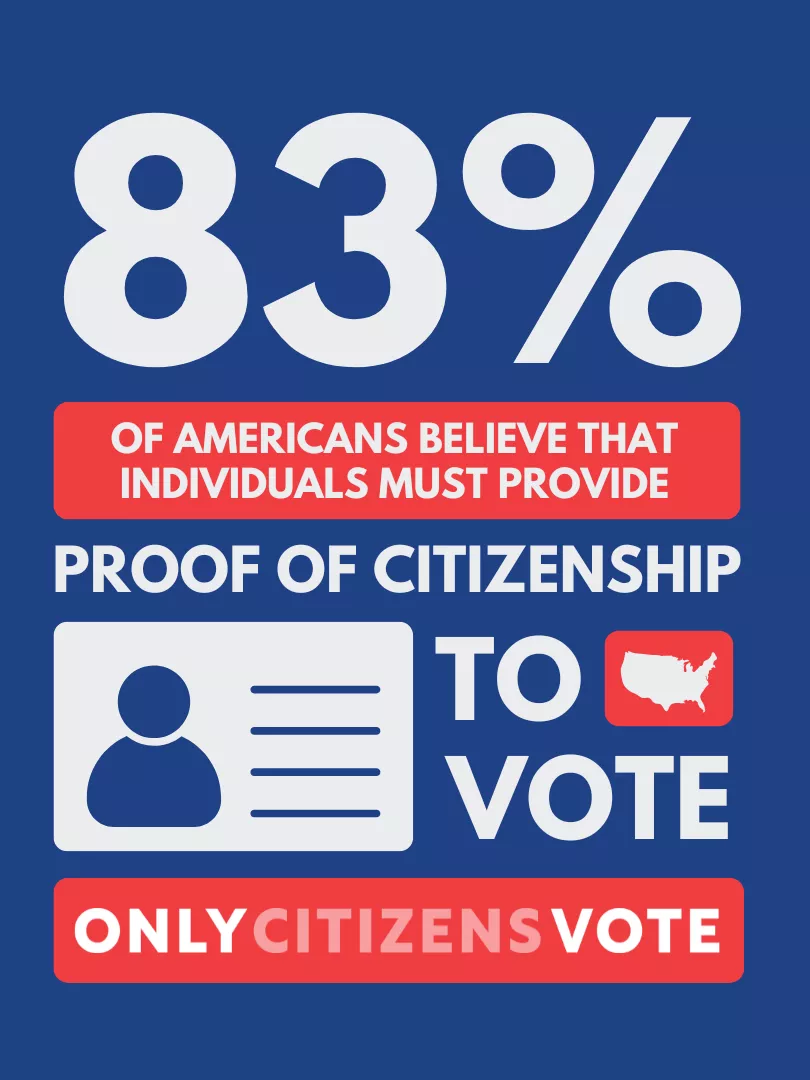
Failure to address these vulnerabilities not only risks diluting the votes of lawful citizens but also undermines public confidence in the electoral process. Recent court decisions, executive actions, and enforcement operations underscore the critical importance of purging ineligible voters—particularly non-citizens—from registration lists to ensure only American voices shape America's future. Yet, in states like Wisconsin, persistent resistance to basic safeguards—such as requiring proof of citizenship at registration or utilizing federal tools like the Department of Homeland Security's Systematic Alien Verification for Entitlements (SAVE) system—exposes a troubling prioritization of voter access convenience over the republic's foundational integrity. As Founding Father Alexander Hamilton warned in Federalist No. 68, the electoral process must guard against "foreign power and interference," a principle that demands rigorous verification, even if it means forgoing the ease of unchecked registration.
The Risks of Unclean Voter Rolls
Voter rolls that are not regularly and properly maintained in accordance with state and federal laws can become a breeding ground for fraud and error. According to experts, outdated or inaccurate registrations allow for the possibility of deceased individuals, duplicates, or non-citizens remaining on the lists, potentially enabling illegal voting. This issue is exacerbated in states with lax verification processes, where motor voter laws or automatic registration can inadvertently add ineligible individuals. For instance, the recent arrest by U.S. Immigration and Customs Enforcement (ICE) of an illegal alien from India, Anmol Anmol, who was driving an 18-wheeler with a New York commercial driver's license issued under the name "No Name Given," highlights systemic failures in identity verification. This case, part of a DHS operation in Oklahoma, reveals how states like New York are issuing official documents without confirming citizenship or even full legal names, raising alarms about how such IDs could be used to register to vote. If illegal aliens can obtain driver's licenses so easily, what's stopping them from exploiting similar loopholes in voter registration systems? The risks are not hypothetical: they include compromised election outcomes, eroded trust, and even public safety threats, as seen in related incidents where illegal alien truck drivers caused fatal accidents.
Real-world examples underscore the peril. In Kansas, the Attorney General recently filed charges against a newly elected mayor for voting as a non-U.S. citizen, demonstrating how even local elections can be tainted without proper checks. Cleaning voter rolls is not just about preventing fraud—it's about preserving the sanctity of citizenship. Non-citizen voting dilutes the electoral power of legal voters and distorts representation, potentially swaying close races in battleground states. The integrity of our republic hinges on this: one citizen, one vote. Prioritizing ease of access—such as forgoing citizenship proof—may streamline registration, but it erodes the very trust that sustains democracy, inviting chaos over order.
Wisconsin's Resistance: A Case Study in Compromised Integrity
Nowhere is this tension more evident than in Wisconsin, a perennial swing state where election safeguards remain woefully inadequate. Wisconsin does not require proof of citizenship at the time of voter registration, relying instead solely on a sworn affirmation under penalty of perjury—a system critics decry as honor-based and ripe for exploitation. While the state mandates proof of residence (such as a utility bill or driver's license) to confirm address eligibility, it explicitly omits any documentation verifying U.S. citizenship, leaving a glaring vulnerability in the process.
Compounding this, Wisconsin officials have refused to leverage readily available federal resources, such as DHS's SAVE system, which provides a straightforward, no-cost method to cross-check voter registrations against immigration databases and flag potential non-citizens. SAVE has proven instrumental in other states for eliminating fraud risks, with recent enhancements allowing seamless integration for voter roll maintenance. Yet, Wisconsin's Elections Commission (WEC) has resisted such tools, citing administrative burdens and potential disenfranchisement of eligible voters. This stance persists even amid mounting evidence of the need: the state's 3.6 million registered voters include thousands of outdated or questionable entries, and without proactive cleanup, the potential for non-citizen ballots looms large.
The recent Cerny v. Wisconsin Elections Commission (Case No. 24-CV-1353) saga illustrates the uphill battle. On October 3, 2025, Waukesha County Circuit Court Judge Michael P. Maxwell ordered the WEC to verify the citizenship of all registered voters ahead of the February 2026 election, mandating a review of the rolls over the next five months in compliance with the Help America Vote Act (HAVA). Brought by voter Ardis Cerny, the suit exposed how Wisconsin's lax policies violated both state and federal mandates. However, by October 31, the ruling was placed on hold pending appeal, with Wisconsin Attorney General Josh Kaul filed a motion to stay the decision—arguing it would overwhelm resources and suppress turnout despite the fact that WEC provided affidavit testimony that they could comply with everything the Judge ordered.
This resistance isn't mere oversight; it's a choice that elevates ease over essence. Wisconsin's same-day registration, a hallmark of accessibility, becomes a double-edged sword without citizenship barriers, potentially inviting ineligible participation in a state where margins are razor-thin—recall the 2020 presidential race decided by just 20,682 votes. Democracy’s health demands we affirm: convenience cannot trump citizenship. As Senator Rick Scott (R-FL) champions in the SAVE Act, federal incentives should compel states like Wisconsin to adopt these tools, ensuring elections reflect the will of citizens, not opportunists.
Key Victories in the Fight for Integrity: Federal Leadership and Beyond
A significant step forward came from federal action. On March 25, 2025, President Donald Trump issued Executive Order 14248, "Preserving and Protecting the Integrity of American Elections," requiring documentary proof of citizenship for federal voter registration forms and tying funding to robust state verifications. This directive amends the national mail-in form via the U.S. Election Assistance Commission (EAC), shielding against fraud and interference. While critics decry it as overreach, it aligns with DHS efforts, like the ICE operation nabbing Anmol, to bar non-citizens from public trust roles.
These measures build on judicial wins like Cerny, setting precedents for nationwide reform. Yet, implementation lags in resistant states, where appeals—like Wisconsin's—stall progress.
The Political Angle: Why Some Democrats Oppose Strict Verification
While election integrity should transcend partisanship, political motivations often come into play. Republicans frequently argue that Democrats resist stringent voter roll cleanups and citizenship checks because they benefit from increased immigration—legal and illegal—for electoral advantages. One key contention is apportionment: The inclusion of non-citizens in census counts can shift congressional seats and Electoral College votes toward Democrat-leaning states with large immigrant populations. A congressional report estimates that immigration-driven population changes in the 2020 Census shifted 17 House seats, favoring areas with high migrant inflows. Senator Bill Hagerty (R-TN) has claimed Democrats "want these illegal migrants" to influence apportionment.
Furthermore, some argue that lax borders and opposition to measures like the SAVE Act—which requires proof of citizenship for voting—are designed to cultivate future voters. Illegal immigrants, once granted amnesty or pathways to citizenship, tend to support Democratic policies, as seen in historical patterns post-1986 amnesty. In June 2025, House Democrats overwhelmingly voted against a bill
to prevent non-citizens from voting in D.C. elections, fueling accusations of prioritizing political power over integrity. High-profile figures like Elon Musk have echoed claims that Democrats import migrants to sway elections, though fact-checks note that non-citizen voting is rare and illegal. Still, bills like the SAVE Act aim to block what Scott calls Democrats' strategy to "help Democrats win" by allowing illegal voting. Critics from the left, such as those at the Brennan Center, dismiss these as myths perpetuated to suppress turnout, but the persistence of such arguments highlights deep divisions—divisions that Wisconsin's appeals only deepen.
Conclusion: Prioritizing the Republic's Core
Cleaning voter rolls and removing illegal immigrants is essential to protect democracy. Cases like Cerny v. WEC, Trump's EO, and DHS enforcements demonstrate proactive steps, but ongoing vigilance is required to counter any incentives for undermining these efforts. Wisconsin's refusal to mandate citizenship proof or embrace SAVE exemplifies the stakes: our Republic cannot endure if access eclipses authenticity. As citizens, we must demand transparency to ensure every vote counts—and only lawful ones do. The ease of a flawed system pales against the enduring strength of one built on unassailable integrity. Let us choose the latter, for in safeguarding our elections, we safeguard our sovereignty.

Interested in the content of this Article?
Reach out to the MacIver Institute to aquire more information


