- Podcasts
 Podcasts
 - Videos
 Videos
 - Policy Issues
 Policy Issues
 - About
 About
About


The Wisconsin Supreme Court ruled last Thursday that several laws passed during the 2018 special session are constitutional, giving the Republican Legislature another legal victory over Governor Tony Evers and the general powers of the executive branch. The Court ruled that all but one of the laws in question did not violate the separation of powers and that “the Plaintiffs have not met their high burden to demonstrate that the challenged provisions are unconstitutional in all of their applications.”
The laws in question were passed to give the Legislature more oversight of the executive branch and require the Administration to consult with the Legislature before executing decisions like settling a lawsuit brought by the Attorney General or publishing so-called guidance documents.
In response to the Supreme Court’s decision, Speaker Robin Vos (R-Rochester) commented “Our state’s founders established co-equal branches of government in Wisconsin. This ruling reaffirms that each branch is equal to the other.”
Governor Evers and State Attorney General Josh Kaul, both Democrats, argued that these laws limited their executive powers and violated the separation of powers between the legislative and executive branches.
This case was originally filed with the Dane County Circuit Court in 2019 by a coalition of unions headed by the Service Employees International Union (SEIU). They argued that all of the “lame-duck” laws in question violated the separation of powers because “these new laws either overly burden the executive branch or took executive power and gave it to the legislature.” The Circuit Court sided with the union coalition and temporarily stopped the Legislature from enforcing these laws. The State Supreme Court took over the case in June 2019.
Today’s decision from the Supreme Court was handed out in three separate majority opinions.
Justice Brian Hagedorn wrote the unanimous decision that gave the Legislature greater authority over the administrative rules process, prohibits the Court System from deferring to administrative agencies’ conclusion of law rather than state law itself, and establishes that the Legislature has a say in security policies at the Capitol. Hagedorn also wrote the 5-2 opinion (Dallet and Ann Walsh Bradley dissenting) that requires legislative oversight of legal settlements proposed by the Attorney General and makes it easier for the Legislature to intervene in state government lawsuits. Justice Daniel Kelly wrote the 4-3 opinion (Chief Justice Roggensack, Hagedorn and Ziegler dissenting) rejecting the Legislature’s oversight of state agency guidance documents.
For Republicans, the decision determining that the Legislature does have the constitutional authority to exert oversight of legal settlements proposed by the Attorney General was critical. The law seeks to prevent AG Kaul from engaging in “sue and settle,” a tactic where the attorney general sues a business or industry, then uses legal and political pressure to force a settlement that requires the defendant to give money to a preferred, sometimes extreme, political cause.
Attorney General Josh Kaul disagrees and believes that eventually the Supreme Court will side with him. “Today’s decision leaves for another day a ruling on whether most applications of two provisions undermining the authority of the Office of Attorney General are constitutional, but the ultimate result is inevitable: those provisions will be found to be unconstitutional in nearly all of their applications.”
Sen. Scott Fitzgerald (R-Juneau), however, called the ruling, in general, a “victory for the Legislature and all Wisconsinites who want to hold government accountable. A rogue attorney general can no longer unilaterally settle away laws already on the books and unelected bureaucrats can’t expand their powers beyond what the people have given them through their representatives.”
According to the Court’s 144 page decision, the plaintiffs, in general, set a high bar for success by making a “facial challenge” to the laws, meaning that the “challenged provisions are unconstitutional in all of their applications.” In all but one instance, the Supreme Court found, however, that there were “at least some constitutional applications of these laws” and “asking us to declare the laws unenforceable under any circumstances necessarily fails.”
Another part of the ruling will allow the Joint Committee for Review of Administrative Rules (JCRAR) greater authority over issuing multiple suspensions of administrative rules. The Supreme Court rationalized that because the court had previously decided that “if one three-month suspension passes constitutional muster, two three-month suspensions surely does as well.”
Today’s Supreme Court ruling reaffirmed an earlier opinion that prohibits the court system in Wisconsin from considering an agency’s interpretation of a law. In the previous Tetra Tech case, the Supreme Court “ended our practice of deferring to administrative agencies’ conclusions of law.” In the past, some courts in Wisconsin actually gave more deference to a state agency’s interpretation of a law than to the actual law itself. Today’s decision seems to be a clear defeat for bureaucrats and their ability to interpret a law to fit their needs.
The final part of the victory for the Republican Legislature is the requirement that the executive branch must notify the Joint Committee of Legislative Organization (JCLO) if the Administration plans to make changes to security procedures at the State Capitol.
In Justice Kelly’s 4-3 opinion, the court ruled that a law related to “guidance documents” did in fact violate the separation of powers. Guidance documents are materials produced by an agency that detail or explain to the public how the agency will implement a law or apply a statute. The Legislature had sought to require that all guidance documents be reviewed by the Legislature and the public be given an opportunity to comment before being published. Kelly’s opinion said it was “readily apparent” that the “creation and dissemination of guidance documents fall within the executive’s core authority. Guidance documents, as the legislature has defined them, necessarily exist outside of the legislature’s authority.”
Critics of guidance documents say agencies use them to bypass legislative oversight and that, too often, they have the force of law.
It is worth noting that Kelly’s opinion took an additional and seemingly unneeded step to make it clear that “a guidance document does not have the force of law and does not provide the authority for implementing or enforcing a standard, requirement, or threshold, including as a term or condition of any license.” Conservatives pointed to Kelly’s deliberate acknowledgment that guidance documents in Wisconsin have no legal authority as a moral victory.
Read the ruling here.
Another long-awaited court decision dropped Friday concerning the veto powers of the Wisconsin Governor. Three of Governor Tony Evers’ veto items from the 2019-21 budget were ruled unconstitutional and invalid today and one veto item on truck registration fees was ruled constitutional. There was no majority opinion in the case, but instead a collection of partial-concurrence, partial-dissent opinions from justices.
Of the three Evers vetoes that were ruled unconstitutional, one was related to how money can be allocated from the state’s portion of the 2016 VW Settlement. The Legislature’s bill would have given $3,000,000 to fund energy-efficient school bus modernization around WI. Evers’ vetoes instead removed that $3,000,000 from the budget and replaced it with a grant program for alternative fuels. The Supreme Court ruled 5-2 that this was unconstitutional, with Justices Ann Walsh Bradley and Rebecca Dallet dissenting.
The second veto set of vetoes ruled unconstitutional tried to repurpose funds from the DOT’s local road improvement program (LRIP) into generalized local grants. In the original bill, $90,000,000 was meant to go to the LRIP, but Evers’ veto instead diverted $75,000,000 of the appropriation to local grants that do not need to fund road projects. As MacIver previously reported, opening up the Transportation Fund grant program to non-road projects resulted in funding requests to convert a railroad station to a museum, new bike paths and the building of a scenic overlook. The Court ruled 5-2 that this was unconstitutional and invalid. Justices Ann Walsh Bradley and Rebecca Dallet dissented.
The third veto related to a tax on vapor products. The Legislature’s original bill set a tax for vaping products, but only applied that tax to the device that heated liquid into vapor, but not the liquid itself. In Evers’s veto, he made it so that the vape liquid could also be taxed. The Court ruled 4-3 that this was an unconstitutional veto. Chief Justice Patience Roggensack and Justices Rebecca Dallet and Ann Walsh Bradley dissented.
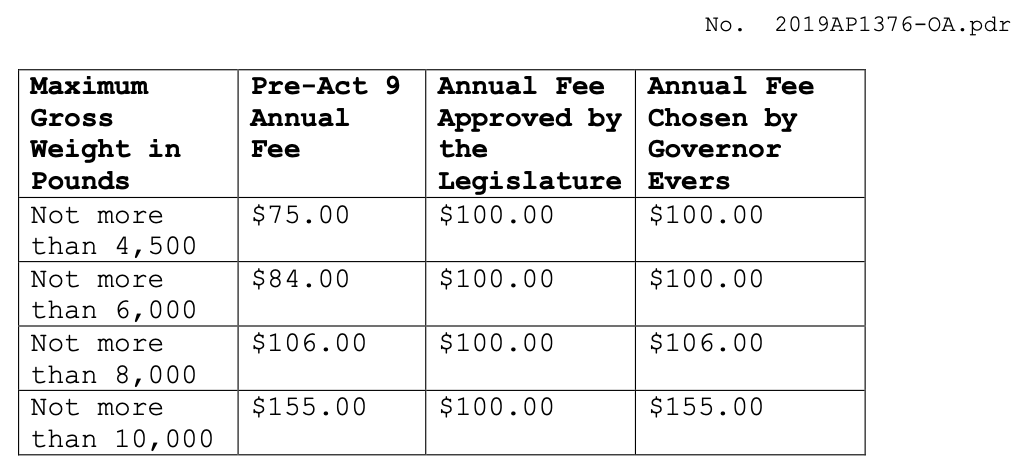
The final veto that the Court considered was related to registration fees for trucks. The Legislature’s bill originally made all fees for all weight classes of trucks the same. This meant two weight classes of trucks would see a reduction of the fee. Evers vetoed part of the bill so that the two highest weight classes would not see a reduction in their respective fees. The Court ruled 5-2 that this was a constitutional change, so it remains in effect. Justices Daniel Kelly and Rebecca Bradley dissented.

Interested in the content of this Article?
Reach out to the MacIver Institute to aquire more information